热带病与寄生虫学 ›› 2026, Vol. 24 ›› Issue (4): 209-213.doi: 10.20199/j.issn.1672-2302.2026.04.004

• 布鲁氏菌病防控专题 • 上一篇    下一篇

2011—2025年重庆市人间布鲁氏菌病发病及诊断延迟情况分析

彭娟1,2(), 荆德智2, 李梦芬2, 李霞2, 张迎春2, 黄文利1()   

  1. 1 重庆市疾病预防控制中心, 重庆 400042
    2 重庆市合川区疾病预防控制中心
  • 收稿日期:2026-06-30 出版日期:2026-08-20 发布日期:2026-09-29
  • 通信作者: 黄文利,E-mail: 153821737@qq.com
  • 作者简介:彭娟,女,本科,主治医师,研究方向:地方病防治。E-mail: 776515922@qq.com

The incidence and diagnostic delay of human brucellosis in Chongqing from 2011 to 2025

PENG Juan1,2(), JING Dezhi2, LI Mengfen2, LI Xia2, ZHANG Yingchun2, HUANG Wenli1()   

  1. 1 Chongqing Center for Disease Control and Prevention, Chongqing 400042, China
    2 Hechuan District Center for Disease Control and Prevention of Chongqing
  • Received:2026-06-30 Online:2026-08-20 Published:2026-09-29
  • Contact: HUANG Wenli, E-mail: 153821737@qq.com

摘要:

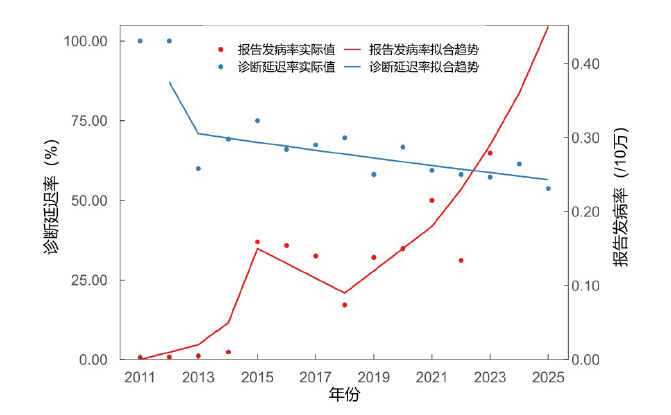
目的 分析重庆市人间布鲁氏菌病(简称布病)发病及诊断延迟情况,为优化防控策略提供科学依据。方法 通过中国疾病预防控制信息系统获取2011—2025年重庆市人间布病病例资料,运用Joinpoint模型回归分析布病报告发病率和诊断延迟率趋势,采用ArcGIS热点分析工具进行空间热点分析。结果 2011—2025年重庆市累计报告人间布病病例766例,年均发病率0.17/10万,诊断延迟率为61.23%(469/766),诊断延迟中位数为21(8, 61) d。Joinpoint回归分析显示,2011—2025年重庆市报告发病率呈波动上升趋势(AAPC=43.81%,t=4.35,P<0.001);诊断延迟率呈波动下降趋势(AAPC=-4.47%,t=-3.70,P<0.001)。空间分析显示,渝东北三峡库区(222例,占28.98%)和渝西地区(218例,占28.46%)报告病例居多,渝东北三峡库区(64.41%,143/222)和渝东南武陵山区(63.36%,83/131)诊断延迟率较高;报告发病率热点从彭水苗族土家族自治县、武隆区转移至2025年的巫山县、潼南区,诊断延迟率无显著热点聚集。报告病例以男性(546例,占71.28%)、45~59岁(383例,占50.00%)、农牧民(459例,占59.92%)、乡镇居住者(547例,占71.41%)为主;男性(62.45%)、≤14岁组(85.71%)、乡镇居住者(61.61%)、农牧民(60.57%)诊断延迟率较高。三级医院报告病例数较多(560例,占73.11%)。结论 近年来重庆市布病报告发病率呈波动上升态势,诊断延迟率呈改善趋势,但基层医疗机构确诊能力不足。应加强基层医务人员培训,提升布病的早期识别与鉴别诊断能力。

关键词: 人间布鲁氏菌病, 发病趋势, 诊断延迟, 空间热点, 重庆市

Abstract:

ObjectiveTo analyze the incidence and diagnostic delay of human brucellosis in Chongqing area to provide a scientific basis for optimizing prevention and control strategies. Methods The case data on human brucellosis in Chongqing City from 2011 to 2025 were obtained from the Chinese Disease Prevention and Control Information System. Joinpoint regression analysis was conducted to analyze the trend of reported incidence and diagnostic delay rate of brucellosis. ArcGIS hotspot analysis tool was used for spatial hotspot analysis. Results From 2011 to 2025, a total of 766 cases of brucellosis were reported in Chongqing City, with an average annual incidence rate of 0.17 per 100 000 population. The diagnostic delay rate was 61.23% (469/766), and the median diagnostic delay was 21 (8, 61) days. Joinpoint regression analysis showed that the reported incidence rate of brucellosis in Chongqing exhibited a fluctuating upward trend from 2011 to 2025 (AAPC=43.81%, t=4.35, P<0.001). The diagnostic delay rate presented a fluctuating downward trend (AAPC=-4.47%, t=-3.70, P<0.001). Spatial analysis revealed that the cases were mostly reported in the Three Gorges Reservoir area of northeastern Chongqing (222 cases, 28.98%) and the western Chongqing (218 cases, 28.46%). The diagnostic delay rate was relatively higher in the Three Gorges Reservoir area of northeastern Chongqing (64.41%, 143/222) and the Wuling mountainous area of southeastern Chongqing (63.36%, 83/131). The hotspots of reported incidence shifted from Pengshui Miao and Tujia Autonomous County and Wulong District to Wushan County and Tongnan District by 2025, while no significant spatial clustering of diagnostic delay rate was observed. The cases were chiefly reported in males (546 cases, 71.28%), population aged 45-59 years (383 cases, 50.00%), farmers and herdsmen (459 cases, 59.92%), and residents living in townships (547 cases, 71.41%). The diagnostic delay rate was the highest in males (62.45%), the age group ≤14 years (85.71%), township residents (61.61%), and farmers and herdsmen (60.57%). A relatively large number of cases were reported from tertiary hospitals (560 cases, 73.11%). Conclusion In the past years, the reported incidence rate of brucellosis in Chongqing City has shown a fluctuating upward trend, and the diagnostic delay rate has been improved, yet primary healthcare institutions lack the capacity to confirm the diagnosis. These findings suggest that training for the primary healthcare providers should be strengthened to improve their ability to identify and differentiate brucellosis at an early stage.

Key words: Human brucellosis, Incidence trend, Diagnostic delay, Spatial hotspot, Chongqing City

中图分类号: