热带病与寄生虫学 ›› 2026, Vol. 24 ›› Issue (4): 214-219.doi: 10.20199/j.issn.1672-2302.2026.04.005

• 布鲁氏菌病防控专题 • 上一篇    下一篇

2011—2025年新疆生产建设兵团人间布鲁氏菌病流行特征分析

赵倩1(), 刘慧慧2, 冯云珠1, 于亚乐1, 王童敏1(), 张慧1()   

  1. 1 新疆生产建设兵团疾病预防控制中心, 新疆乌鲁木齐 830032
    2 中国疾病预防控制中心
  • 收稿日期:2026-06-30 出版日期:2026-08-20 发布日期:2026-09-29
  • 通信作者: 王童敏,E-mail: wtm1123@163.com;张慧,E-mail: 290162837@qq.com
  • 作者简介:赵倩,女,本科,副主任医师,研究方向:传染病防控。E-mail: 493396733@qq.com
  • 基金资助:
    新疆生产建设兵团科技计划项目(2024AB073);国家疾控局公共卫生人才培养支持项目

Epidemiological characteristics of human brucellosis in the Xinjiang Production and Construction Corps, 2011-2025

ZHAO Qian1(), LIU Huihui2, FENG Yunzhu1, YU Yale1, WANG Tongmin1(), ZHANG Hui1()   

  1. 1 Xinjiang Production and Construction Corps Center for Disease Control and Prevention, Urumqi 830032, Xinjiang Uygur Autonomous Region, China
    2 Chinese Center for Disease Control and Prevention
  • Received:2026-06-30 Online:2026-08-20 Published:2026-09-29
  • Contact: WANG Tongmin, E-mail: wtm1123@163.com; ZHANG Hui, E-mail: 290162837@qq.com

摘要:

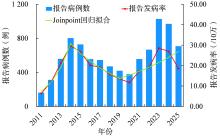
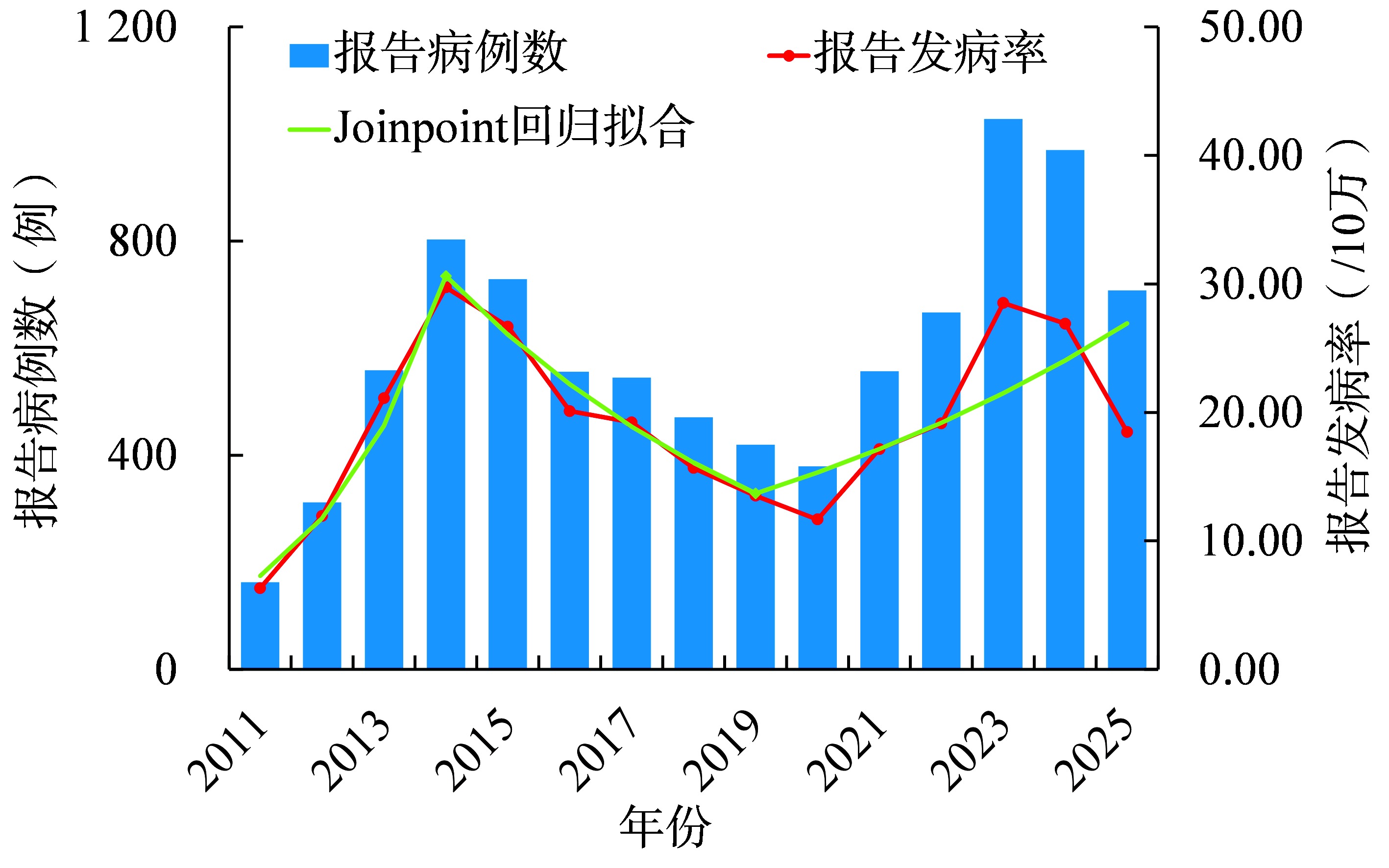
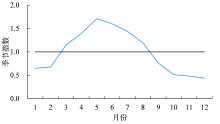
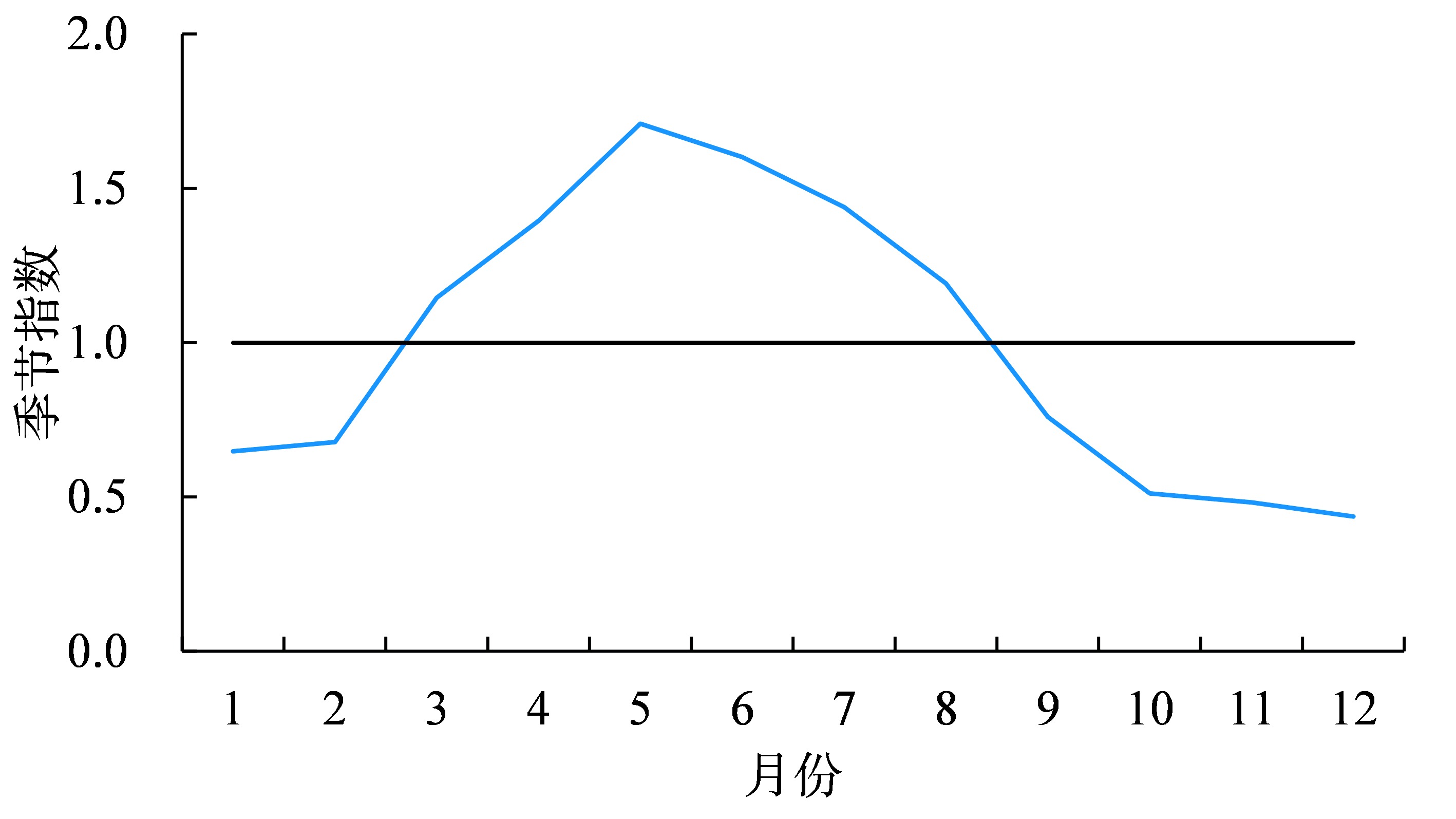
目的 分析新疆生产建设兵团(简称兵团)人间布鲁氏菌病(简称布病)流行特征及变化趋势,为布病防控提供参考。方法 通过中国疾病预防控制信息系统获取2011—2025年兵团人间布病报告病例数据,采用描述流行病学方法分析三间分布特征。采用Joinpoint回归分析布病报告发病率的时间变化趋势,综合应用季节指数法与圆形分布法分析其季节性特征。结果 2011—2025年兵团共报告布病8 867例,年均报告发病率19.27/10万。Joinpoint回归分析结果显示,2011—2025年兵团布病报告发病率总体呈上升趋势(AAPC=9.78%,95%CI:6.02%~16.00%,P<0.001),其中2011—2014年快速上升(APC=61.33%,95%CI:27.71%~151.71%,P<0.001),2014—2019年下降(APC=-14.86%,95%CI:-30.01%~-6.00%,P<0.001),2019—2025年上升(APC=11.92%,95%CI:4.88%~31.65%,P<0.001)。空间分布上,报告病例主要集中在第八师(1 418例)、第三师(1 357例)、第六师(1 353例)、第四师(1 050例),占58.40%(5 178/8 867)。时间分布上,布病发病存在明显的季节性分布,3—8月的季节指数均>1,为发病高峰期(6 226例,占70.22%);圆形分布法分析结果表明,总体发病高峰日为6月5日,总体发病高峰期为3月7日—9月3日。人群分布上,男女性别比为2.57∶1,男性年均报告发病率(26.51/10万)高于女性(11.33/10万);50~54岁年龄组报告发病率最高(54.67/10万)。职业以农牧民为主(5 695例,占64.23%),其次为工人(1 080例,占12.18%)。结论 2011—2025年兵团布病疫情总体呈上升趋势,高发人群为中老年、男性、农牧民,发病高峰主要集中于春夏季。建议依据各地疫情差异实施分区精准防控,并在高发季强化高危人群的健康宣教与防护干预。

关键词: 人间布鲁氏菌病, 流行特征, 变化趋势, 新疆生产建设兵团

Abstract:

ObjectiveTo analyze the epidemiological characteristics of human brucellosis in the Xinjiang Production and Construction Corps (XPCC) for evidence for local prevention and control of this infection. Methods The data of reported cases of human brucellosis in the XPCC from 2011 to 2025 were obtained through the Chinese Disease Prevention and Control Information System, and analyzed using descriptive epidemiology for the characteristics of temporal, regional and population distribution. Joinpoint regression analysis was performed to analyze the temporal trend in incidence, and both seasonal index and circular distribution methods were applied to analyze the seasonal prevalence characteristics. Results A total of 8 867 brucellosis cases were reported in the XPCC from 2011 to 2025, with an average annual reported incidence of 19.27 per 100 000 population. Joinpoint regression analysis showed that the overall reported incidence of human brucellosis in the XPCC presented an upward trend from 2011 to 2025 (AAPC=9.78%, 95%CI: 6.02% to 16.00%, P<0.001), during which a rapid increase from 2011 to 2014 (APC=61.33%, 95%CI: 27.71% to 151.71%, P<0.001), a decline from 2014 to 2019 (APC=-14.86%, 95%CI: -30.01% to -6.00%, P<0.001), and a rise from 2019 to 2025 (APC=11.92%, 95%CI: 4.88% to 31.65%, P<0.001). Spatially, the cases were mostly concentrated in the 8th Division (1 418 cases), 3rd Division (1 357 cases), 6th Division (1 353 cases), and 4th Division (1 050 cases), accounting for 58.40% of all cases (5 178/8 867). Brucellosis in the XPCC area exhibited typical seasonal distribution, with a seasonal index>1 from March to August, representing the peak period of incidence (6 226 cases, 70.22%). The results of the circular distribution analysis indicated that the overall peak date of onset was June 5, and the overall peak period of onset spanned from March 7 to September 3. In terms of population distribution, the male-to-female ratio was 2.57∶1, with males having a higher average annual incidence rate (26.51 per 100 000) than females (11.33 per 100 000). The highest incidence rate was observed among individuals aged 50-54 years (54.67 per 100 000). Farmers and herdsmen accounted for the majority of cases (5 695 cases, 64.23%), followed by workers (1 080 cases, 12.18%). Conclusion From 2011 to 2025, the epidemic of brucellosis in the XPCC generally showed an upward trend, the high-risk population primarily comprises middle-aged and elderly male farmers and herdsmen, and the peak incidence mainly occurs in spring and summer. It is recommended to implement region-specific, targeted prevention and control measures based on the epidemic differences among cities and divisions, and to strengthen health education and protective interventions for high-risk populations during peak seasons.

Key words: Human brucellosis, Epidemiological characteristics, Changing trend, Xinjiang Production and Construction Corps

中图分类号: