
Journal of Tropical Diseases and Parasitology ›› 2026, Vol. 24 ›› Issue (4): 246-253.doi: 10.20199/j.issn.1672-2302.2026.04.011
• CASE REPORT • Previous Articles Next Articles
ZHAI Chenda1,2( ), BU Ruiping2,3, LIU Zeqi1,2, YANG Jing2()
Received:2026-05-06
Online:2026-08-20
Published:2026-09-29
Contact:
YANG Jing, E-mail: m13739764558_2@163.com
CLC Number:
ZHAI Chenda, BU Ruiping, LIU Zeqi, YANG Jing. Hemophagocytic syndrome secondary to visceral leishmaniasis: a case report and literature review[J]. Journal of Tropical Diseases and Parasitology, 2026, 24(4): 246-253.
Add to citation manager EndNote|Ris|BibTeX
URL: http://www.rdbzz.com/EN/10.20199/j.issn.1672-2302.2026.04.011
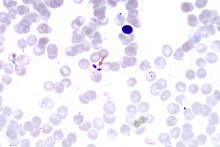
Figure 1
Amastigotes of Leishmania donovani detected in bone marrow smear of the patient (Wright-Giemsa staining, ×1 000)

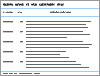
Table1
Clinical characteristics of 42 patients with hemophagocytic syndrome secondary to visceral leishmaniasis
| 序号 | 发表年份 | 年龄 | 性别 | 确诊地区 | 接触史 | 职业 | 基础疾病或特殊情况 | 临床表现 | 病变部位 | 诊断方法 | 治疗方案 | 转归 | ||||||||||||||||||||||||||
|---|---|---|---|---|---|---|---|---|---|---|---|---|---|---|---|---|---|---|---|---|---|---|---|---|---|---|---|---|---|---|---|---|---|---|---|---|---|---|
| 1 | 1996[ | 2岁 | 男 | 突尼斯 | 不详 | 不详 | 巨细胞病毒、单纯疱疹病毒血清学阳性 | 发热,脾大,血细胞减少, 镜下血尿,蛋白尿 | 骨髓,脾脏, 肝脏,肾脏 | 骨髓穿刺 | 锑剂 | 治愈 | ||||||||||||||||||||||||||
| 2 | 2001[ | 19岁 | 男 | 中国杭州 | 不详 | 士兵 | 无 | 发热,脾大,肝大, 血细胞减少,腹水,腹泻 | 骨髓,脾脏, 肝脏,浆膜腔 | 骨髓穿刺 | 不详 | 不详 | ||||||||||||||||||||||||||
| 3 | 2001[ | 4岁 | 男 | 土耳其 | 不详 | 不详 | 无 | 发热,脾大,肝大, 血细胞减少,淋巴结肿大 | 骨髓,脾脏, 肝脏,淋巴结 | 骨髓穿刺,rK16/rK39 抗体检测 | 免疫球蛋白+抗生素→ 锑剂→两性霉 素B脂质体→甲泼尼龙 | 死亡 | ||||||||||||||||||||||||||
| 4 | 2006[ | 34岁 | 男 | 突尼斯 | 不详 | 不详 | 无 | 发热,脾大,肝大,血细胞减少,寒战,消化道出血,弥散性血管内凝血 | 骨髓,脾脏, 肝脏 | 外周血 寄生虫培养 | 抗生素 | 死亡 | ||||||||||||||||||||||||||
| 5 | 2007[ | 15岁 | 男 | 土耳其 | 不详 | 不详 | 无 | 发热,脾大,肝大,血细胞减少,鼻出血,乏力,腹水 | 骨髓,脾脏, 肝脏,淋巴结 | 骨髓穿刺,rK39抗体检测 | 锑剂联合头孢吡肟→ 两性霉素B脂质体联合 头孢吡肟 | 死亡 | ||||||||||||||||||||||||||
| 6 | 2009[ | 46岁 | 女 | 以色列 | 间接接触农场 动物及宠物 | 不详 | 无 | 发热,脾大,肝大, 血细胞减少, 眼周及四肢水肿 | 骨髓,脾脏, 肝脏 | 骨髓穿刺 | 免疫球蛋白+氢化可的松→地塞米松+环孢素A→两性霉素B脂质体 | 治愈 | ||||||||||||||||||||||||||
| 7 | 2012[ | 24岁 | 男 | 中国成都 | 于西藏 矿产勘查 | 武警 战士 | 无 | 发热,脾大,血细胞减少, 黄疸 | 骨髓,脾脏, 神经系统 | 骨髓穿刺,rK39抗体检测 | 地塞米松+环孢素A+ 免疫球蛋白→锑剂+ 环孢素 | 好转 | ||||||||||||||||||||||||||
| 8 | 2013[ | 19岁 | 男 | 中国北京 | 不详 | 不详 | 无 | 发热,脾大,肝大, 血细胞减少,乏力 | 骨髓,脾脏, 肝脏 | 骨髓穿刺,rK16/rK39 抗体检测 | 依托泊苷+糖皮质激素+环孢素A→两性霉素B脂质体→锑剂 | 好转 | ||||||||||||||||||||||||||
| 9 | 2015[ | 30岁 | 女 | 印度 | 无 | 不详 | 妊娠24周, B12缺乏 | 发热,脾大,血细胞减少, 寒战 | 脾脏,肝脏 | rK16抗体 检测 | 抗生素→地塞米松→ 两性霉素B脂质体 | 好转 | ||||||||||||||||||||||||||
| 10 | 2015[ | 39岁 | 女 | 中国甘肃 | 住所附近有 售狗处 | 不详 | 无 | 发热,脾大,血细胞减少, 乏力,咳嗽 | 骨髓,脾脏, 生殖道 | 骨髓穿刺,rK39抗体检测 | 锑剂→加地塞米松 | 好转 | ||||||||||||||||||||||||||
| 11 | 2017[ | 40岁 | 男 | 印度 | 流行区居住 | 农民 | 无 | 发热,脾大,肝大, 血细胞减少,寒战,乏力 | 骨髓,脾脏, 肝脏 | 骨髓穿刺 | 抗生素→两性霉素B脂质体 | 治愈 | ||||||||||||||||||||||||||
| 12 | 2017[ | 1岁 3个月 | 男 | 中国四川 | 发病前5月住汶川 | 不详 | 无 | 发热,脾大,肝大, 血细胞减少 | 骨髓,脾脏, 肝脏 | 骨髓穿刺,rK39抗体检测 | 亚胺培南西司他丁→ 锑剂 | 好转 | ||||||||||||||||||||||||||
| 13 | 2017[ | 60岁 | 男 | 中国河南 | 发病前1年于山西长治河堤 工作 | 农民 | EB病毒合并感染 | 发热,寒战, 血细胞减少 | 骨髓 | 骨髓穿刺 | 阿昔洛韦+甲泼尼龙+环孢素A→ 依托泊苷→锑剂 | 治愈 | ||||||||||||||||||||||||||
| 14 | 2018[ | 23岁 | 男 | 英国 | 于塞浦路斯 停留3个月 | 学生 | 胆囊炎,EB病毒抗体阳性 | 发热,脾大,血细胞减少, 盗汗,咳嗽 | 骨髓,脾脏 | rK39抗体 检测,PCR | 抗生素→两性霉素B脂质体+甲泼尼龙→米替福新+甲泼尼龙 | 好转 | ||||||||||||||||||||||||||
| 15 | 2018[ | 9岁 | 女 | 中国甘肃 | 牛羊接触史 | 学生 | PRF1+STXBP2 基因杂合突变 | 发热,脾大,肝大,血细胞减少,颈部淋巴结肿大 | 骨髓,脾脏, 肝脏,淋巴结 | rK39 抗体检测 | 地塞米松→锑剂 | 好转 | ||||||||||||||||||||||||||
| 16 | 2019[ | 11月龄 | 女 | 中国甘肃 | 流行区居住 | 不详 | 无 | 发热,脾大, 血细胞减少 | 骨髓,脾脏 | 骨髓穿刺,rK39抗体检测 | 锑剂 | 好转 | ||||||||||||||||||||||||||
| 17 | 2019[ | 76岁 | 男 | 法国 | 频繁前往西班牙流行区 | 不详 | 前列腺癌, 皮肤癌 | 发热,脾大,肝大, 血细胞减少 | 骨髓,脾脏, 肝脏 | 组织学检查,间接免疫荧光抗体试验,PCR | 糖皮质激素→依托泊苷+环孢素A→脾切除术→两性霉素B脂质体 | 好转 | ||||||||||||||||||||||||||
| 18 | 2020[ | 30岁 | 男 | 中国重庆 | 四川偏远地区 工作 | 桥梁 工人 | 肺部感染 | 发热,脾大, 血细胞减少,寒战, 多处淋巴结肿大 | 骨髓,脾脏, 肝脏,淋巴结, 浆膜腔 | 骨髓穿刺 | 地塞米松+免疫球蛋白→两性霉素B脂质体+锑剂 | 好转 | ||||||||||||||||||||||||||
| 19 | 2021[ | 2岁 | 男 | 中国甘肃 | 流行区居住 | 不详 | 支气管肺炎 | 发热,脾大,肝大,血细胞减少,颈部淋巴结肿大 | 骨髓,脾脏,肝脏,淋巴结 | 骨髓穿刺,rK39抗体检测 | 头孢曲松→锑剂→ 加地塞米松+免疫球蛋白 | 好转 | ||||||||||||||||||||||||||
| 20 | 2021[ | 25岁 | 男 | 中国浙江 | 不详 | 不详 | 无 | 发热,脾大,肝大, 血细胞减少 | 骨髓,脾脏, 肝脏 | 骨髓穿刺,mNGS | 脾切除术→ 两性霉素B脂质体 | 好转 | ||||||||||||||||||||||||||
| 21~31 | 2022[ | 23~61岁 | 男 (9例) 女 (2例) | 中国山西(7例),甘肃(2例),内蒙古、北京 (各1例) | 野外活动史(2例),哺乳动物接触史(1例),均在流行区 居住 | 不详 | EB病毒合并感染 (2例), 干燥综合征 (1例) | 发热(11例),脾大 (10例),血细胞减少 (9例),浅表淋巴结肿大 (3例) | 骨髓(9例),脾脏(10例),肝脏(3例),淋巴结(3例) | 骨髓穿刺(9例),rK39 抗体检测(9例),PCR (9例) | 锑剂(3例),两性霉素B脂质体(5例),两性霉素B脂质体+芦可替尼 (3例) | 好转 | ||||||||||||||||||||||||||
| 32 | 2023[ | 1岁 3个月 | 男 | 中国甘肃 | 流行区居住 | 不详 | 无 | 发热,脾大,肝大,血细胞减少,双侧淋巴结肿大 | 骨髓,脾脏,肝脏,淋巴结 | rK39 抗体检测 | 锑剂+甲泼尼龙 | 治愈 | ||||||||||||||||||||||||||
| 33 | 2023[ | 1岁 | 女 | 中国甘肃 | 流行区居住 | 不详 | 无 | 发热,脾大,血细胞减少 | 骨髓,脾脏 | 骨髓穿刺,rK39抗体检测 | 锑剂+甲泼尼龙+输血 | 治愈 | ||||||||||||||||||||||||||
| 34 | 2023[ | 5月龄 | 女 | 中国甘肃 | 流行区居住 | 不详 | 无 | 发热,脾大, 血细胞减少,咳嗽 | 骨髓,脾脏 | 骨髓穿刺,rK39抗体检测 | 锑剂+甲泼尼龙+输血 | 治愈 | ||||||||||||||||||||||||||
| 35 | 2023[ | 10月龄 | 男 | 中国甘肃 | 流行区居住 | 不详 | 败血症,纯红细胞再生障碍性贫血 | 发热,脾大,血细胞减少 | 骨髓,脾脏, 肝脏 | 骨髓穿刺,rK39抗体检测 | 美罗培南+甲泼尼龙→锑剂+输血 | 治愈 | ||||||||||||||||||||||||||
| 36 | 2023[ | 74岁 | 男 | 中国广东 | 长期居住新疆 | 退休 | 无 | 发热,脾大,血细胞减少 | 骨髓,脾脏 | 骨髓穿刺 | 两性霉素B脂质体→ 锑剂 | 治愈 | ||||||||||||||||||||||||||
| 37 | 2024[ | 1岁 3个月 | 女 | 叙利亚 | 不详 | 不详 | 曾患伤寒已治愈 | 发热,脾大,肝大 | 骨髓,脾脏, 肝脏 | 骨髓穿刺,直接凝集试验 | 抗生素→两性霉素B脂质体→甲泼尼龙+免疫球蛋白→锑剂 | 好转 | ||||||||||||||||||||||||||
| 38 | 2025[ | 中年 | 男 | 印度 | 流行区居住 | 不详 | 2型糖尿病 | 发热,血细胞减少,皮疹, 肌无力,寒战 | 骨髓,骨骼肌,皮肤 | 骨髓穿刺,rK39抗体检测,PCR,外周血涂片 | 两性霉素B脂质体 | 好转 | ||||||||||||||||||||||||||
| 39 | 2025[ | 64岁 | 男 | 比利时 | 发病前2个月于葡萄牙度假 | 不详 | 急性胆汁淤积性肝炎,胃食管返流病 | 发热,脾大,肝大, 血细胞减少,腹痛,黄疸, 淋巴结肿大 | 骨髓,脾脏, 肝脏,淋巴结 | 骨髓穿刺,PCR | 两性霉素B脂质体+地塞米松→复发→高剂量两性霉素B脂质体 | 治愈 | ||||||||||||||||||||||||||
| 40 | 2025[ | 31岁 | 男 | 中国重庆 | 6月前新疆 工作 | 不详 | EB病毒合并感染 | 发热,脾大,血细胞减少, 干咳,便血 | 骨髓,脾脏, 消化道 | mNGS | 两性霉素B脂质体+地塞米松+依托泊苷 | 治愈 | ||||||||||||||||||||||||||
| 41 | 2025[ | 50岁 | 男 | 印度 | 流行区居住 | 牧师 | 无 | 发热,脾大,血细胞减少, 肉眼血尿 | 骨髓,脾脏 | rK39 抗体检测 | 两性霉素B脂质体→甘露醇+输血(因脑出血) | 好转 | ||||||||||||||||||||||||||
| 42 | 2025 (本病例) | 39岁 | 男 | 中国河北 | 野外作业史 | 矿山从业人员 | 2型糖尿病 | 发热,脾大,血细胞减少,淋巴结肿大,咳嗽,畏寒,寒战,乏力,高热时头痛 | 骨髓,脾脏 | 骨髓穿刺,mNGS | 抗生素→两性霉素B脂质体+地塞米松→两性霉素B脂质体 | 好转 | ||||||||||||||||||||||||||
| [1] | 周晓农, 李石柱, 陈军虎, 等. 优化防控策略和研究重点遏制我国内脏利什曼病疫情回升[J]. 中国血吸虫病防治杂志, 2024, 36(4):329-333. |
| [2] | 毕红霞, 刘焱斌. 《黑热病诊疗方案(2023年版)》解读[J]. 中国抗生素杂志, 2024, 49(7):729-736. |
| [3] | 中国医师协会血液科医师分会, 中华医学会儿科学分会血液学组, 噬血细胞综合征中国专家联盟. 中国噬血细胞综合征诊断与治疗指南(2022年版)[J]. 中华医学杂志, 2022, 102(20):1492-1499. |
| [4] |
Costa CHN, Chang KP, Costa DL, et al. From infection to death: an overview of the pathogenesis of visceral leishmaniasis[J]. Pathogens, 2023, 12(7):969.
doi: 10.3390/pathogens12070969 URL |
| [5] | 何敬, 曾丽蓉, 高宏, 等. 噬血细胞综合征2例临床报告及文献复习[J]. 天津中医药, 2017, 34(6):400-402. |
| [6] |
Henter JI, Horne A, Aricó M, et al. HLH-2004: Diagnostic and therapeutic guidelines for hemophagocytic lymphohistiocytosis[J]. Pediatr Blood Cancer, 2007, 48(2):124-131.
doi: 10.1002/pbc.v48:2 URL |
| [7] |
Nadrid A, Pousse H, Laradi-Chebil S, et al. Leishmaniose viscérale infantile: un diagnostic difficile en cas d’hémophagocytose associée[J]. Arch De Pédiatrie, 1996, 3(9):881-883.
doi: 10.1016/0929-693X(96)87578-6 URL |
| [8] | 徐冬娥, 宋菊贞, 钟庆平, 等. 杜氏利什曼原虫感染致噬血细胞综合征1例[J]. 临床血液学杂志, 2001, 14(3):143. |
| [9] |
Tunç B, Ayata A. HEMOPHAGOCYTIC SYNDROME: a rare life-threatening complication of visceral leishmaniasis in a young boy[J]. Pediatr Hematol Oncol, 2001, 18(8):531-536.
pmid: 11764103 |
| [10] |
Kilani B, Ammari L, Kanoun F, et al. Hemophagocytic syndrome associated with visceral leishmaniasis[J]. Int J Infect Dis, 2006, 10(1):85-86.
doi: 10.1016/j.ijid.2005.03.003 pmid: 16243558 |
| [11] |
Celik U, Alabaz D, Alhan E, et al. Diagnostic dilemma in an adolescent boy: hemophagocytic syndrome in association with kala azar[J]. Am J Med Sci, 2007, 334(2):139-141.
pmid: 17700207 |
| [12] |
Levy L, Nasereddin A, Rav-Acha M, et al. Prolonged fever, hepatosplenomegaly, and pancytopenia in a 46-year-old woman[J]. PLoS Med, 2009, 6(4):e1000053.
doi: 10.1371/journal.pmed.1000053 URL |
| [13] | 范方毅, 苏毅, 王译, 等. 以噬血细胞综合征为首发表现的黑热病1例[J]. 第三军医大学学报, 2012, 34(13):1335-1335,1339. |
| [14] | 吴林, 王旖旎, 崔华, 等. 利什曼原虫感染致噬血细胞性淋巴组织细胞增多症[J]. 内科理论与实践, 2013, 8(3):213-214. |
| [15] | Pawar S, Ragesh R, Nischal N, et al. Unique triad of ‘pregnancy, kala azar and hemophagocytic lymphohistiocytic syndrome from a non-endemic region’[J]. J Assoc Physicians India, 2015, 63(6):65-68. |
| [16] | 伏媛, 魏小芳, 赵英玲, 等. 黑热病继发噬血细胞综合征1例并文献复习[J]. 临床血液学杂志, 2015, 28(3):434-435. |
| [17] |
Raina RK, Raina S, Sharma M. Visceral leishmaniasis-associated hemophagocytosis: a tale of two unexpected diagnoses from a nonendemic region[J]. Trop Parasitol, 2017, 7(1):56-58.
doi: 10.4103/2229-5070.202288 pmid: 28459018 |
| [18] | 易冬玲. 黑热病并噬血细胞综合征1例报告[J]. 中国实用儿科杂志, 2017, 32(8):639-640. |
| [19] | 武永强, 孟君霞, 张晓南, 等. 黑热病引起噬血细胞综合征1例并文献复习[J]. 临床血液学杂志, 2017, 30(1):71-72. |
| [20] | Mahendiran T, Doolub G, Nisbet A. Fever in a returning traveller: visceral leishmaniasis triggering haemophagocytic lymphohistiocytosis[J]. BMJ Case Rep, 2018,2018:bcr2018224775. |
| [21] | 张真珍. 黑热病相关噬血细胞综合征1例[J]. 兰州大学学报(医学版), 2018, 44(6):82-84. |
| [22] | 代伟, 曹蕾, 张福琴. 婴儿内脏利什曼病继发噬血细胞综合征1例[J]. 中国寄生虫学与寄生虫病杂志, 2019, 37(5):513,519. |
| [23] | Machelart I, Lapoirie J, Viallard JF, et al. Visceral leishmaniasis with hemophagocytic lymphohistiocytosis in an immunocompetent adult[J]. Médecine Mal Infect, 2019, 49(7):548-550. |
| [24] | 宋瑞, 吕琳, 谭嘉禾, 等. 利什曼病合并噬血综合征1例[J]. 现代医药卫生, 2020, 36(12):1942-1944. |
| [25] | 晁荣, 王莉, 朱生东, 等. 儿童黑热病继发噬血细胞综合征两例并文献复习[J]. 现代医学, 2021, 49(4):453-456. |
| [26] |
Lin ZN, Sun YC, Wang JP, et al. Next-generation sequencing technology for diagnosis and efficacy evaluation of a patient with visceral leishmaniasis: a case report[J]. World J Clin Cases, 2021, 9(32):9903-9910.
doi: 10.12998/wjcc.v9.i32.9903 URL |
| [27] | 曹靖伟, 贺华文, 陈蕾蕾, 等. 11例黑热病相关噬血细胞综合征的临床特点分析[J]. 临床血液学杂志, 2022, 35(11):801-804. |
| [28] | 李万怡, 王永军, 刘东海, 等. 表现为噬血细胞综合征的儿童内脏利什曼病4例报告并文献复习[J]. 临床儿科杂志, 2023, 41(1):54-59. |
| [29] |
陆丹倩, 吴为强, 周梅, 等. 黑热病继发噬血细胞综合征1例[J]. 中国感染与化疗杂志, 2023, 23(5):630-632.
doi: 10.16718/j.1009-7708.2023.05.016 |
| [30] |
Brimo Alsaman MZ, Abu Sultan F, Ramadan Y, et al. Visceral leishmaniasis complicated with hemophagocytic lymphohistiocytosis and resistant to amphotericin B: a case report[J]. J Med Case Rep, 2024, 18(1):423.
doi: 10.1186/s13256-024-04760-4 |
| [31] |
Ibad IK, Vankayala A, Manwatkar A, et al. Visceral leishmaniasis mimicking inflammatory myositis that led to haemophagocytic lymphohistiocytosis[J]. BMJ Case Rep, 2025, 18(2):e259777.
doi: 10.1136/bcr-2024-259777 URL |
| [32] |
Gestels N, Bottieau E, De Vooght A, et al. An unusual case of acute cholestatic hepatitis: visceral leishmaniasis with secondary haemophagocytic lymphohistiocytosis[J]. Acta Gastroenterol Belg, 2025, 88(1):78-84.
doi: 10.51821/88.1.13361 pmid: 39961304 |
| [33] |
Wang HM, Li JJ, Huang WX. Case Report: Fever of unknown origin with hemophagocytic lymphohistiocytosis and intestinal hemorrhage-a successfully treated case of severe visceral leishmaniasis[J]. Front Med, 2025, 12:1663551.
doi: 10.3389/fmed.2025.1663551 URL |
| [34] | Sahu SN, Gupta AK, Panda PK, et al. Possible liposomal amphotericin B-triggered intracerebral hemorrhage in kala-azar with hemophagocytic lymphohistiocytosis: a case study[J]. Curr Drug Saf,2025:e15748863398954. |
| [35] |
Leblanc C, Nouar D, Izri A, et al. Leishmaniose viscérale sans splénomégalie. À propos d’un cas chez un nourrisson[J]. Arch De Pédiatrie, 2016, 23(4):378-381.
doi: 10.1016/j.arcped.2015.12.007 URL |
| [36] |
Scalzone M, Ruggiero A, Mastrangelo S, et al. Hemophagocytic lymphohistiocytosis and visceral leishmaniasis in children: case report and systematic review of literature[J]. J Infect Dev Ctries, 2016, 10(1):103-108.
doi: 10.3855/jidc.6385 URL |
| [37] | 李孜沫, 龚胜生, 陈丹阳, 等. 基于环境要素的民国时期黑热病流行危险分区[J]. 华中师范大学学报(自然科学版), 2023, 57(5):673-681. |
| [38] |
Meng Z, Fan PW, Fan ZX, et al. Environmental change increases the transmission risk of visceral leishmaniasis in Central China around the Taihang mountains[J]. Environ Health, 2025, 24(1):27.
doi: 10.1186/s12940-025-01180-9 |
| [39] | Neycheva S, Oparanov B, Kamburova A, et al. Hemophagocytic lymphohistiocytosis triggered by leishmaniasis: a case report and literature review[J]. Am J Case Rep, 2021, 22:e933012. |
| [40] |
Shi Q, Huang MJ, Li XL, et al. Clinical and laboratory characteristics of hemophagocytic lymphohistiocytosis induced by Leishmania infantum infection[J]. PLoS Negl Trop Dis, 2021, 15(11):e0009944.
doi: 10.1371/journal.pntd.0009944 URL |
| [41] | Bougiouklou T, Petrakis V, Dragoumani I, et al. Case reports of visceral leishmaniasis-associated hemophagocytic lymphohistiocytosis in adults: a complex immune phenomenon[J]. Reports (MDPI), 2026, 9(1):29. |
| [42] |
Shi SL, Zhao H, Zhou BJ, et al. Diagnostic value of bone marrow cell morphology in visceral leishmaniasis-associated hemophagocytic syndrome: Two case reports[J]. World J Clin Cases, 2022, 10(16):5463-5469.
doi: 10.12998/wjcc.v10.i16.5463 URL |
| [43] |
Wang LX, Hu M, Wu XS, et al. Case report: diagnosis and treatment of two clinical cases of visceral leishmaniasis-related hemophagocytic lymphohistiocytosis[J]. Am J Trop Med Hyg, 2023, 109(2):296-300.
doi: 10.4269/ajtmh.22-0776 URL |
| [44] |
Zhang WZ, Yin YH, Li Y, et al. Clinical utility of plasma Epstein-Barr virus DNA monitoring in pediatric Epstein-Barr virus-associated hemophagocytic lymphohistiocytosis: a Chinese retrospective observational study[J]. Ital J Pediatr, 2024, 50(1):139.
doi: 10.1186/s13052-024-01689-8 pmid: 39080799 |
| [45] | 段丽敏, 尹光丽, 田甜, 等. 血浆EBV核酸载量对成人继发性噬血细胞综合征患者临床特征及预后的影响[J]. 中国实验血液学杂志, 2024, 32(4):1238-1247. |
| [46] |
Dou LR, Zhang J, Wu L, et al. Clinical and prognostic significance of whole blood Epstein-Barr virus DNA in patients with primary hemophagocytic lymphohistiocytosis: a retrospective observational study from China[J]. Ann Hematol, 2025, 104(7):3597-3607.
doi: 10.1007/s00277-025-06447-2 |
| [47] |
Ferreira DG, Do Val Rezende P, Murao M, et al. Hemophagocytic lymphohistiocytosis: a case series of a Brazilian institution[J]. Rev Bras Hematol Hemoter, 2014, 36(6):437-441.
doi: 10.1016/j.bjhh.2014.07.003 URL |
| [48] | Gnanasambandam J, Geminiganesan S, Vilvanathan V, et al. Secondary hemophagocytic lymphohistiocytosis-a common ramification of different diseases[J]. Electron J Int Fed Clin Chem Lab Med, 2022, 33(1):63-69. |
| [49] |
Zhang J, Suo TL, Cheng YL, et al. Managing visceral leishmaniasis-associated hemophagocytic lymphohistiocytosis in pediatric patients: Clinical insights and treatment strategies[J]. J Investig Med, 2026, 74(5):503-514.
doi: 10.1177/10815589251390398 URL |
| [50] |
Falci DR, da Rosa FB, Pasqualotto AC. Hematological toxicities associated with amphotericin B formulations[J]. Leuk Lymphoma, 2015, 56(10):2889-2894.
doi: 10.3109/10428194.2015.1010080 URL |
| [1] | ZHONG Yin, XIA Lan, LI Yunkui, XIONG Yan, WANG Danxia, LI Ting. The treatment outcomes and influencing factors in rifampicin-resistant pulmonary tuberculosis patients in Sichuan Province, 2017-2023 [J]. Journal of Tropical Diseases and Parasitology, 2026, 24(3): 172-176,封三. |
| [2] | ZHANG Liyi, LIAO Wenping, ZHANG Wen, SU Qian. Influencing factors for medical visit and diagnosis delay in the tuberculosis patients aged 65 and above in Chongqing Municipality, 2020-2024 [J]. Journal of Tropical Diseases and Parasitology, 2026, 24(2): 80-84,104. |
| [3] | WAN Chuanzhen, ZHU Dequan, DONG Xuejun, WU Cuiping. Bilateral iliac artery aneurysms with abdominal aortic dissecting aneurysm caused by Brucella infection: Report of one case with literature review [J]. Journal of Tropical Diseases and Parasitology, 2026, 24(2): 115-123. |
| [4] | HUANG Lirong, SHEN Yong, WU Di, LIU Qin. Prevention, control and reflections on the imported and emerging trypanosomiasis in China [J]. Journal of Tropical Diseases and Parasitology, 2026, 24(1): 1-6. |
| [5] | ZHANG Liqin, GONG Lei, LIU Yaqian, DAI Yanni, GENG Haoxiang, MENG Meng, WU Jiabing. Research progress on the epidemic status, diagnosis, treatment and control measures of Chikungunya fever [J]. Journal of Tropical Diseases and Parasitology, 2026, 24(1): 58-64. |
| [6] | XU Caihong, LI Jinhao, WEN Yaxin, ZHAO Yanlin. Current status, challenges and perspectives on preventive treatment for latent tuberculosis infection in China [J]. Journal of Tropical Diseases and Parasitology, 2025, 23(6): 319-323. |
| [7] | LI Jinhao, WEN Yaxin, GE Fangjun, HU Dongmei, XU Caihong. Current status of preventive treatment for tuberculosis and factors affecting its completion rate in China, 2021-2024 [J]. Journal of Tropical Diseases and Parasitology, 2025, 23(6): 324-329. |
| [8] | LI Jinhao, HU Dongmei, XIA Lan, WANG Senlu, YANG Rui, XU Caihong. Acceptance and influencing factors of latent tuberculosis infection preventive treatment [J]. Journal of Tropical Diseases and Parasitology, 2025, 23(6): 341-347. |
| [9] | LEI Rongrong, WANG Qingya, WU Chengguo, FAN Jun, ZHANG Ya, ZHANG Ting. Treatment outcomes and influencing factors analysis in rifampicin-resistant pulmonary tuberculosis patients in Chongqing, 2018-2022 [J]. Journal of Tropical Diseases and Parasitology, 2025, 23(6): 353-357. |
| [10] | ZHANG Chunshan, WU Xiaoli, WU Jian. Severe whipworm infection in a patient with intellectual disability [J]. Journal of Tropical Diseases and Parasitology, 2025, 23(5): 310-312. |
| [11] | HUANG Lulu, LIU Jingshu, ZHOU Zhengbin, LUO Zhuowei, LI Yuanyuan, CHEN Junhu, LI Shizhu. Epidemiological feature of mountain-type zoonotic visceral leishmaniasis in China from 2011 to 2023 [J]. Journal of Tropical Diseases and Parasitology, 2025, 23(3): 131-136,148. |
| [12] | WANG Hanfei, HU Dongmei, ZHANG Xiaomeng, LI Tao, XU Caihong, LIU Huihui. Disease economic burden in patients with rifampicin-resistant pulmonary tuberculosis [J]. Journal of Tropical Diseases and Parasitology, 2025, 23(3): 183-188. |
| [13] | SHI Guangzhong, ADILI Simayi, ZHAO Jiangshan, MAIMAITIJIANG Umar, YUSUPJIANG Rosuli, LIU Huihui. Investigation and analysis of a cluster outbreak of visceral leishmaniasis in Xinjiang Uygur Autonomous Region [J]. Journal of Tropical Diseases and Parasitology, 2024, 22(6): 367-370. |
| [14] | PENG Junxia, WANG Xin, YANG Jiayue, SU Qian. Clinical observation of faveravir for severe fever with thrombocytopenia syndrome [J]. Journal of Tropical Diseases and Parasitology, 2024, 22(5): 271-276. |
| [15] | WANG Bibai, LIU Pengxin, ZHANG Yuchao, XU Li, ZHANG Zhongqiong, WU Jianhua, ZHOU Zhi. Clinical diagnosis and treatment of an elderly patient with confirmed Norwegian scabies [J]. Journal of Tropical Diseases and Parasitology, 2024, 22(5): 311-314. |
| Viewed | ||||||
|
Full text |
|
|||||
|
Abstract |
|
|||||
