
热带病与寄生虫学 ›› 2026, Vol. 24 ›› Issue (1): 30-35.doi: 10.20199/j.issn.1672-2302.2026.01.006
梁茹1( ), 张亮2, 郭文慧3, 薛新宇3, 李瑞凤1()
收稿日期:2025-07-14
出版日期:2026-02-20
发布日期:2026-03-31
通信作者:
李瑞凤,E-mail: 作者简介:梁茹,女,硕士,副主任医师,研究方向:儿科消化。E-mail: 基金资助:
LIANG Ru1(), ZHANG Liang2, GUO Wenhui3, XUE Xinyu3, LI Ruifeng1()
Received:2025-07-14
Online:2026-02-20
Published:2026-03-31
Contact:
LI Ruifeng, E-mail: 摘要:
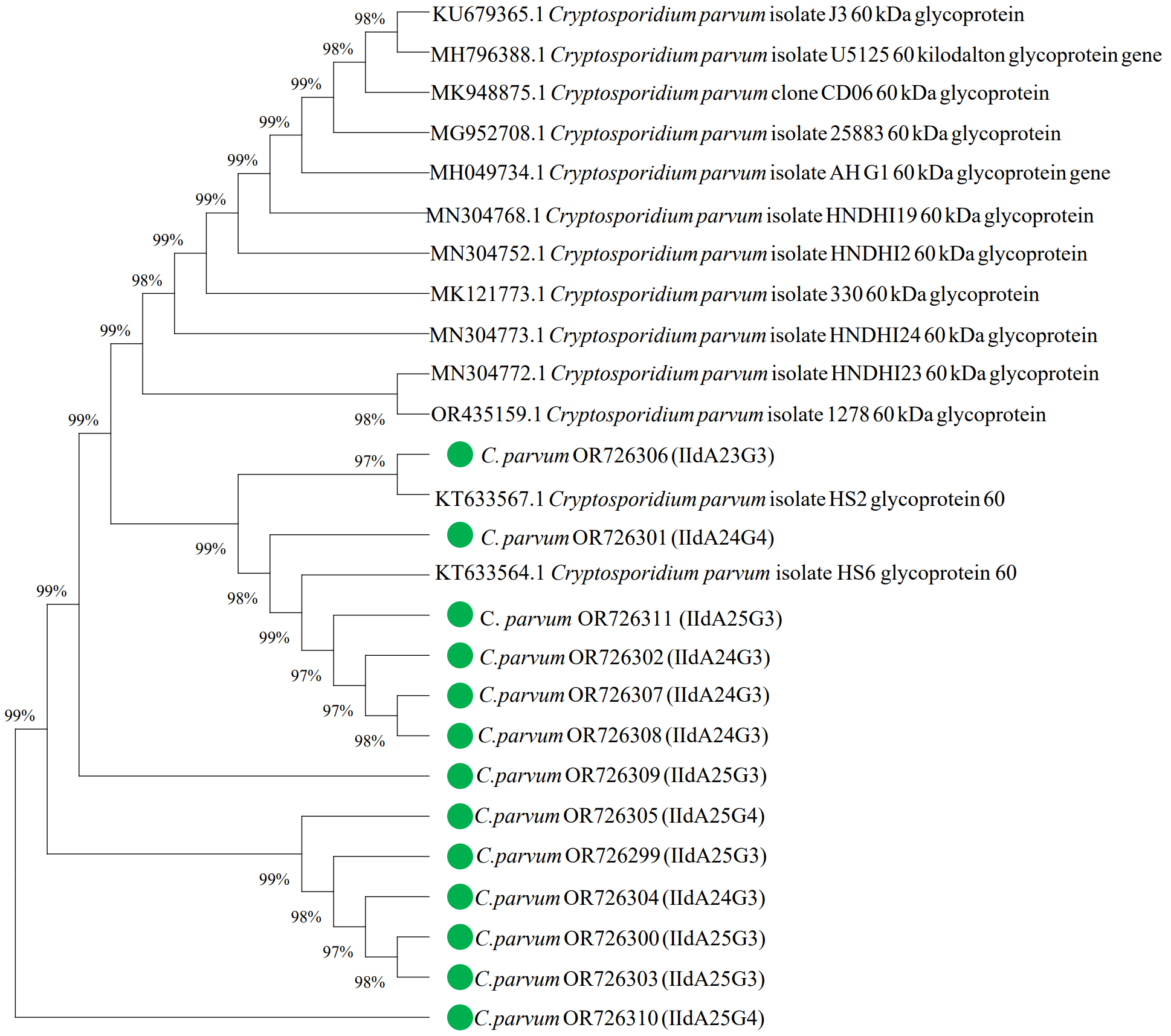
目的 了解内蒙古自治区某医院5岁及以下腹泻儿童隐孢子虫感染分子流行病学特点,为本地区隐孢子虫感染的防控提供参考。方法 收集2021年9月至2022年8月在内蒙古自治区妇幼保健院就诊的5岁及以下腹泻患儿的粪便样本,采用巢式PCR扩增隐孢子虫的18S rRNA基因片段以了解隐孢子虫感染情况。基于18S rRNA基因序列进行同源性分析并构建系统发育树,进行虫种鉴定;基于gp60基因位点进一步鉴定基因亚型。结果 共采集1 292例腹泻儿童粪便样本,其中156例样本隐孢子虫18S rRNA基因测序阳性,阳性率为12.07%。男童和女童阳性率分别为13.37%(92/688)和10.60%(64/604),差异无统计学意义(χ2=2.335,P>0.05)。1~3岁年龄组阳性率最高(15.70%,81/516),各年龄组间差异有统计学意义(χ2=12.620,P<0.05)。居住于郊县的腹泻儿童阳性率(15.66%,62/396)高于市区(10.49%,94/896),差异有统计学意义(χ2=6.902,P<0.05)。各月均检出阳性样本,其中12月阳性率最高(17.81%,13/73)。所有阳性样本经同源性分析均鉴定为微小隐孢子虫,系统发育树显示与微小隐孢子虫参考株聚为同一分支。基于gp60基因共检出5种亚型,分别为ⅡdA23G3、ⅡdA24G3、ⅡdA24G4、ⅡdA25G3和ⅡdA25G4,其中ⅡdA25G3为优势亚型(占42.95%,67/156)。系统发育树显示上述5种亚型形成独立进化分支,且与已知微小隐孢子虫Ⅱd亚型参考株聚为同一分支。结论 当地腹泻儿童隐孢子虫感染水平较高,3岁及以下婴幼儿是重点关注对象,郊县为重点关注地区。流行虫种为微小隐孢子虫,ⅡdA25G3为优势亚型。
中图分类号:
梁茹, 张亮, 郭文慧, 薛新宇, 李瑞凤. 内蒙古自治区某医院5岁以下腹泻儿童隐孢子虫感染分子流行病学研究[J]. 热带病与寄生虫学, 2026, 24(1): 30-35.
LIANG Ru, ZHANG Liang, GUO Wenhui, XUE Xinyu, LI Ruifeng. Molecular epidemiological related research on Cryptosporidium infection in children under 5 years old with diarrhea in a hospital of Inner Mongolia Autonomous Region[J]. Journal of Tropical Diseases and Parasitology, 2026, 24(1): 30-35.
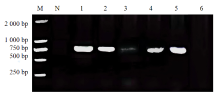
图1
部分腹泻儿童粪便样本18S rRNA基因巢式PCR扩增结果 注:M为DNA marker DL2000;N为阴性对照;1为阳性对照;2~6为样品条带。
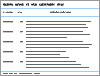
表1
调查儿童隐孢子虫感染的分布特征
| 分布特征 | 检测数(例) | 阳性数(例) | 阳性率(%) | 分布特征 | 检测数(例) | 阳性数(例) | 阳性率(%) |
|---|---|---|---|---|---|---|---|
| 性别 | 土默特左旗 | 71 | 12 | 16.90 | |||
| 男 | 688 | 92 | 13.37 | 清水河县 | 63 | 8 | 12.70 |
| 女 | 604 | 64 | 10.60 | 检出月份 | |||
| 年龄(岁) | 1 | 72 | 12 | 16.67 | |||
| <1 | 668 | 69 | 10.33 | 2 | 60 | 9 | 15.00 |
| 1~3 | 516 | 81 | 15.70 | 3 | 97 | 11 | 11.34 |
| 4~5 | 108 | 6 | 5.56 | 4 | 110 | 11 | 10.00 |
| 居住地 | 5 | 115 | 11 | 9.57 | |||
| 赛罕区 | 277 | 29 | 10.47 | 6 | 148 | 14 | 9.46 |
| 回民区 | 209 | 25 | 11.97 | 7 | 132 | 16 | 12.12 |
| 新城区 | 234 | 23 | 9.83 | 8 | 141 | 16 | 11.35 |
| 玉泉区 | 176 | 17 | 9.66 | 9 | 118 | 13 | 11.02 |
| 武川县 | 104 | 15 | 14.42 | 10 | 116 | 16 | 13.79 |
| 和林格尔县 | 76 | 14 | 18.42 | 11 | 110 | 14 | 12.73 |
| 托克托县 | 82 | 13 | 15.85 | 12 | 73 | 13 | 17.81 |
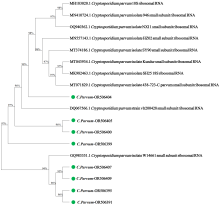
图2
基于隐孢子虫18S rRNA基因位点的系统发育进化树 注:OR506391~OR506409为本研究选取的8条代表性序列,其他隐孢子虫及其基因型的序列从GenBank中获得。
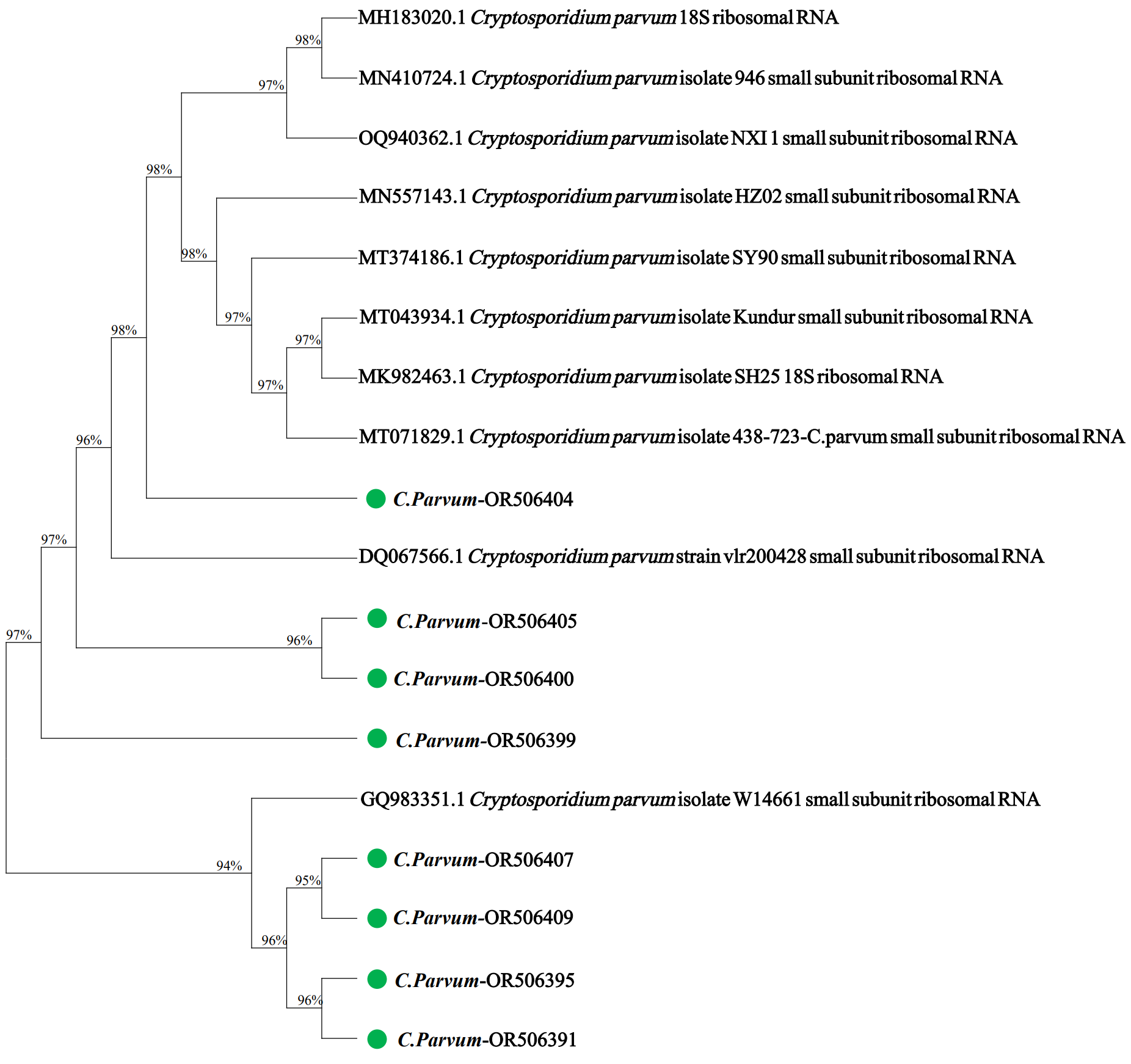
图3
gp60基因位点巢式PCR产物检测电泳 注:M为DNA marker DL2000;N为阴性对照;1为阳性对照;2~4为样品条带。
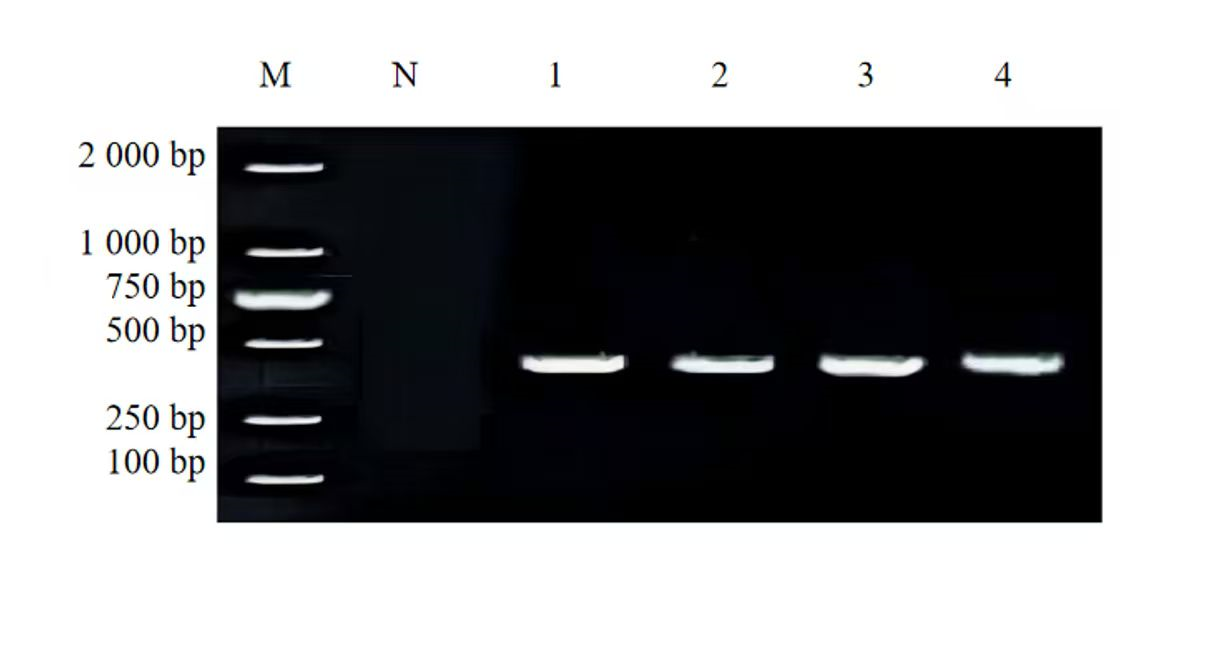
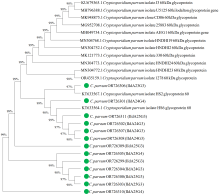
图4
基于隐孢子虫gp60基因位点的系统发育进化树 注:OR726299~OR726311为本研究选取的13条代表性序列,其他隐孢子虫及其基因型的序列从GenBank中获得。
| [1] |
Mohammad SM, Ali MS, Abdel-Rahman SA, et al. Genotyping of Cryptosporidium species in children suffering from diarrhea in Sharkyia Governorate, Egypt[J]. J Infect Dev Ctries, 2021, 15(10):1539-1546.
doi: 10.3855/jidc.14367 URL |
| [2] | Yang X, Guo YQ, Xiao LH, et al. Molecular epidemiology of human cryptosporidiosis in low- and middle-income countries[J]. Clin Microbiol Rev, 2021, 34(2):e00087-e00019. |
| [3] | Fayer R. Cryptosporidium: a water-borne zoonotic parasite[J]. Vet Parasitol, 2004, 12(1/2):37-56. |
| [4] |
Ryan U, Zahedi A, Paparini A. Cryptosporidium in humans and animals-a one health approach to prophylaxis[J]. Parasite Immunol, 2016, 38(9):535-547.
doi: 10.1111/pim.12350 pmid: 27454991 |
| [5] | 韩范, 谭渭仙, 周性兰. 南京地区人体隐孢子虫病2例报告[J]. 江苏医药, 1987, 13(12):692-703. |
| [6] | 程永璋, 陈学军, 林爱芬,等. 杭州地区人体隐孢子虫病26例报告[J]. 上海医学检验杂志, 2000, 15(5):307. |
| [7] |
Liu H, Shen YJ, Yin JH, et al. Prevalence and genetic characterization of Cryptosporidium, Enterocytozoon, Giardia and Cyclospora in diarrheal outpatients in China[J]. BMC Infect Dis, 2014, 14:25.
doi: 10.1186/1471-2334-14-25 URL |
| [8] |
Yu ZJ, Li FW, Zeng ZM, et al. Prevalence and clinical significance of Cryptosporidium infection in patients with hepatitis B virus-associated acute-on-chronic liver failure[J]. Int J Infect Dis, 2011, 15(12):e845-e848.
doi: 10.1016/j.ijid.2011.08.006 URL |
| [9] |
Chen YC, Wu YY, Qin HK, et al. Prevalence of Cryptosporidium infection in children from China: a systematic review and meta-analysis[J]. Acta Trop, 2023, 244:106958.
doi: 10.1016/j.actatropica.2023.106958 URL |
| [10] | 王旭, 沈玉娟, 曹建平. 我国隐孢子虫病流行现状与防控进展[J]. 热带病与寄生虫学, 2022, 20(3):136-148. |
| [11] | 夏云婷, 王丽, 崔旭初,等. 内蒙古某牧区儿童隐孢子虫感染情况调查[J]. 环境卫生学杂志, 2015, 5(6):504-506. |
| [12] |
Xiao L, Escalante L, Yang C, et al. Phylogenetic analysis of Cryptosporidium parasites based on the small-subunit rRNA gene locus[J]. Appl Environ Microbiol, 1999, 65(4):1578-1583.
doi: 10.1128/AEM.65.4.1578-1583.1999 URL |
| [13] |
Alves M, Xiao LH, Sulaiman I, et al. Subgenotype analysis of Cryptosporidium isolates from humans, cattle, and zoo ruminants in Portugal[J]. J Clin Microbiol, 2003, 41(6):2744-2747.
doi: 10.1128/JCM.41.6.2744-2747.2003 URL |
| [14] |
Kalantari N, Ghaffari S, Bayani M. Cryptosporidium spp. infection in Iranian children and immunosuppressive patients: A systematic review and meta-analysis[J]. Caspian J Intern Med, 2018, 9(2):106-115.
doi: 10.22088/cjim.9.2.106 pmid: 29732026 |
| [15] | 王庆权. 安徽省人群隐孢子虫感染现状调查及流行因素分析[D]. 合肥: 安徽医科大学, 2015. |
| [16] | 张小萍, 何艳燕, 王真瑜,等. 上海市综合性医院腹泻患者隐孢子虫感染状况调查[J]. 中国热带医学, 2016, 1(12):1183-1186. |
| [17] | 刘晓洁, 毛铁波, 吴鹏,等. 武汉市腹泻婴幼儿隐孢子虫感染的分子流行病学调查[J]. 中国血吸虫病防治杂志, 2017, 29(2):188-191,205. |
| [18] |
Kurenzvi L, Sebunya TK, Coetzee T, et al. Prevalence of Cryptosporidium parvum, Giardia intestinalis and molecular characterization of group A rotavirus associated with diarrhea in children below five years old in Gaborone, Botswana[J]. Pan Afr Med J, 2020, 37:159.
doi: 10.11604/pamj.2020.37.159.25392 pmid: 33425192 |
| [19] |
Bouzid M, Kintz E, Hunter PR. Risk factors for Cryptosporidium infection in low and middle income countries: a systematic review and meta-analysis[J]. PLoS Negl Trop Dis, 2018, 12(6):e0006553.
doi: 10.1371/journal.pntd.0006553 URL |
| [20] |
Hossain MJ, Saha D, Antonio M, et al. Cryptosporidium infection in rural Gambian children: Epidemiology and risk factors[J]. PLoS Negl Trop Dis, 2019, 13(7):e0007607.
doi: 10.1371/journal.pntd.0007607 URL |
| [21] |
Liu AQ, Gong BY, Liu XH, et al. A retrospective epidemiological analysis of human Cryptosporidium infection in China during the past three decades (1987-2018)[J]. PLoS Negl Trop Dis, 2020, 14(3):e0008146.
doi: 10.1371/journal.pntd.0008146 URL |
| [22] |
Xu N, Liu H, Jiang YY, et al. First report of Cryptosporidium viatorum and Cryptosporidium occultus in humans in China, and of the unique novel C. viatorum subtype XVaA3h[J]. BMC Infect Dis, 2020, 20(1):16.
doi: 10.1186/s12879-019-4693-9 |
| [23] |
Gong C, Cao XF, Deng L, et al. Epidemiology of Cryptosporidium infection in cattle in China: a review[J]. Parasite, 2017, 24:1.
doi: 10.1051/parasite/2017001 URL |
| [24] |
Urrea-Quezada A, Mariana González-Díaz, Isaac Villegas-Gómez, et al. Clinical Manifestations of Cryptosporidiosis and Identification of a New Cryptosporidium Subtype in Patients From Sonora, Mexico[J]. Pediatr Infect Dis J, 2018, 37(5): e136-e138.
doi: 10.1097/INF.0000000000001762 URL |
| [25] | Cama VA, Bern C, Roberts J, et al. Cryptosporidium species and subtypes and clinical manifestations in children, Peru[J]. Emerg Infect Dis, 2008, 14(10):567-74. |
| [26] |
Sánchez A, Munoz M, Gómez N, et al. Molecular epidemiology of Giardia, Blastocystis and Cryptosporidium among indigenous children from the Colombian Amazon Basin[J]. Front Microbiol, 2017, 8:248.
doi: 10.3389/fmicb.2017.00248 pmid: 28270802 |
| [27] |
Yu FC, Li DF, Chang YK, et al. Molecular characterization of three intestinal protozoans in hospitalized children with different disease backgrounds in Zhengzhou, Central China[J]. Parasites Vectors, 2019, 12(1):543.
doi: 10.1186/s13071-019-3800-5 |
| [28] |
Wang T, Wei ZL, Zhang Y, et al. Molecular detection and genetic characterization of Cryptosporidium in kindergarten children in Southern Xinjiang, China[J]. Infect Genet Evol, 2022, 103:105339.
doi: 10.1016/j.meegid.2022.105339 URL |
| [29] |
Tao W, Li YJ, Yang H, et al. Widespread occurrence of zoonotic Cryptosporidium Species and subtypes in dairy cattle from Northeast China: public health concerns[J]. J Parasitol, 2018, 104(1):10-17.
doi: 10.1645/17-140 URL |
| [30] |
Yan XL, Guo WH, Liang R, et al. Prevalence and molecular characterization of Cryptosporidium spp. in cattle in central and Western Inner Mongolia, China[J]. Front Vet Sci, 2025, 12:1587302.
doi: 10.3389/fvets.2025.1587302 URL |
| [1] | 华华, 包名家, 王妍, 闫俊, 唐鹭. 2005—2024年黑龙江省其他感染性腹泻流行特征与病原学分析[J]. 热带病与寄生虫学, 2026, 24(1): 13-18. |
| [2] | 王周超, 金美玲, 宋歌, 孙思浓, 毛玲玲, 孙英伟. 2015—2024年辽宁省其他感染性腹泻流行特征及空间聚集性分析[J]. 热带病与寄生虫学, 2026, 24(1): 19-24. |
| [3] | 陈皓东, 赵俊岭, 董言, 刘万里, 努尔比亚·艾尔肯, 郭荣. 2015—2024年新疆维吾尔自治区其他感染性腹泻流行特征与病原学分析[J]. 热带病与寄生虫学, 2026, 24(1): 25-29. |
| [4] | 杜彦历, 刘雅琼, 周兴余, 袁珩. 2019—2023年四川省其他感染性腹泻流行特征及病原谱分析[J]. 热带病与寄生虫学, 2026, 24(1): 7-12. |
| [5] | 葛芳君, 文雅欣, 李锦浩, 徐彩红. 2021—2024年我国0~14岁儿童无症状结核病登记情况分析[J]. 热带病与寄生虫学, 2025, 23(6): 335-340. |
| [6] | 刘世英, 李旭芳, 潘火云, 杨花梅, 陈敏霞, 徐翼. 18例儿童中重型广州管圆线虫病临床特点与治疗分析[J]. 热带病与寄生虫学, 2025, 23(2): 110-115. |
| [7] | 戴志辉, 林慧君, 周帅锋, 杨子琪, 陈生宝, 邓志红, 罗垲炜. 2014—2023年湖南省其他感染性腹泻流行特征分析[J]. 热带病与寄生虫学, 2025, 23(1): 7-11. |
| [8] | 李知晋, 袁熠, 夏宇, 付晓庆, 漆莉. 2017—2023年重庆市5岁及以下儿童其他感染性腹泻流行特征分析[J]. 热带病与寄生虫学, 2025, 23(1): 12-16. |
| [9] | 李勇, 王斐, 安洲, 仝飞, 叶琴, 黄月娥. 2005—2023年芜湖市其他感染性腹泻发病趋势及时空聚集性分析[J]. 热带病与寄生虫学, 2025, 23(1): 17-23. |
| [10] | 程东林, 郭倩, 郭启胜, 唐干, 王紫薇, 范引光. 2012—2022年滁州市其他感染性腹泻流行特征与变化趋势[J]. 热带病与寄生虫学, 2025, 23(1): 24-29. |
| [11] | 陆明艳, 王笑笑, 刘硕, 施超, 沈元. 2018—2023年无锡市其他感染性腹泻流行特征分析[J]. 热带病与寄生虫学, 2025, 23(1): 30-33. |
| [12] | 张盈, 杨丽蓉, 王晨. 儿童呼吸道合胞病毒感染的临床特征分析[J]. 热带病与寄生虫学, 2024, 22(4): 248-251. |
| [13] | 王阿鑫, 肖永康, 龚磊, 吴家兵. 2018—2022年安徽省其他感染性腹泻突发公共卫生事件流行特征分析[J]. 热带病与寄生虫学, 2024, 22(1): 7-11. |
| [14] | 张强, 何宇, 桑燕茹, 曾臻, 陈伟. 2012—2022年合肥市其他感染性腹泻流行特征及病原学检测结果分析[J]. 热带病与寄生虫学, 2024, 22(1): 16-22. |
| [15] | 王依, 李成媛, 毛元春, 李伟. 基于PRISMA声明的儿童蛲虫病健康教育干预措施的系统综述[J]. 热带病与寄生虫学, 2024, 22(1): 47-53. |
| 阅读次数 | ||||||
|
全文 |
|
|||||
|
摘要 |
|
|||||
