热带病与寄生虫学 ›› 2026, Vol. 24 ›› Issue (2): 105-108.

• 防治研究 • 上一篇    下一篇

2023—2024年上海市蝇类生态学监测结果分析

王静静,朱江,刘洪霞,陈健   

  1. 上海市疾病预防控制中心,上海200336

  • 收稿日期:2025-10-31 出版日期:2026-04-20 发布日期:2026-05-29
  • 通信作者: 刘洪霞,E-mail: liuhongxia@scdc.sh.cn;陈健,E-mail: chenjian@scdc.sh.cn
  • 作者简介:王静静,女,硕士,实习研究员,研究方向:病媒生物监测与控制。E-mail: wangjingjing@scdc.sh.cn 朱江,男,本科,副主任医师,研究方向:病媒生物监测与控制。E-mail: zhujiang@scdc.sh.cn 王静静和朱江同为第一作者
  • 基金资助:
    上海市科学技术委员会上海市2024年度生命科技领域定向项目(24DX2800300)

The fly ecological surveillance results in Shanghai from 2023 to 2024

Shanghai Center for Disease Control and Prevention, Shanghai 200336, China   

  1. Shanghai Center for Disease Control and Prevention, Shanghai 200336, China
  • Received:2025-10-31 Online:2026-04-20 Published:2026-05-29

摘要:

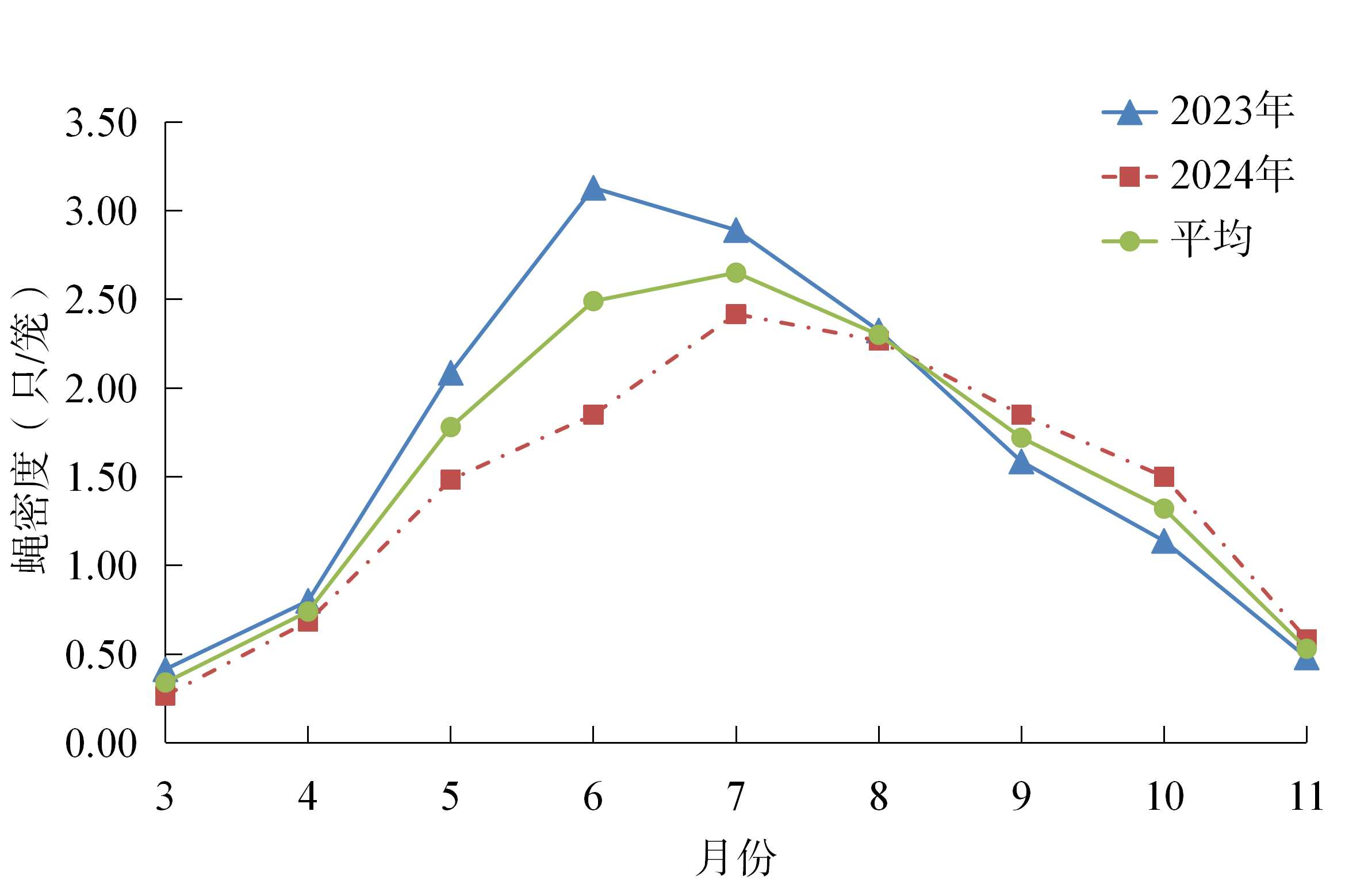
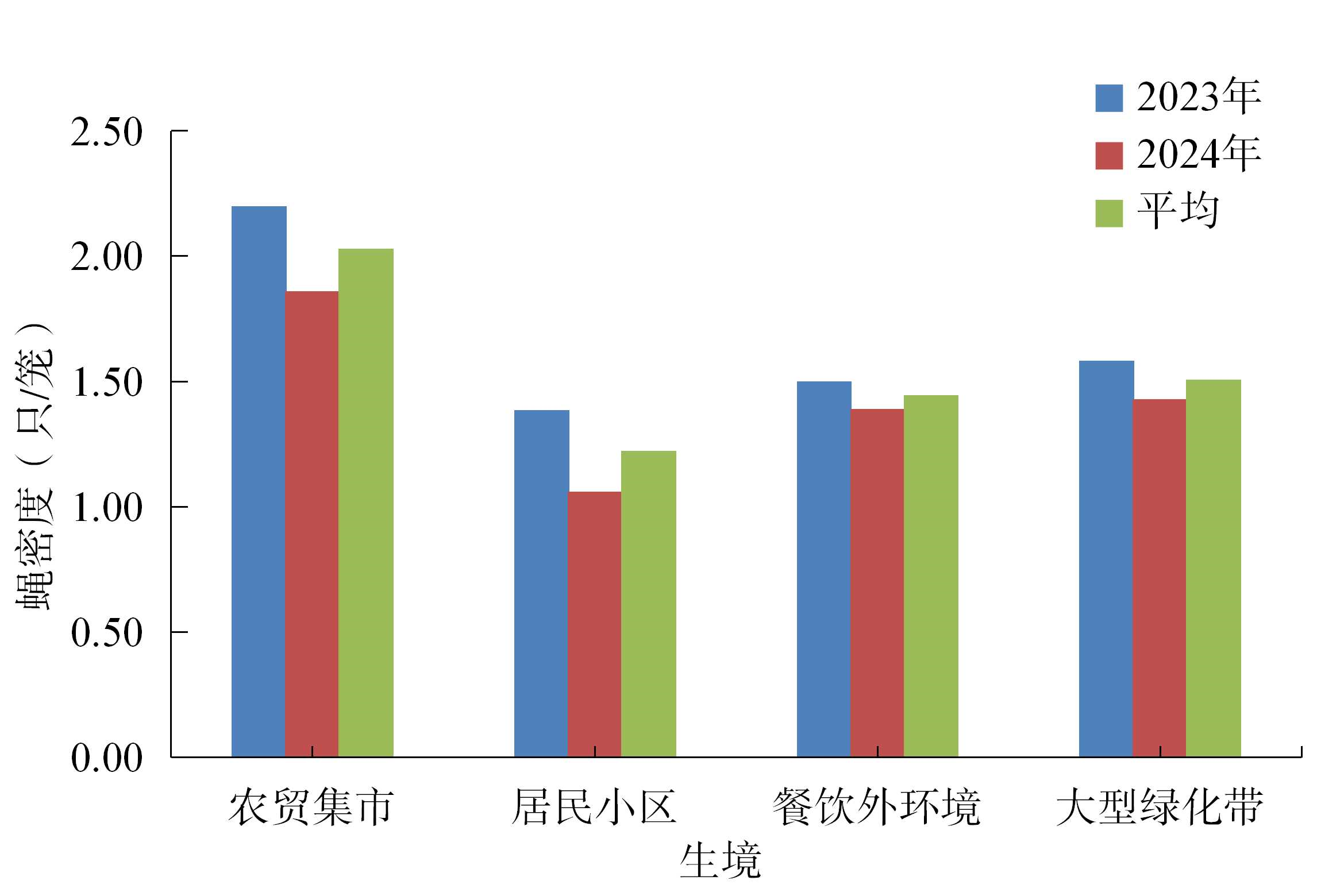
摘要:目的 了解上海市蝇类构成和密度季节消长趋势,为蝇类科学防制提供依据。方法 按照上海市病媒生物监测方案要求,2023—2024年3—11月在上海市开展蝇类生态学监测。选择各监测点的农贸集市、餐饮外环境、居民小区、大型绿化带等四类生境开展调查,采用笼诱法捕蝇并对选定生境的蝇种进行种类鉴定与计数,对蝇类构成、密度等指标进行分析和比较。结果 2023—2024年上海市共布笼2 430笼,捕蝇3 892只,平均蝇密度为1.54只/笼。其中,2023年和2024年蝇密度分别为1.65只/笼、1.43只/笼,差异无统计学意义(t=1.282,P>0.05)。鉴定蝇种14种;数量居前3位的蝇种依次为厩腐蝇、大头金蝇、棕尾别麻蝇,分别占15.08%(587/3 892)、13.36%(520/3 892)和13.00%(506/3 892);平均蝇密度居前3位的蝇种依次为棕尾别麻蝇(0.23只/笼)、大头金蝇(0.22只/笼)和厩腐蝇(0.20只/笼)。不同季节蝇种数量分布不同,除厩腐蝇和棕尾别麻蝇在监测期间均活跃外,春季巨尾阿丽蝇捕获数较多(占24.08%,202/839),夏秋季大头金蝇捕获数较多(占16.15%,493/3 053)。2023—2024年上海市蝇密度消长呈单峰型,6—8月达到高峰,每年不同月份间蝇密度差异均有统计学意义(χ2=46.498、37.311,P均<0.001)。不同生境中,大型绿化带(1 505只,占38.67%)和农贸集市捕蝇数(1 032只,占26.52%)较多;农贸集市平均蝇密度最高(2.03只/笼),大型绿化带、餐饮外环境、居民小区的平均蝇密度依次为1.51、1.45和1.22只/笼。结论 上海市优势蝇种为厩腐蝇和棕尾别麻蝇,蝇密度高峰出现在夏季,农贸集市是蝇类防治重点场所,提示应在蝇类活动期持续加强对重点场所的蝇类综合控制。

关键词: 蝇, 密度, 种类, 监测, 季节消长, 上海市

Abstract:

Abstract: Objective  To understand the composition and seasonal fluctuation trend of fly density in Shanghai area for a basis for scientific prevention and control of flies. Methods  According to the vector surveillance protocol of Shanghai, we conducted an ecological monitoring of flies at various surveillance sites in Shanghai area from March to November during 2023-2024. The surveys were carried out in four types of habitats at each monitoring site, including farmers’markets, external environments of catering establishments, residential quarters, and large greenbelts. The flies were captured in the selected habitats by cage trapping, identified for the species and counted. Finally, the fly species composition and its density were analyzed and compared. Results  A total of 2 430 traps were deployed, and 3 892 flies were captured during 2023-2024. The annual mean density was 1.54 flies/cage. The fly density was 1.65 per trap in 2023 and 1.43 per trap in 2024, which showed no significant difference (t=1.282, P>0.05). Fourteen fly species were identified, with Muscina stabulans (15.08%, 587/3 892), Chrysomya megacephala (13.36%, 520/3 892), and Boettcherisca peregrina (13.00%, 506/3 892) being the top three by count. However, B. peregrina (0.23 flies/cage), C. megacephala (0.22 flies/cage), and M. stabulans (0.20 flies/cage) ranked highest by density. Species composition varied seasonally, except for M. stabulans and B. peregrina being active during the entire monitoring period. In spring, the dominant species was Aldrichina grahami (24.08%, 202/839), while C. megacephala (16.15%, 493/3,053) was more prevailing in summer and autumn. The fly density fluctuation in Shanghai area between 2023 and 2024 exhibited a unimodal pattern, peaking from June to August, with statistical differences among different months in each year (χ2=46.498, 37.311, all P<0.001). Among different habitats, large green belts (1 505 flies, 38.67%) and farmers’ markets (1 032 flies, 26.52%) accounted for the majority of captured flies. The farmers’ markets had the highest average fly density (2.03 flies/cage), followed by large green belts (1.51 flies/cage), external environments of catering establishments (1.45 flies/cage), and residential quarters (1.22 flies/cage). Conclusion  M. stabulans and B. peregrina are predominant fly species in Shanghai area. The fly density peaks in summer and agricultural trade fairs shall be the key sites for fly control. Our findings suggest that integrated fly control in the key sites should be persistently strengthened during active fly seasons. 

Key words: Fly, Density, Species, Surveillance, Seasonal fluctuation, Shanghai Municipality