热带病与寄生虫学 ›› 2026, Vol. 24 ›› Issue (2): 65-69,75.

• 特别报道 • 上一篇    下一篇

2006—2025年我国恙虫病死亡病例流行特征分析

岳玉娟1,李贵昌1,吾力肯·吐尔达力2   

  1. 1. 中国疾病预防控制中心传染病预防控制所,传染病溯源预警与智能决策全国重点实验室,北京102206;
    2. 新疆维吾尔自治区疾病预防控制中心,新疆病媒传染病重点实验室
  • 收稿日期:2026-03-19 出版日期:2026-04-20 发布日期:2026-05-29
  • 作者简介:岳玉娟,女,博士,副研究员,研究方向:3S技术与公共卫生。E-mail: yueyujuan@icdc.cn
  • 基金资助:
    中国疾病预防控制中心公共卫生应急反应机制的运行——传染病预防与控制(102393260020020000002)

Epidemiological characteristics of fatal cases of scrub typhus in China from 2006 to 2025

YUE Yujuan1, LI Guichang1, WULIKEN Tuerdali   

  1. 1. National Institute for Communicable Disease Control and Prevention, Chinese Center for Disease Control and Prevention; National Key Laboratory of Intelligent Tracking and Forecasting for Infectious Diseases, Beijing 102206, China; 
    2. Xinjiang Uygur Autonomous Region Center for Disease Control and Prevention, Xinjiang Key Laboratory of Vector-borne Infectious Diseases
  • Received:2026-03-19 Online:2026-04-20 Published:2026-05-29

摘要:

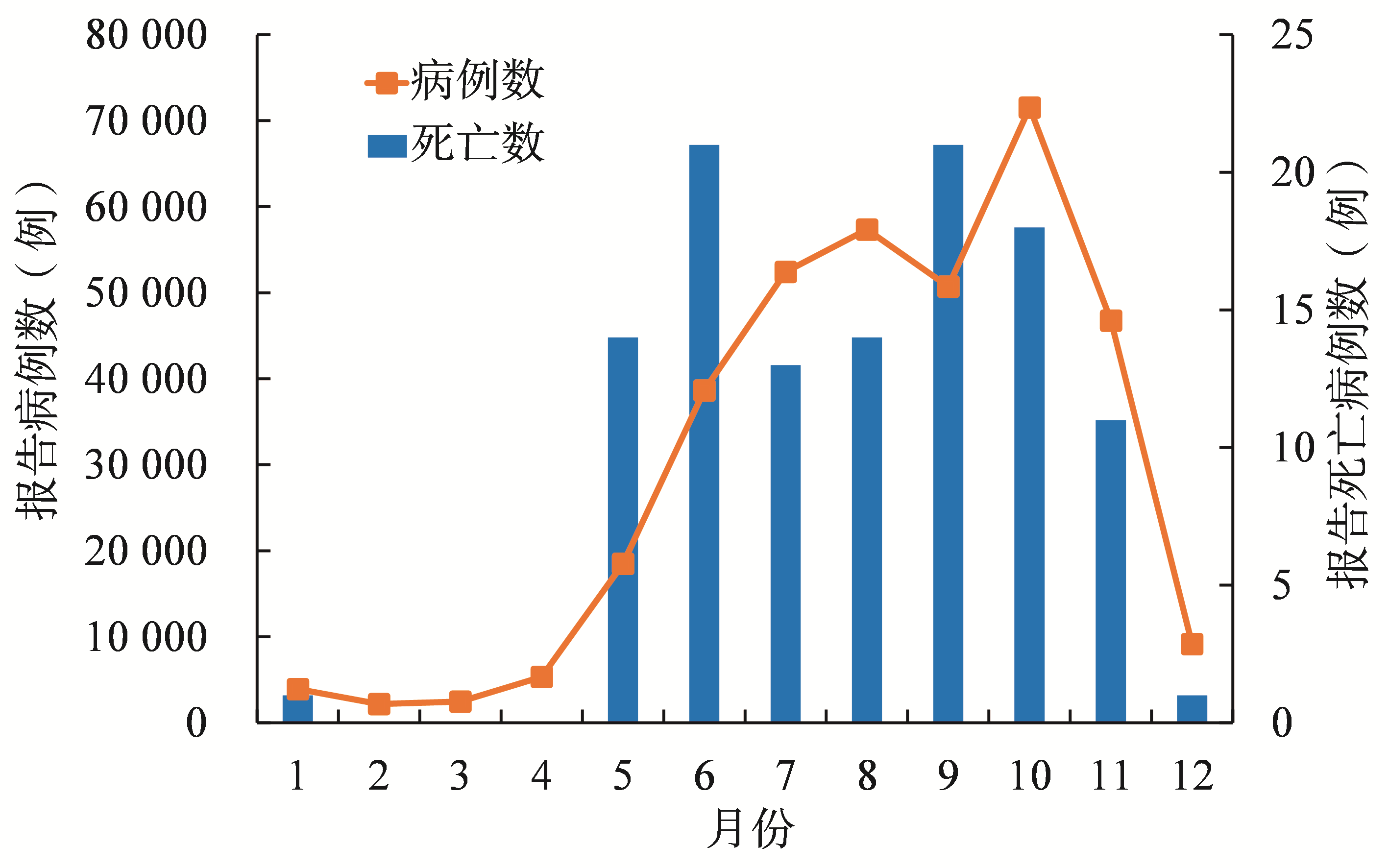
摘要目的 分析我国恙虫病死亡病例的流行病学特征,为恙虫病的科学防控提供参考。方法 收集中国疾病预防控制信息系统中2006—2025年我国报告的恙虫病病例数据,采用描述流行病学方法分析恙虫病死亡病例的时间、地区和人群分布特征以及发病、诊断、死亡的时间间隔。结果 2006—2025年我国累计报告恙虫病病例359 017例,报告死亡病例114例,年均病死率为0.03%。除2006年和2009年外,每年均有死亡病例报告。恙虫病死亡病例集中在5—11月,占总死亡病例数的98.25%(112/114)。报告死亡病例分布在11个省(自治区)、46个地级市(州)、77个县(市、区)。广东(55例)、云南(28例)、福建(11例)和广西(10例)等4个省份死亡病例数占91.23%(104/114)。死亡病例数较高的地级市(州)为广东省的广州市(17例)、佛山市(7例)、河源市(6例)和云南省的楚雄彝族自治州(10例)、临沧市(5例)。男性和女性死亡病例数分别为65例和49例,性别比为1.33∶1;50~79岁年龄组人群死亡病例数占67.54%(77/114),农民、离退人员、家务及待业人群死亡病例数占75.44%(86/114)。死亡病例发病至明确诊断的时间间隔中位数为7(3,11)天,发病至死亡时间间隔中位数为7(3,10)天。共有30例病例死亡后才明确诊断(占26.32%),有54例病例明确诊断当天死亡(占47.37%)。结论 我国恙虫病报告病例数呈上升趋势,2010年以来每年均有死亡病例报告。死亡病例具有季节性和空间聚集性特征。建议在恙虫病高发季节针对重点地区和人群,加强病例监测、诊疗与救治,以及相关防控知识的宣传教育。

关键词: 恙虫病, 恙螨, 死亡病例, 流行特征

Abstract:

Abstract: Objective  To analyze the epidemiological characteristics of fatal cases of scrub typhus in China for a reference for scientific prevention and control of this mite-borne disease. Methods  Fatal cases of scrub typhus registered in China from 2006 to 2025 were obtained from the Chinese Disease Prevention and Control Information System. Descriptive epidemiology was used to analyze the characteristics of temporal, regional, and population distribution of fatal scrub typhus cases, as well as the time intervals among onset, diagnosis, and death. Results  From 2006 to 2025, a total of 359 017 scrub typhus cases and 114 fatal cases were reported in China, with an average annual case fatality rate of 0.03%. Deaths were reported every year except in 2006 and 2009. Scrub typhus deaths were concentrated between May and November, accounting for 98.25% (112/114) of the total deaths. The fatal cases were distributed across 11 provinces (autonomous regions), 46 prefecture-level cities, and 77 counties (cities, districts). Among the provinces (autonomous regions), Guangdong (55 deaths), Yunnan (28 deaths), Fujian (11 deaths), and Guangxi (10 deaths) added up to 91.23% (104/114) of all deaths. The prefecture-level cities with relatively higher number of fatal cases comprised Guangzhou City (17 deaths), Foshan City (7 deaths), and Heyuan City (6 deaths) in Guangdong Province, and Chuxiong Yi Autonomous Prefecture (10 deaths) and Lincang City (5 deaths) in Yunnan Province. Of the fatal cases, 65 were in males and 49 in females, with a gender ratio of 1.33∶1. The age group of 50-79 years contributed to 67.54% (77/114) of the total deaths. In terms of occupation distribution, 75.44% (86/114) of the deaths were in farmer, retiree, housekeeper and the unemployed. The median time interval from infection onset to confirmed diagnosis for fatal cases was 7 (3, 11) days, and the median time interval from onset to death was 7 (3, 10) days. A total of 30 cases were diagnosed only after death (26.32%), while 54 cases (47.37%) died on the day of definitive diagnosis. Conclusion  The number of reported cases of scrub typhus in China presents an increasing trend, and deaths have been yearly reported since 2010. The fatal cases exhibit distinct seasonal and spatial clustering characteristics. It is recommended to enhance case surveillance, early diagnosis, standardized treatment, and health education on prevention and control of scrub typhus in high-incidence seasons, key regions and populations at high risks. 

Key words: Scrub typhus, Chigger mite, Fatal cases, Epidemiological characteristics