
热带病与寄生虫学 ›› 2026, Vol. 24 ›› Issue (3): 166-171.doi: 10.20199/j.issn.1672-2302.2026.03.007
方惟希( ), 桂红芽, 俞俊岭, 李春, 罗婉蓉, 孙永, 冯玉杰, 何军()
收稿日期:2026-03-04
出版日期:2026-06-20
发布日期:2026-07-31
通信作者:
何军,E-mail: 作者简介:方惟希,女,硕士,技师,研究方向:微生物检验。E-mail: 基金资助:
FANG Weixi(), GUI Hongya, YU Junling, LI Chun, LUO Wanrong, SUN Yong, FENG Yujie, HE Jun()
Received:2026-03-04
Online:2026-06-20
Published:2026-07-31
Contact:
HE Jun, E-mail: 摘要:
目的 了解安徽省外环境禽流感病毒分布情况及职业暴露人群抗体水平,为禽流感疫情防控提供科学依据。方法 2022—2024年,依据禽流感相关监测方案在安徽省开展外环境禽流感病原学监测和职业暴露人群血清学监测工作。在城乡活禽市场、家禽规模养殖场、家禽散养户集中地区、家禽屠宰加工厂和野生禽鸟栖息地等外环境进行标本采集,并采用实时荧光定量PCR法检测标本中的甲型流感病毒核酸,阳性者进一步检测H5、H7、H9亚型;对合肥市、马鞍山市、阜阳市和池州市等4市的禽流感职业暴露人群进行抗体监测。采用描述流行病学方法对上述监测结果进行统计分析。结果 2022—2024年安徽省共采集禽流感外环境标本3 919份,检出甲型流感病毒核酸阳性标本1 455份,阳性率为37.13%,阳性标本以H9亚型为主(1 158份,占79.59%),存在H5+H9和H7+H9混合阳性标本。7—9月与11月—次年1月阳性率相对较高(42.49%、41.03%)。监测场所中,家禽屠宰加工厂阳性率最高(52.27%);标本类型中,清洗禽类的污水阳性率最高(46.36%);不同场所、标本类型的阳性率差异均有统计学意义(χ2=283.922、76.204,P均<0.001)。安徽省共采集职业暴露人群血清标本1 025份,检出阳性标本70份,阳性率为6.83%,单一亚型中,H5N6阳性标本占比最高(占52.86%,37/70);不同城市中,合肥市职业暴露人群抗体阳性率最高(10.19%);不同场所中,家禽散养户集中地区阳性率最高(9.86%),H5N6、H10N3抗体阳性标本均来自家禽散养户集中地区。结论 安徽省外环境中存在多种亚型禽流感病毒,阳性标本以H9亚型为主,职业暴露人群血清抗体阳性标本以H5N6亚型为主。建议重点加强对城乡活禽市场等高风险场所的监管,对家禽散养户进行禽流感防控宣传,持续开展禽流感的监测,减少人感染H5N6等高致病性禽流感风险。
中图分类号:
方惟希, 桂红芽, 俞俊岭, 李春, 罗婉蓉, 孙永, 冯玉杰, 何军. 2022—2024年安徽省外环境禽流感病毒和职业暴露人群抗体监测结果分析[J]. 热带病与寄生虫学, 2026, 24(3): 166-171.
FANG Weixi, GUI Hongya, YU Junling, LI Chun, LUO Wanrong, SUN Yong, FENG Yujie, HE Jun. The antibody monitoring results of avian influenza virus in the external environments and occupational exposure populations in Anhui Province from 2022 to 2024[J]. Journal of Tropical Diseases and Parasitology, 2026, 24(3): 166-171.
表1
2022—2024年安徽省禽相关外环境标本中禽流感病毒核酸检测结果
| 特征 | 标本数 (份) | 阳性数及阳性率[份(%)] | 亚型及其构成比[份(%)] | ||||||
|---|---|---|---|---|---|---|---|---|---|
| 未分型 | H5 | H7 | H9 | H5+H9 | H7+H9 | ||||
| 年份 | |||||||||
| 2022 | 425 | 210(49.41) | 0(0) | 6(2.86) | 1(0.48) | 193(91.90) | 10(4.76) | 0(0) | |
| 2023 | 979 | 391(39.94) | 26(6.65) | 7(1.79) | 6(1.53) | 330(84.40) | 21(5.37) | 1(0.26) | |
| 2024 | 2 515 | 854(33.96) | 24(2.81) | 57(6.67) | 7(0.82) | 635(74.36) | 129(15.11) | 2(0.23) | |
| 监测场所 | |||||||||
| 城乡活禽市场 | 3 118 | 1 377(44.16) | 49(3.56) | 70(5.08) | 14(1.02) | 1 088(79.01) | 153(11.11) | 3(0.22) | |
| 家禽散养户集中地区 | 446 | 50(11.21) | 0(0) | 0(0) | 0(0) | 45(90.00) | 5(10.00) | 0(0) | |
| 家禽屠宰加工厂 | 44 | 23(52.27) | 1(4.35) | 0(0) | 0(0) | 21(91.30) | 1(4.35) | 0(0) | |
| 家禽规模养殖场 | 181 | 5(2.76) | 0(0) | 0(0) | 0(0) | 4(80.00) | 1(20.00) | 0(0) | |
| 野生禽鸟栖息地 | 120 | 0(0) | 0(0) | 0(0) | 0(0) | 0(0) | 0(0) | 0(0) | |
| 不详 | 10 | 0(0) | 0(0) | 0(0) | 0(0) | 0(0) | 0(0) | 0(0) | |
| 标本类型 | |||||||||
| 清洗禽类的污水 | 453 | 210(46.36) | 4(1.90) | 11(5.24) | 1(0.48) | 167(79.52) | 27(12.86) | 0(0) | |
| 宰杀或摆放禽肉案板表面的擦拭标本 | 615 | 261(42.44) | 8(3.07) | 24(9.20) | 7(2.68) | 191(73.18) | 30(11.49) | 1(0.38) | |
| 笼具表面擦拭标本 | 649 | 257(39.60) | 12(4.67) | 7(2.72) | 2(0.78) | 206(80.16) | 28(10.89) | 2(0.78) | |
| 禽类饮水 | 391 | 143(36.57) | 5(3.50) | 3(2.10) | 1(0.70) | 125(87.41) | 9(6.29) | 0(0) | |
| 粪便标本 | 745 | 183(24.56) | 9(4.92) | 7(3.83) | 0(0) | 155(84.70) | 12(6.56) | 0(0) | |
| 不详 | 1 066 | 401(37.62) | 12(2.99) | 18(4.49) | 3(0.75) | 314(78.30) | 54(13.47) | 0(0) | |
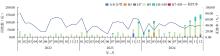
图1
2022—2024年安徽省禽流感外环境阳性标本时间分布
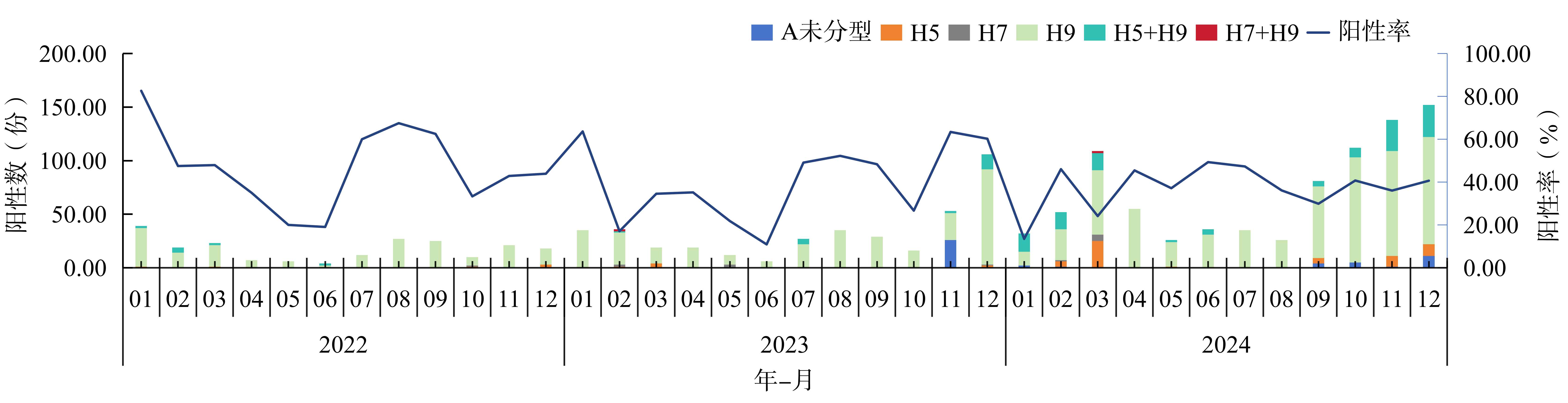
表2
2022—2024年安徽省禽流感职业暴露人群血清抗体检测结果
| 特征 | 标本数(份) | 阳性数及阳性率[份(%)] | 亚型及其构成比[份(%)] | ||||||
|---|---|---|---|---|---|---|---|---|---|
| H3N8 | H5N6 | H9N2 | H10N3 | H3N8+H9N2 | H3N8+H5N6 | ||||
| 年份 | |||||||||
| 2022 | 218 | 17(7.80) | 3(17.65) | 8(47.06) | 6(35.29) | 0(0) | 0(0) | 0(0) | |
| 2023 | 503 | 29(5.77) | 10(34.48) | 6(20.69) | 9(31.03) | 2(6.90) | 2(6.90) | 0(0) | |
| 2024 | 304 | 24(7.89) | 0(0) | 23(95.83) | 0(0) | 0(0) | 0(0) | 1(4.17) | |
| 地市 | |||||||||
| 合肥市 | 314 | 32(10.19) | 0(0) | 29(90.63) | 2(6.25) | 0(0) | 1(3.13) | 0(0) | |
| 池州市 | 306 | 19(6.21) | 5(26.32) | 6(31.58) | 5(26.32) | 1(5.26) | 1(5.26) | 1(5.26) | |
| 马鞍山市 | 205 | 11(5.37) | 3(27.27) | 2(18.18) | 6(54.55) | 0(0) | 0(0) | 0(0) | |
| 阜阳市 | 200 | 8(4.00) | 5(62.50) | 0(0) | 2(25.00) | 1(12.5) | 0(0) | 0(0) | |
| 监测场所 | |||||||||
| 家禽散养户集中地区 | 416 | 41(9.86) | 6(14.63) | 31(75.61) | 2(4.88) | 1(2.44) | 1(2.44) | 0(0) | |
| 家禽规模养殖场 | 145 | 0(0) | 0(0) | 0(0) | 0(0) | 0(0) | 0(0) | 0(0) | |
| 城乡活禽市场 | 90 | 7(7.78) | 1(14.29) | 0(0) | 6(85.71) | 0(0) | 0(0) | 0(0) | |
| 家禽屠宰加工厂 | 67 | 3(4.48) | 1(33.33) | 0(0) | 2(66.67) | 0(0) | 0(0) | 0(0) | |
| 不详 | 307 | 19(6.19) | 5(26.32) | 6(31.58) | 5(26.32) | 1(5.26) | 1(5.26) | 1(5.26) | |
| 性别 | |||||||||
| 男性 | 571 | 47(8.23) | 9(19.14) | 22(46.81) | 12(25.53) | 2(4.26) | 2(4.26) | 0(0) | |
| 女性 | 454 | 23(5.07) | 4(17.39) | 15(65.21) | 3(13.04) | 0(0) | 0(0) | 1(4.35) | |
| 年龄组(岁) | |||||||||
| 15~24 | 4 | 0(0) | 0(0) | 0(0) | 0(0) | 0(0) | 0(0) | 0(0) | |
| 25~34 | 13 | 0(0) | 0(0) | 0(0) | 0(0) | 0(0) | 0(0) | 0(0) | |
| 35~44 | 49 | 6(12.24) | 0(0) | 3(50.00) | 2(33.33) | 0(0) | 1(16.67) | 0(0) | |
| 45~54 | 151 | 5(3.31) | 2(40.00) | 2(40.00) | 1(20.00) | 0(0) | 0(0) | 0(0) | |
| 55~64 | 201 | 18(8.96) | 1(5.56) | 16(88.89) | 0(0) | 1(5.56) | 0(0) | 0(0) | |
| 65~74 | 157 | 7(4.46) | 0(0) | 5(71.43) | 2(28.57) | 0(0) | 0(0) | 0(0) | |
| 75~84 | 93 | 5(5.38) | 1(20.00) | 3(60.00) | 0(0) | 0(0) | 0(0) | 1(20.00) | |
| 85~90 | 8 | 0(0) | 0(0) | 0(0) | 0(0) | 0(0) | 0(0) | 0(0) | |
| 不详 | 349 | 29(8.31) | 9(31.03) | 8(27.59) | 10(34.48) | 1(3.45) | 1(3.45) | 0(0) | |
| [1] |
Zhao LC, Xia HZ, Huang JJ, et al. Features of nuclear export signals of NS2 protein of influenza D virus[J]. Viruses, 2020, 12(10):1100.
doi: 10.3390/v12101100 URL |
| [2] |
Klimov AI, Garten R, Russell C, et al. WHO recommendations for the viruses to be used in the 2012 Southern Hemisphere Influenza Vaccine: epidemiology, antigenic and genetic characteristics of influenza a(H1N1)pdm09, a(H3N2) and B influenza viruses collected from February to September 2011[J]. Vaccine, 2012, 30(45):6461-6471.
doi: 10.1016/j.vaccine.2012.07.089 pmid: 22917957 |
| [3] | 杨丽, 代林翔, 张俭. 甲型流感病毒的流行病学特征及防控策略研究进展[J]. 病毒学报, 2026, 42(3):1057-1063. |
| [4] | 康宁, 谭毅. 人感染禽流感流行现状及疫苗研究进展[J]. 应用预防医学, 2021, 27(6):569-574. |
| [5] | 蒋权归, 曹婕, 李庆霞, 等. 海南省禽流感病毒的流行与遗传演化特征[J]. 中国家禽, 2026, 48(4):81-89. |
| [6] |
Yang RG, Sun HL, Gao F, et al. Human infection of avian influenza A H3N8 virus and the viral origins: a descriptive study[J]. Lancet Microbe, 2022, 3(11):e824-e834.
doi: 10.1016/S2666-5247(22)00192-6 pmid: 36115379 |
| [7] |
Jing JS, Wang LY, Wang GC, et al. A human infection case with avian-origin H10N3 influenza virus[J]. Quant Imaging Med Surg, 2021, 11(10):4508-4510.
doi: 10.21037/qims URL |
| [8] | 汪琪莹, 刘嵩. 安徽省疫源水鸟传播禽流感的风险分析[J]. 安徽林业科技, 2024, 50(2):58-61. |
| [9] | 吴福清, 李群, 吴家兵, 等. 安徽省首例人感染禽流感病毒的流行病学调查[J]. 现代预防医学, 2008, 35(1):152-153. |
| [10] | 王辉, 夏志才, 陈晓龙, 等. 安徽省首例人感染H5N6禽流感病例流行病学调查结果分析[J]. 安徽预防医学杂志, 2016, 22(3):149-152,193. |
| [11] | 吴家兵, 侯赛, 何军, 等. 安徽省人感染H7N9禽流感病例调查分析[J]. 中华疾病控制杂志, 2015, 19(8):778-781. |
| [12] | He J, Gong L, Chen XL, et al. A retrospective investigation of a case of dual infection by avian-origin influenza a (H10N5) and seasonal influenza a (H3N2) viruses-Anhui Province, China, December 2023-January 2024[J]. China CDC Wkly, 2024, 6(25):605-613. |
| [13] | 王利辉, 徐佳楠, 杨慧萍, 等. 2022-2024年四川省外环境禽流感病毒监测结果分析[J]. 现代疾病预防控制, 2025, 36(11):843-846. |
| [14] | 黎美汐, 李翔, 余晓, 等. 2020-2023年湖北省外环境中禽流感病毒监测分析[J]. 疾病监测, 2024, 39(11):1460-1464. |
| [15] | 孙晓强, 穆婷, 袁芳, 等. 2021-2022年宁夏外环境禽流感病毒和职业暴露人群血清学监测分析[J]. 江苏预防医学, 2024, 35(5):604-606,618. |
| [16] | 李保娣, 李红育, 徐丛杉, 等. 2019-2020年甘肃省外环境禽流感病毒及职业暴露人群血清学分析[J]. 疾病监测, 2022, 37(1):58-61. |
| [17] | World Health Organization. Influenza (avian and other zoonotic) Fact sheet[EB/OL]. (2026-01-21)[2026-03-03]. https://www.who.int/zh/news-room/fact-sheets/detail/influenza-(avian-and-other-zoonotic). |
| [18] | 孙婷婷, 岑山, 王静. 甲型流感病毒宿主适应的分子基础及其相关宿主因子的研究进展[J]. 遗传, 2023, 45(11):976-985. |
| [19] | 楼秀玉, 王欣莹, 颜浩, 等. 2016-2020年浙江省禽类相关外环境禽流感病毒污染状况及职业暴露人群血清监测[J]. 疾病监测, 2022, 37(9):1170-1174. |
| [20] | Zhang Y, Gao L, Shen CJ, et al. Exploring the determinants of influenza A/H7N9 control intervention efficacy in China: Disentangling the effect of the ‘1110’ policy and poultry vaccination[J]. Transbounding Emerging Dis, 2022, 69(5):e1982-e1991. |
| [21] | 梁正林, 杨忠秀, 邓星超, 等. 2014-2018年贵港市活禽市场外环境禽流感病毒检测和职业暴露人群血清学监测结果分析[J]. 实用预防医学, 2020, 27(2):138-141. |
| [22] | 侯雪芹, 侯元林, 朱俊. 2015-2017年广元市禽相关环境中禽流感病毒监测分析[J]. 现代预防医学, 2017, 44(17):3236-3239. |
| [23] |
李辉, 刘莉, 周义生, 等. 禽流感病毒H5N6亚型快速荧光免疫层析检测方法的建立[J]. 中国人兽共患病学报, 2025, 41(3):243-248,283.
doi: 10.3969/j.issn.1002-2694.2025.00.035 |
| [24] |
赵科伕, 姜春晓, 胡玉倩, 等. 合肥市首例人感染H5N6禽流感病例临床及流行病学特征[J]. 中国热带医学, 2025, 25(8):1016-1021.
doi: 10.13604/j.cnki.46-1064/r.2025.08.12 |
| [25] |
Sandhu S, Ferrante C, MacCosham A, et al. Epidemiological characteristics of human infections with avian influenza a(H5N6) virus, China and Laos: a multiple case descriptive analysis, February 2014-June 2023[J]. Can Commun Dis Rep, 2024, 50(1/2):77-85.
doi: 10.14745/ccdr.v50i12a09 URL |
| [26] | 中华人民共和国农业部. 全国高致病性禽流感免疫方案[EB/OL]. (2017-07-10)[2026-03-03]. http://www.moa.gov.cn/gk/tzgg_1/tz/201707/t20170711_5744436.htm. |
| [27] |
Chanchaidechachai T, Stegeman A, Velkers FC, et al. Assessing the impact of outdoor farming, farm size, and farm density on highly pathogenic avian influenza epidemics: a modelling study in the Netherlands[J]. One Health, 2026, 22:101424.
doi: 10.1016/j.onehlt.2026.101424 URL |
| [1] | 刘雅倩, 龚磊, 戴艳妮, 耿浩翔, 张力芹, 孟梦, 朱梦, 朱标, 吴家兵. 基于分布滞后非线性模型的安徽省流感发病与气象因素的关联性研究[J]. 热带病与寄生虫学, 2026, 24(1): 36-40. |
| [2] | 苏颖, 王斌冰, 柴瑜, 董燕, 王军平, 张宁, 宋菲扬. 2012—2024年安徽省急性乙型肝炎流行特征及疫苗接种情况分析[J]. 热带病与寄生虫学, 2025, 23(3): 144-148. |
| [3] | 方雨, 王荣, 方雪晖. 安徽省老年人肺结核防治核心信息知晓情况调查研究[J]. 热带病与寄生虫学, 2025, 23(2): 116-121. |
| [4] | 汪天平, 操治国. 安徽省实现消除血吸虫病的机遇、挑战与思考[J]. 热带病与寄生虫学, 2025, 23(1): 1-6. |
| [5] | 张进, 娄秋月, 戴色莺, 吴建军. 2012—2023年安徽省丙型病毒性肝炎流行特征分析[J]. 热带病与寄生虫学, 2025, 23(1): 34-39. |
| [6] | 许月野, 许薇, 杨月阳, 张安胜, 杨志伟, 王广辉, 操治国, 赵金红. 钉螺体内吸虫尾蚴的形态和分子特征鉴定[J]. 热带病与寄生虫学, 2025, 23(1): 44-48. |
| [7] | 葛盈露, 杨灵康, 刘以诺, 马婉婉, 王鹏, 孙永, 史永林. 2021—2023年安徽省手足口病柯萨奇病毒A组16型分子分型研究[J]. 热带病与寄生虫学, 2024, 22(4): 233-238. |
| [8] | 王阿鑫, 肖永康, 龚磊, 吴家兵. 2018—2022年安徽省其他感染性腹泻突发公共卫生事件流行特征分析[J]. 热带病与寄生虫学, 2024, 22(1): 7-11. |
| [9] | 冯明子, 傅荔艳, 葛盈露, 马婉婉, 王鹏, 孙永, 史永林. 2016—2020年安徽省手足口病相关柯萨奇病毒A组16型分子分型研究[J]. 热带病与寄生虫学, 2023, 21(4): 199-203. |
| [10] | 邓舒, 滕雪娇, 赵玉秋, 吴家兵. 2018—2022年安徽省突发公共卫生事件流行特征分析[J]. 热带病与寄生虫学, 2023, 21(3): 130-134,140. |
| [11] | 朱海, 孙成松, 汪奇志, 呼明闯, 章乐生, 赵蕾, 张世清. 安徽省部分地区淡水鱼华支睾吸虫感染状况调查分析[J]. 热带病与寄生虫学, 2022, 20(6): 325-329. |
| [12] | 代波, 汪天平, 许晓娟, 何家昶, 汪昊, 高风华, 丁宋军, 刘婷, 张世清. 2020年洪涝灾害后安徽省钉螺扩散情况调查[J]. 热带病与寄生虫学, 2022, 20(4): 191-196. |
| [13] | 马晓荷, 汪敏, 朱磊, 郭见多, 李清越, 刘婷, 翟杜娟, 孙成松, 张世清, 汪天平. 安徽省不同地区日本血吸虫群体线粒体基因遗传变异研究[J]. 热带病与寄生虫学, 2021, 19(5): 254-. |
| [14] | 李保娣, 李红育, 徐丛杉, 张慧, 王雪莹, 赵哲, 汪鹏, 于德山. 2017—2018 年甘肃省外环境禽流感病毒监测分析[J]. 热带病与寄生虫学, 2021, 19(4): 185-. |
| [15] | 操治国, 刘道华, 金伟, 郭见多, 张世清, 李启扬, 呼明闯, 汪敏, 朱磊, 汪天平. 2016—2020 年安徽省人群华支睾吸虫感染情况调查分析[J]. 热带病与寄生虫学, 2021, 19(3): 131-134. |
| 阅读次数 | ||||||
|
全文 |
|
|||||
|
摘要 |
|
|||||
