
热带病与寄生虫学 ›› 2026, Vol. 24 ›› Issue (2): 115-123.doi: 10.20199/j.issn.1672-2302.2026.02.010
万传珍1( ), 朱德全2, 董学军1, 吴翠萍1()
收稿日期:2025-11-25
出版日期:2026-04-20
发布日期:2026-05-29
通信作者:
吴翠萍,E-mail: 作者简介:万传珍,女,硕士在读,研究方向:传染病学。E-mail:
WAN Chuanzhen1(), ZHU Dequan2, DONG Xuejun1, WU Cuiping1()
Received:2025-11-25
Online:2026-04-20
Published:2026-05-29
Contact:
WU Cuiping, E-mail: 摘要:
本文报道了1例布鲁氏菌感染引起的髂动脉瘤及腹主动脉夹层动脉瘤病例。患者因反复发热、下腹痛就诊,腹部增强CT提示腹主动脉假性动脉瘤并双侧髂动脉病变,先后接受腹主动脉腔内隔绝术(endovascular aneurysm repair, EVAR)及髂动脉支架植入术,经围手术期预防性抗感染治疗后,患者体温短暂恢复正常,但出院后再次出现发热及腹痛。进一步追问流行病学史发现患者为羊养殖户,布鲁氏菌虎红平板凝集试验(rose bengal plate test, RBPT)呈阳性,试管凝集试验(serum agglutination test, SAT)滴度为1∶200,血培养检出布鲁氏菌(羊种3型),最终确诊为布鲁氏菌病相关感染性动脉瘤。经多西环素、利福平及左氧氟沙星三联抗生素治疗后,患者病情好转出院,院外继续口服多西环素及利福平治疗,随访良好。本文对该病例资料进行回顾分析并对相关文献进行检索与复习,归纳该病的临床特征、诊断及治疗要点,总结诊疗经验,以提高临床对该病的认识。
中图分类号:
万传珍, 朱德全, 董学军, 吴翠萍. 布鲁氏菌感染引起髂动脉瘤及腹主动脉夹层动脉瘤1例并文献复习[J]. 热带病与寄生虫学, 2026, 24(2): 115-123.
WAN Chuanzhen, ZHU Dequan, DONG Xuejun, WU Cuiping. Bilateral iliac artery aneurysms with abdominal aortic dissecting aneurysm caused by Brucella infection: Report of one case with literature review[J]. Journal of Tropical Diseases and Parasitology, 2026, 24(2): 115-123.
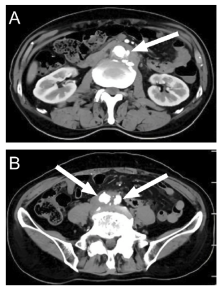
图1
患者首次入院全腹部增强CT影像学表现 注:A箭头处为腹主动脉瘤及夹层破口;B箭头处为侧髂总动脉起始部动脉瘤。
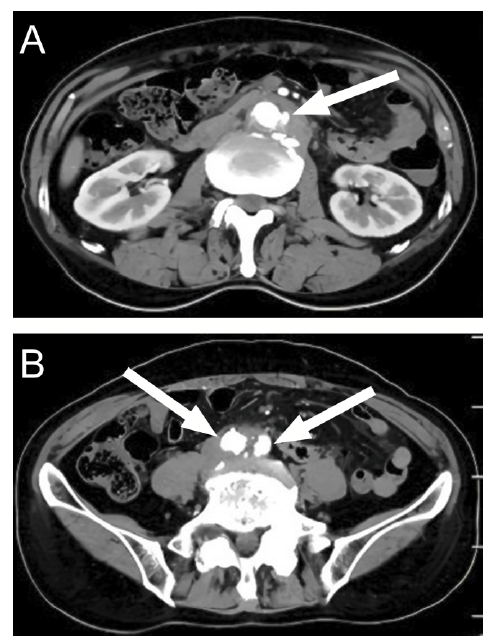
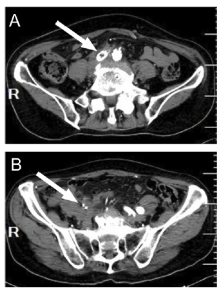
图2
患者第2次入院全主动脉CTA影像学表现 注:A箭头处示右髂总动脉灌注不良;B箭头处示右髂内动脉及髂外动脉闭塞。
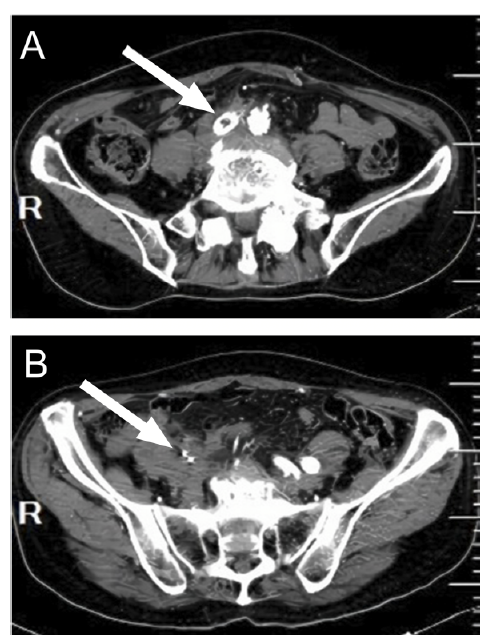
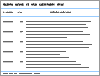
表1
47例布鲁氏菌病并主/髂动脉疾病患者临床资料
| 序 号 | 发表 年份 | 年龄(岁) | 性别 | 确诊 地区 | 接触史 | 职业 | 基础疾病 | 临床表现 | 感染部位 | 病变性质 | 诊断方法 | 手术 方式 | 抗菌药物 | 转归 |
|---|---|---|---|---|---|---|---|---|---|---|---|---|---|---|
| 1 | 2005[ | 72 | 男 | 比利时 | 食用生羊奶酪 | 不详 | 不详 | 发热、腹痛、腰痛 | 腹主动脉 | 动脉瘤 | 腹主动脉MRI,组织培养(+), SAT(+) | 开放手术 | 多西环素+利福平 | 好转 |
| 2 | 2006[ | 78 | 女 | 希腊 | 不详 | 不详 | 高血压、动脉硬化 | 胸痛 | 升主动脉 | 动脉瘤 | CTA,病灶组织PCR(+) | 开放手术 | 不详 | 好转 |
| 3 | 2007[ | 59 | 男 | 韩国 | 接触生牛、羊肉 | 屠夫 | 无 | 发热、腹痛 | 腹主动脉 | 动脉瘤 | 腹部CT,血培养(+) | 开放手术 | 多西环素+利福平 | 好转 |
| 4 | 2007[ | 61 | 男 | 波兰 | 直接接触牛、羊 | 兽医 | 高血压、慢性非活动性布鲁氏菌病 | 剧烈胸痛、背痛 | 胸主动脉、腹主动脉、髂动脉 | 夹层动脉瘤 | SAT(+),布鲁氏菌素皮内试验(+),超声 | TE-VAR | 无 | 好转 |
| 5 | 2008[ | 65 | 男 | 希腊 | 养殖山羊,食用生奶酪 | 牧民 | 布鲁氏菌性脊柱炎 | 腰痛、腹痛、双下肢水肿、腹部搏动性包块 | 腹主动脉 | 动脉瘤 | 增强腹部CT,CTA, 脓液培养(+) | EVAR | 不详 | 好转 |
| 6 | 2009[ | 59 | 男 | 瑞士 | 不详 | 不详 | 无 | 耻骨上区疼痛、背痛、纳差、消瘦 | 腹主动脉 | 动脉瘤 | 腹部CT,血培养(+),主动脉壁组织培养(+) | 开放手术 | 多西环素+利福平 | 好转 |
| 7 | 2011[ | 39 | 男 | 伊朗 | 直接接触牛、羊 | 兽医 | 高血压、 主动脉夹层、升主动脉置换、布鲁氏菌病 | 发热、左髋痛 | 升主动脉 | 假性动脉瘤 | SAT(+),CTA,血培养(+), 瘤壁组织培养(+) | 开放手术 | 环丙沙星+利福平+庆大霉素 | 好转 |
| 8 | 2013[ | 66 | 男 | 希腊 | 养殖与屠宰山羊,食用生乳制品 | 屠夫 | 高血压、高脂血症 | 腹痛、腰痛、腹部搏动性包块 | 腹主动脉、双侧髂动脉 | 动脉瘤 | CTA,SAT(+), 瘤腔液体培养(+) | 开放手术 | 多西环素+利福平+环丙沙星 | 好转 |
| 9 | 2013[ | 56 | 女 | 法国 | 不详 | 不详 | 脊柱结核 | 发热、腹痛、腹部搏动性包块 | 腹主动脉 | 动脉瘤 | CTA,血培养(+),瘤体组织培养(+),SAT(+) | 开放手术 | 多西环素+利福平+庆大霉素 | 好转 |
| 10 | 2016[ | 60 | 女 | 沙特阿拉伯 | 食用生牛奶 | 不详 | 主动脉夹层 | 剧烈腹痛、腰背痛、腹部搏动性包块 | 腹主动脉 | 动脉瘤 | 腹部增强CT,布鲁氏菌IgG(+++),病灶组织培养(+) | 开放手术 | 多西环素+利福平 | 好转 |
| 11 | 2017[ | 69 | 男 | 以色列 | 不详 | 不详 | 膀胱癌 | 发热、腹痛、咯血、吞咽困难 | 胸主动脉 | 动脉瘤 | CTA,血培养(+),SAT(+),胃镜示远端食管受压 | TEVAR | 利福平+庆大霉素 | 好转 |
| 12 | 2017[ | 63 | 男 | 中国 | 养殖山羊 | 农民 | 无 | 发热、腹痛、腹部搏动性包块 | 腹主动脉 | 假性动脉瘤 | CTA,血培养(+),布鲁氏菌IgG(+++) | EVAR | 多西环素+利福平 | 好转 |
| 13 | 2017[ | 65 | 男 | 中国 | 接触牛及生牛肉 | 不详 | 动脉硬化 | 发热、胸痛 | 胸主动脉 | 假性动脉瘤 | CTA,血培养(+), SAT 1∶400(++++) | TEVAR | 多西环素+利福平 | 好转 |
| 14 | 2019[ | 52 | 男 | 沙特阿拉伯 | 不详 | 不详 | 糖尿病 | 发热、胸痛、吞咽困难、呕血 | 胸主动脉 | 动脉瘤、主动脉-食管瘘 | CTA,血培养(+),DSA | TEVAR+食管支架 | 多西环素+利福平+庆大霉素 | 死亡 |
| 15 | 2019[ | 49 | 女 | 印度 | 食用生牛奶 | 家庭主妇 | 无 | 发热、腹痛、腹部搏动性包块 | 腹主动脉 | 夹层动脉瘤并破裂 | 腹部CT,CTA,血培养(+),瘤内血栓培养(+) | 开放手术 | 多西环素+利福平 | 失访 |
| 16 | 2019[ | 73 | 女 | 中国 | 食用山羊胎盘 | 不详 | 无 | 发热、关节肌肉不适、腹痛 | 腹主动脉 | 动脉瘤 | CTA,血培养(+) | EVAR | 多西环素+利福平+庆大霉素 | 好转 |
| 17 | 2019[ | 65 | 男 | 美国 | 猎杀并食用野猪 | 猎户 | 高血压、高脂血症 | 大量咯血 | 胸主动脉 | 动脉瘤、主动脉-支气管瘘 | 胸部CT,DSA,血培养(+),主动脉壁组织培养(+)、PCR(+) | TEVAR+开放手术 | 多西环素 | 失访 |
| 18 | 2021[ | 67 | 男 | 中国 | 养殖羊、猪 | 农民 | 无 | 发热、背痛 | 左髂总动脉 | 假性动脉瘤 | CTA,DSA,SAT 1∶400,血培养(+) | EVAR | 多西环素+利福平 | 好转 |
| 19 | 2021[ | 79 | 男 | 荷兰 | 食用生奶酪 | 不详 | 不详 | 发热、腹痛、腹股沟痛 | 右髂总动脉 | 动脉瘤并破裂、动脉旁脓肿 | 增强CT,血培养(+), 脓液培养(+) | EVAR+开放手术 | 多西环素+利福平+复方磺胺甲噁唑 | 好转 |
| 20 | 2021[ | 55 | 男 | 中国 | 养殖牛、羊 | 农民 | 布鲁氏菌病 | 发热、关节痛、胸闷、双下肢水肿 | 升主动脉 | 假性动脉瘤、感染性心内膜炎 | 血培养(+),SAT 1∶100(+),TEE | 开放手术 | 多西环素+利福平+左氧氟沙星 | 好转 |
| 21 | 2022[ | 67 | 男 | 中国 | 接触生牛、羊肉 | 餐馆员工 | 高血压、糖尿病 | 腰痛、左臀部痛 | 胸主动脉 | 动脉瘤、穿透性溃疡 | CTA,血培养(+) | TEVAR | 多西环素+利福平 | 好转 |
| 22 | 2023[ | 59 | 男 | 中国 | 羊屠宰史 | 农民 | 肝损害 | 发热、腹痛、双下肢肿痛 | 右髂总动脉 | 假性动脉瘤并破裂 | CTA,血培养(+) | EVAR | 米诺环素+利福平+头孢曲松 | 好转 |
| 23 | 2023[ | 64 | 男 | 中国 | 邻居养殖山羊 | 不详 | 无 | 发热、腹痛 | 腹主动脉 | 假性动脉瘤 | CTA,RBPT(+), SAT 1∶200(++) | EVAR | 米诺环素+利福平+左氧氟沙星 | 好转 |
| 24 | 2023[ | 65 | 男 | 中国 | 接触生牛、羊肉 | 屠夫 | 布鲁氏菌病 | 发热、声音嘶哑 | 降主动脉 | 假性动脉瘤 | CTA,RBPT(+),SAT(+), 组织宏基因组测序 | 开放手术 | 多西环素+利福平 | 好转 |
| 25 | 2023[ | 53 | 男 | 伊朗 | 养殖牛、羊并食用其产品 | 牧民 | 冠心病、消化性溃疡、前列腺增生 | 腹痛、黑便、腹部搏动性包块 | 腹主动脉 | 动脉瘤、主动脉-十二指肠瘘 | 腹部CT,SAT(+), Coomb’s试验1∶640 | 开放手术 | 多西环素+利福平+环丙沙星 | 好转 |
| 26 | 2023[ | 79 | 男 | 中国 | 养殖牛、羊 | 农民 | 无 | 剧烈腹痛 | 腹主动脉 | 假性动脉瘤 | 腹部增强CT,DSA, 血培养(+) | EVAR | 利福平 | 死亡 |
| 27 | 2023[ | 67 | 男 | 中国 | 养殖牛、羊 | 农民 | 痛风 | 腰痛 | 腹主动脉、右髂内动脉 | 动脉瘤 | 腹部增强CT,DSA,血培养(+),SAT1∶100(+) | EVAR | 利福平+多西环素 | 好转 |
| 28 | 2023[ | 65 | 男 | 中国 | 养殖山羊 | 农民 | 无 | 腹痛、腰痛 | 腹主动脉 | 假性动脉瘤 | 腹部增强CT,DSA,血培养(+),SAT1∶100(+) | EVAR | 多西环素+利福平 | 好转 |
| 29 | 2024[ | 70 | 男 | 中国 | 养殖山羊 | 农民 | 高血压 | 发热、腹痛 | 左髂总动脉 | 动脉瘤 | CTA,RBPT(+),SAT(+), 血培养(+) | EVAR | 多西环素+利福平 | 好转 |
| 30 | 2024[ | 66 | 男 | 中国 | 养殖山羊 | 农民 | 高血压 | 发热、腹痛、腰背痛 | 腹主动脉 | 动脉瘤 | CTA,RBPT(+),SAT(+) | EVAR | 多西环素+利福平 | 好转 |
| 31 | 2024[ | 61 | 男 | 中国 | 养殖山羊 | 农民 | 下腔静脉及双侧髂静脉血栓形成 | 发热、腹痛、腰背痛、下肢水肿 | 右髂总动脉 | 动脉瘤 | CTA,RBPT(+),SAT(+) | EVAR | 多西环素+利福平 | 好转 |
| 32 | 2024[ | 63 | 男 | 中国 | 养殖山羊 | 农民 | 糖尿病 | 发热、腹痛 | 腹主动脉 | 动脉瘤 | CTA,RBPT(+),SAT(+) | EVAR | 多西环素+利福平 | 好转 |
| 33 | 2024[ | 55 | 男 | 中国 | 养殖山羊 | 农民 | 肾积水 | 发热、腰背痛 | 右髂总动脉 | 动脉瘤 | CTA,RBPT(+),SAT(+) | EVAR | 多西环素+利福平 | 好转 |
| 34 | 2024[ | 42 | 男 | 中国 | 养殖山羊 | 农民 | 无 | 腰背痛 | 腹主动脉 | 动脉瘤 | CTA,RBPT(+),SAT(+) | EVAR | 多西环素+利福平 | 好转 |
| 35 | 2024[ | 74 | 男 | 中国 | 养殖山羊 | 农民 | 无 | 腹痛、便血 | 腹主动脉 | 动脉瘤、主动脉-肠瘘 | CTA,RBPT(+),SAT(+), 血培养(+) | 无 | 短期死亡 | 死亡 |
| 36 | 2025[ | 48 | 男 | 美国 | 狩猎并屠宰野猪 | 猎户 | 冠心病 | 发热、腰背痛、腹部搏动性包块 | 腹主动脉 | 动脉瘤 | CTA,MALDI-TOF鉴定为布鲁氏菌 | EVAR+开放手术 | 多西环素+庆大霉素 | 好转 |
| 37 | 2025[ | 70 | 男 | 美国 | 养殖山羊,食用生羊奶,狩猎并屠宰野猪 | 猎户 | 冠心病、高血压 | 腰背痛、便血、黑便 | 腹主动脉 | 动脉瘤、主动脉肠瘘 | CTA,脓液培养(+) | 开放手术 | 多西环素+利福平 | 死亡 |
| 38 | 2025[ | 70 | 男 | 中国 | 养殖山羊 | 农民 | 高血压 | 发热、腹痛、右下肢痛 | 腹主动脉、右髂动脉 | 动脉瘤 | CTA,SAT 1∶400(+++), RBPT(+),血培养(+) | EVAR | 多西环素+利福平+氨基糖苷类 | 好转 |
| 39 | 2025[ | 61 | 女 | 中国 | 养殖山羊 | 农民 | 无 | 腹痛 | 腹主动脉 | 动脉瘤并破裂 | CTA,SAT 1∶100(++), RBPT(+),血培养(+) | EVAR | 多西环素+利福平+氨基糖苷类 | 好转 |
| 40 | 2025[ | 55 | 男 | 中国 | 养殖山羊 | 农民 | 高血压、动脉硬化 | 发热、腹痛 | 腹主动脉、左髂动脉 | 动脉瘤、髂动脉瘤破裂 | CTA,SAT 1∶400(+++), RBPT(+),血培养(+) | EVAR | 多西环素+利福平+氨基糖苷类 | 好转 |
| 41 | 2025[ | 54 | 男 | 中国 | 接触生牛、羊肉 | 屠夫 | 冠心病 | 发热、腹痛、左下肢痛 | 左髂动脉 | 动脉瘤 | CTA,SAT 1∶400(+++), RBPT(+) | EVAR | 多西环素+利福平+氨基糖苷类 | 好转 |
| 42 | 2025[ | 70 | 男 | 中国 | 养殖山羊 | 农民 | 慢性肾功能衰竭 | 腹痛、腹部搏动性包块 | 腹主动脉 | 动脉瘤 | CTA,SAT 1∶200(++), RBPT(+) | EVAR | 多西环素+利福平+氨基糖苷类 | 好转 |
| 43 | 2025[ | 64 | 男 | 中国 | 接触生牛、羊肉 | 屠夫 | 无 | 腹痛 | 腹主动脉 | 动脉瘤 | CTA,SAT 1∶400(++), RBPT(+) | EVAR | 多西环素+利福平+氨基糖苷类 | 好转 |
| 44 | 2025[ | 73 | 女 | 中国 | 养殖山羊 | 农民 | 糖尿病 | 胸痛、胸闷 | 胸主动脉 | 动脉瘤 | CTA,SAT 1∶400(++), RBPT(+),血培养(+) | TEVAR | 多西环素+利福平+氨基糖苷类 | 好转 |
| 45 | 2025[ | 59 | 男 | 中国 | 养殖山羊 | 农民 | 无 | 腰背痛 | 腹主动脉 | 动脉瘤 | CTA,SAT 1∶400(++), RBPT(+),血培养(+) | EVAR | 多西环素+利福平+氨基糖苷类 | 好转 |
| 46 | 2025[ | 75 | 男 | 中国 | 养殖山羊 | 农民 | 高血压 | 腹痛、腹部搏动性包块 | 腹主动脉 | 动脉瘤 | CTA,SAT 1∶200(+++), RBPT(+) | EVAR | 多西环素+利福平+氨基糖苷类 | 好转 |
| 47 | 2025[ | 58 | 男 | 中国 | 养殖山羊 | 农民 | 糖尿病 | 腹痛 | 左髂动脉 | 动脉瘤 | CTA,SAT 1∶200(+++), RBPT(+) | EVAR | 多西环素+利福平+氨基糖苷类 | 好转 |
| [1] |
Laine CG, Johnson VE, Scott HM, et al. Global estimate of human brucellosis incidence[J]. Emerg Infect Dis, 2023, 29(9): 1789-1797.
doi: 10.3201/eid2909.230052 pmid: 37610167 |
| [2] | Tao ZF, Chen QL, Chen YS, et al. Epidemiological characteristics of human brucellosis-China, 2016-2019[J]. China CDC Wkly, 2021, 3(6):114-119. |
| [3] |
Liu ZG, Gao LP, Wang M, et al. Long ignored but making a comeback: a worldwide epidemiological evolution of human brucellosis[J]. Emerg Microbes Infect, 2024, 13(1): 2290839.
doi: 10.1080/22221751.2023.2290839 URL |
| [4] |
Herrick JA, Lederman RJ, Sullivan B, et al. Brucella arteritis: clinical manifestations, treatment, and prognosis[J]. Lancet Infect Dis, 2014, 14(6):520-526.
doi: 10.1016/S1473-3099(13)70270-6 pmid: 24480149 |
| [5] |
Li X, Li XY, Cheng ZH. Brucellosis involving the aorta and iliac arteries: a systematic review of 130 cases[J]. Front Bioeng Biotechnol, 2023, 11:1326246.
doi: 10.3389/fbioe.2023.1326246 URL |
| [6] |
Willems SA, Brouwers JJWM, Eefting D. Aortic and iliac involvement in brucellosis-arare but life threatening manifestation: a review of the literature[J]. Eur J Vasc Endovasc Surg, 2022, 63(5): 743-750.
doi: 10.1016/j.ejvs.2022.02.004 URL |
| [7] | 国家卫生健康委办公厅, 国家中医药局综合司. 布鲁氏菌病诊疗方案(2023年版)[J]. 中国感染控制杂志, 2024, 23(5):661-664. |
| [8] | Quartiers J, durieux R, De Leval L, et al. Abdominal aortic aneurysm due to Brucella melitensis[J]. Acta Chir Belg, 2005, 105(1): 93-95. |
| [9] |
Tsioufis K, Stefanadis C, Kallikazaros I. A footprint of Brucella infection: enormous saccular aneurysm of the ascending aorta[J]. Heart, 2006, 92(9):1308.
pmid: 16908703 |
| [10] |
Park SJ, Kim MN, Kwon TW. Infected abdominal aortic aneurysm caused by Brucella abortus: a case report[J]. J Vasc Surg, 2007, 46(6): 1277-1279.
doi: 10.1016/j.jvs.2007.06.043 URL |
| [11] |
Kusztal M, Dorobisz A, Kuzniar J, et al. Dissecting aneurysm of the thoracic aorta in a patient with nephrotic syndrome and brucellosis[J]. Int Urol Nephrol, 2007, 39(2):641-645.
doi: 10.1007/s11255-006-9090-9 pmid: 17318348 |
| [12] |
Kokkinis K, Stathopoulou S, Petrocheilou G, et al. Brucella spondylitis complicated by an infected abdominal aortic aneurysm and deep venous thrombosis: case report and review of the literature[J]. Eur J Orthop Surg Traumatol, 2008, 18(1):23-27.
doi: 10.1007/s00590-007-0256-7 URL |
| [13] |
Wolff T, Leupold J, Nüesch R. Bang! The smoker with suprapubic pain[J]. Lancet, 2009, 374(9684):174.
doi: 10.1016/S0140-6736(09)60869-2 pmid: 19595351 |
| [14] |
Ali Amirghofran A, Karimi A, Emaminia A, et al. Brucellosis relapse causing prosthetic valve endocarditis and aortic root infective pseudoaneurysm[J]. Ann Thorac Surg, 2011, 92(4):e77-e79.
doi: 10.1016/j.athoracsur.2011.03.144 URL |
| [15] |
Kakkos SK, Papadoulas S, Lampropoulos G, et al. Aorto-iliac aneurysm infected by Brucella: distinctive presentation patterns of a rare entity[J]. Vascular, 2013, 21(5):307-315.
doi: 10.1177/1708538113478777 pmid: 23508391 |
| [16] | Goudard Y, Pierret C, de La Villéon B, et al. In situ repair of a primary Brucella-infected abdominal aortic aneurysm: long-term follow-up[J]. Ann Vasc Surg, 2013, 27(2):241,e1-241,e5. |
| [17] |
Alhaizaey A, Alassiri M, Alghamdi M, et al. Mycotic aortic aneurysm due to brucellosis[J]. J Vasc Surg Cases Innov Tech, 2016, 2(2):50-52.
doi: 10.1016/j.jvsc.2016.03.009 pmid: 31193364 |
| [18] |
Fuchs I, Taylor J, Malev A, et al. Definitive endovascular repair of a brucellar descending thoracic aortic aneurysm[J]. Isr Med Assoc J, 2017, 19(5):325-327.
pmid: 28513124 |
| [19] | Zhang T, Ji DH, Wang F. Endovascular treatment of Brucella-infected abdominal aortic aneurysm: a case report[J]. Medicine(Baltimore), 2017, 96(42):e7666. |
| [20] |
Wang S, Wang Q, Liu H, et al. Endovascular treatment of thoracic aortic pseudoaneurysm due to brucellosis: a rare case report[J]. BMC Infect Dis, 2017, 17(1):387.
doi: 10.1186/s12879-017-2485-7 pmid: 28576116 |
| [21] | Alsheef M, Alsaleh S, Alanezi N, et al. Desc: ending thoracic aortic aneurysm due to Brucella melitensis[J]. Case Rep Infect Dis, 2019, 2019:4939452. |
| [22] |
Ramachandran Nair H, Goura P, Pitchai S, et al. Brucella-induced ruptured infrarenal dissecting abdominal aortic aneurysm[J]. Aorta (Stamford), 2019, 7(2):56-58.
doi: 10.1055/s-0039-1688449 pmid: 31529429 |
| [23] | Li HL, Chan YC, Cui DZ, et al. Successful endovascular aneurysm repair for Brucella Mycotic aneurysm acquired from ingestion of sheep placenta[J]. Ann Vasc Surg, 2019,57:241,e1-241,e5. |
| [24] |
Wu SJ, Huddin JC, Wanger A, et al. A case of Brucella aortitis associated with development of thoracic aortic aneurysm and aortobronchial fistula[J]. Cardiovasc Pathol, 2019, 39:5-7.
doi: 10.1016/j.carpath.2018.10.011 URL |
| [25] |
Wang QL, Tang L, Qin Y, et al. Case report: apseudoaneurysm involving the left common iliac artery secondary to brucellosis: arare case report[J]. Front Bioeng Biotechnol, 2021, 9:811229.
doi: 10.3389/fbioe.2021.811229 URL |
| [26] | Willems SA, Buntinx M, Gelinck LBS, et al. Ruptured aneurysm of the common iliac artery caused by Brucella melitensis: a case report[J]. EJVES Vasc Forum, 2021, 52:26-29. |
| [27] |
Liu S, Ju H, Feng Y, et al. Pseudoaneurysm of ascending aorta induced by Brucella Endocarditis in bicuspid aortic valve[J]. Echocardiography, 2021, 38(6):1017-1020.
doi: 10.1111/echo.v38.6 URL |
| [28] |
Li S, Wang Q. Brucellosis relapse causing thoracic aortic ulcers and aneurysm formation: a case report[J]. Infect Dis, 2022, 22(1): 43.
doi: 10.1093/infdis/22.1.43 URL |
| [29] | Ma HB, Yang YL, Liu HH, et al. Brucella-infected abdominal aortic aneurysm: management strategies for an uncommon aneurysm[J]. Front Med(Lausanne), 2023, 10:271217. |
| [30] |
Guo HW, Sun YX, Sun J, et al. Surgical treatment of thoracic aortic pseudoaneurysm caused by Brucella melitensis[J]. J Cardiothorac Surg, 2023, 18(1):74.
doi: 10.1186/s13019-023-02171-y |
| [31] |
Hosseinzadeh A, Zehra J, Ali Davarpanah M, et al. Aortoduodenal fistula and abdominal aortic aneurysm as a complication of Brucella Aortitis managed with Insitu aortic aneurysm repair: a case report[J]. Clin Case Rep, 2023, 11(12):e8269.
doi: 10.1002/ccr3.v11.12 URL |
| [32] | Li X, Wang QL, Zhang Y, et al. Treatment of abdominal aortic pseudoaneurysm caused by brucellosis with endovascular aneurysm repair[J]. Front Bioeng Biotechnol, 2023, 11:112297. |
| [33] |
Zhang YJ, Wang HQ, Bai L, et al. Endovascular repair and prognosis of patients with Brucella abortus infection-induced aorto-Iliac aneurysm[J]. J Inflamm Res, 2024, 17:2353-2363.
doi: 10.2147/JIR.S450573 URL |
| [34] | Mize BM, Laskey E, Damhorst GL, et al. Two cases of mycotic aneurysms caused by Brucella suis infection of aortic graft material[J]. Open Forum Infect Dis, 2025, 12(7):ofaf404. |
| [35] |
Ma LL, Yang HB, Wang YJ, et al. The application of the drug flushing covered stent grafts in endovascular repair of aortic aneurysms caused by brucellosis[J]. BMC Infect Dis, 2025, 25(1):357.
doi: 10.1186/s12879-025-10755-3 |
| [36] |
Laine CG, Johnson VE, Scott HM, et al. Malaria misdiagnosis substantially contributes to the underestimation of global human brucellosis incidence[J]. BMC Public Health, 2025, 25(1): 1425.
doi: 10.1186/s12889-025-22665-9 |
| [37] | Almuzaini AM, Elbehiry A. Unraveling brucellosis: advances in pathogenesis, diagnostic strategies, therapeutic innovations, and public health perspectives[J]. Front Med(Lausanne), 2025, 12:1629008. |
| [38] |
Di Bonaventura G, Angeletti S, Ianni A, et al. Microbiological laboratory diagnosis of human brucellosis: an overview[J]. Pathogens, 2021, 10(12): 1623.
doi: 10.3390/pathogens10121623 URL |
| [39] |
Feng QS, Ha XQ, Lin T, et al. Brucella cultures characteristics, clinical characteristics, and infection biomarkers of human Brucellosis[J]. J Infect Public Health, 2023, 16(3):303-309.
doi: 10.1016/j.jiph.2023.01.002 URL |
| [40] |
Yamamoto H, Fukushima Y, Ikeda Y, et al. Decisive diagnostic clue for infectious abdominal aortic aneurysm caused by Arthrobacter russicus in a diabetic elderly woman with renal dysfunction: a case report and literature review[J]. Front Cardiovasc Med, 2022, 9:1007213.
doi: 10.3389/fcvm.2022.1007213 URL |
| [41] | Jutidamrongphan W, Kritpracha B, Sörelius K, et al. Features of infective native aortic aneurysms on computed tomography[J]. Insights Imag, 2022, 13(1):2. |
| [42] |
Caradu C, Ammollo RP, Dari L, et al. Management of inflammatory aortic aneurysms-ascoping review[J]. Eur J Vasc Endovasc Surg, 2023, 65(4):493-502.
doi: 10.1016/j.ejvs.2023.01.003 URL |
| [43] |
Xu J, Bettendorf B, D’Oria M, et al. Multidisciplinary diagnosis and management of inflammatory aortic aneurysms[J]. J Vasc Surg, 2023, 78(1):231-242,e2.
doi: 10.1016/j.jvs.2022.12.024 URL |
| [1] | 黄立荣, 沈永, 吴迪, 刘琴. 我国输入性锥虫病与新发锥虫病的防控与思考[J]. 热带病与寄生虫学, 2026, 24(1): 1-6. |
| [2] | 张力芹, 龚磊, 刘雅倩, 戴艳妮, 耿浩翔, 孟梦, 吴家兵. 基孔肯雅热流行、诊疗与防控措施研究进展[J]. 热带病与寄生虫学, 2026, 24(1): 58-64. |
| [3] | 徐彩红, 李锦浩, 文雅欣, 赵雁林. 我国结核分枝杆菌潜伏感染者预防性治疗的现状、挑战与思考[J]. 热带病与寄生虫学, 2025, 23(6): 319-323. |
| [4] | 李锦浩, 文雅欣, 葛芳君, 胡冬梅, 徐彩红. 2021—2024年我国结核病预防性治疗现状及完成情况影响因素分析[J]. 热带病与寄生虫学, 2025, 23(6): 324-329. |
| [5] | 李锦浩, 胡冬梅, 夏岚, 王森路, 杨蕊, 徐彩红. 结核潜伏感染者预防性治疗接受情况及影响因素[J]. 热带病与寄生虫学, 2025, 23(6): 341-347. |
| [6] | 雷蓉蓉, 汪清雅, 吴成果, 范君, 张娅, 张婷. 2018—2022年重庆市利福平耐药肺结核患者治疗转归及影响因素分析[J]. 热带病与寄生虫学, 2025, 23(6): 353-357. |
| [7] | 陈秀芝, 陈晴晴, 储娜, 孙永, 汪敏, 李青, 朱青青, 吴家兵, 龚磊. 2015—2024年安徽省人间布鲁氏菌病流行特征及监测分析[J]. 热带病与寄生虫学, 2025, 23(6): 363-368. |
| [8] | 张春山, 武晓丽, 武健. 智力障碍患者鞭虫重度感染1例[J]. 热带病与寄生虫学, 2025, 23(5): 310-312. |
| [9] | 袁睿, 李柯, 张乐乐, 于彬彬, 杨向东, 王鹏, 张志杰. 空间零膨胀泊松模型在云南省布鲁氏菌病空间分析中的应用[J]. 热带病与寄生虫学, 2025, 23(3): 160-164,188. |
| [10] | 滕影, 孙静, 陈超杰, 李玮, 冯金保, 邓晓岚, 吴萌, 姚晖. 1997—2023年合肥市HIV/AIDS患者生存情况及影响因素分析[J]. 热带病与寄生虫学, 2025, 23(2): 98-104. |
| [11] | 彭俊侠, 王鑫, 杨佳月, 苏倩. 法维拉韦治疗发热伴血小板减少综合征的临床观察[J]. 热带病与寄生虫学, 2024, 22(5): 271-276. |
| [12] | 徐贝, 李萍, 朱传卫, 张青松. 幽门螺杆菌耐药基因检测在临床精准治疗中的价值[J]. 热带病与寄生虫学, 2024, 22(4): 244-247. |
| [13] | 黄春燕, 刘榆华, 谢汉国, 俞铖航. 《广州管圆线虫病诊断标准》(WS/T 321—2010)在福建省和云南省实施情况的跟踪评价[J]. 热带病与寄生虫学, 2024, 22(2): 112-116. |
| [14] | 李翔, 马仲序, 李国忠, 姜建杰, 付旭文, 张乐. 恙虫病临床特征及重症恙虫病的早期诊断[J]. 热带病与寄生虫学, 2023, 21(6): 321-325. |
| [15] | 于晓琳, 李群, 裴迎新. 2012—2022年山东省布鲁氏菌病突发公共卫生事件流行特征分析[J]. 热带病与寄生虫学, 2023, 21(3): 146-149. |
| 阅读次数 | ||||||
|
全文 |
|
|||||
|
摘要 |
|
|||||
