
热带病与寄生虫学 ›› 2026, Vol. 24 ›› Issue (4): 236-240.doi: 10.20199/j.issn.1672-2302.2026.04.009
王圆圆1( ), 左延才1, 刘小松1, 邱申伟1, 黄丽2, 崔红娟3, 潘恺3
收稿日期:2026-04-29
出版日期:2026-08-20
发布日期:2026-09-29
作者简介:王圆圆,女,硕士,副主任技师,研究方向:微生物检验。E-mail: 基金资助:
WANG Yuanyuan1(), ZUO Yancai1, LIU Xiaosong1, QIU Shenwei1, HUANG Li2, CUI Hongjuan3, PAN Kai3
Received:2026-04-29
Online:2026-08-20
Published:2026-09-29
摘要:
目的 了解铜陵市腹泻患者诺如病毒(norovirus, NoV)的基因特征,为NoV防治提供科学依据。方法 收集2023年铜陵市医疗机构腹泻患者中3份NoV阳性粪便样本(编号分别为NR18、NR61、NR246),提取病毒RNA后进行高通量测序;将获得的全基因组序列上传至NCBI网站进行BLAST比对以鉴定基因型;使用MEGA 11软件构建系统进化树,依托进化分支筛选近缘参考株;利用BioEdit软件对3株毒株及参考株开展序列同源性分析,并鉴定衣壳蛋白VP1、VP2区的氨基酸突变位点。结果 NR18、NR61、NR246全基因组长度分别为7 641 nt、7 784 nt、7 567 nt。基因型鉴定与系统进化分析显示,NR18为GⅠ.4 P4型,与广东分离株PV640830.1聚为一支;NR61为GⅠ.2 P2型,与日本分离株LC122690.1聚为一支;NR246为GⅡ.6 P7型,与陕西分离株MW243610.2聚为一支。同源性分析表明,3株毒株与其同型参考株高度同源(ORF区核苷酸同源性为95.3%~99.7%,VP区氨基酸同源性为93.5%~99.5%)。氨基酸突变位点分析显示,NR61变异最显著,与参考株在VP1、VP2区突变位点依次为27个、8个;NR246次之,突变位点分别为15个、8个;NR18最为保守,分别为8个、1个。结论 铜陵市NoV毒株具有遗传多样性,在VP1、VP2区存在不同程度氨基酸突变。建议常态化开展全基因组动态监测,追踪病毒演化变异规律,为区域NoV防控工作提供参考。
中图分类号:
王圆圆, 左延才, 刘小松, 邱申伟, 黄丽, 崔红娟, 潘恺. 铜陵市腹泻患者诺如病毒全基因组序列测定及基因特征分析[J]. 热带病与寄生虫学, 2026, 24(4): 236-240.
WANG Yuanyuan, ZUO Yancai, LIU Xiaosong, QIU Shenwei, HUANG Li, CUI Hongjuan, PAN Kai. Whole-genome sequencing and genetic characterization of norovirus from diarrhea patients in Tongling City[J]. Journal of Tropical Diseases and Parasitology, 2026, 24(4): 236-240.
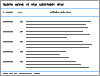
表1
3株NoV毒株全基因组序列各区域分布情况(nt)
| 序列区域 | NR18 | NR61 | NR246 |
|---|---|---|---|
| 全长 | 7 641 | 7 784 | 7 567 |
| ORF1 | 1~5 319 | 1~5 371 | 1~5 095 |
| ORF2 | 5 306~6 940 | 5 355~6 995 | 5 079~6 731 |
| ORF3 | 6 940~7 566 | 6 995~7 630 | 6 731~7 510 |
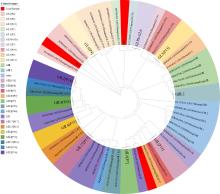
图1
基于NoV毒株全基因组的系统进化树 注:序列MW243610.2实际分离于陕西省,系统注释显示的Beijing为序列提交所在地,并非样本采集地。

表2
3株NoV毒株与其参考序列在ORF1、ORF2、ORF3区的核苷酸同源性(%)
| 毒株 | LC122690.1 | MW243610.2 | PV640830.1 | NR18 | NR246 | NR61 | ||||||||||||||||||
|---|---|---|---|---|---|---|---|---|---|---|---|---|---|---|---|---|---|---|---|---|---|---|---|---|
| ORF1 | ORF2 | ORF3 | ORF1 | ORF2 | ORF3 | ORF1 | ORF2 | ORF3 | ORF1 | ORF2 | ORF3 | ORF1 | ORF2 | ORF3 | ORF1 | ORF2 | ORF3 | |||||||
| LC122690.1 | 100.0 | 100.0 | 100.0 | 37.9 | 36.9 | 32.6 | 70.5 | 67.2 | 62.1 | 70.5 | 67.1 | 62.2 | 38.3 | 37.0 | 32.5 | 98.7 | 98.2 | 98.7 | ||||||
| MW243610 | 37.9 | 36.9 | 32.6 | 100.0 | 100.0 | 100.0 | 38.1 | 38.0 | 30.3 | 38.2 | 37.9 | 30.0 | 98.7 | 98.9 | 95.3 | 38.0 | 36.7 | 32.7 | ||||||
| PV640830.1 | 70.5 | 67.2 | 62.1 | 38.1 | 38.0 | 30.3 | 100.0 | 100.0 | 100.0 | 99.7 | 99.3 | 99.6 | 38.2 | 38.0 | 31.6 | 70.3 | 67.3 | 62.4 | ||||||
| NR18 | 70.5 | 67.1 | 62.2 | 38.2 | 37.9 | 30.0 | 99.7 | 99.3 | 99.6 | 100.0 | 100.0 | 100.0 | 38.3 | 37.8 | 31.4 | 70.3 | 67.3 | 62.5 | ||||||
| NR246 | 38.3 | 37.0 | 32.5 | 98.7 | 98.9 | 95.3 | 38.2 | 38.0 | 31.6 | 38.3 | 37.8 | 31.4 | 100.0 | 100.0 | 100.0 | 38.3 | 36.8 | 32.6 | ||||||
| NR61 | 98.7 | 98.2 | 98.7 | 38.0 | 36.7 | 32.7 | 70.3 | 67.3 | 62.4 | 70.3 | 67.3 | 62.5 | 38.3 | 36.8 | 32.6 | 100.0 | 100.0 | 100.0 | ||||||
表3
3株NoV毒株与其参考序列在VP1、VP2区的氨基酸同源性(%)
| 毒株 | LC122690.1 | MW243610.2 | PV640830.1 | NR18 | NR246 | NR61 | ||||||||||||
|---|---|---|---|---|---|---|---|---|---|---|---|---|---|---|---|---|---|---|
| VP1 | VP2 | VP1 | VP2 | VP1 | VP2 | VP1 | VP2 | VP1 | VP2 | VP1 | VP2 | |||||||
| LC122690.1 | 100.0 | 100.0 | 12.9 | 11.8 | 51.5 | 51.5 | 51.2 | 52.0 | 13.1 | 11.6 | 96.3 | 97.5 | ||||||
| MW243610 | 12.9 | 11.8 | 100.0 | 100.0 | 12.4 | 10.4 | 12.2 | 10.0 | 97.9 | 93.5 | 12.4 | 11.5 | ||||||
| PV640830.1 | 51.5 | 51.5 | 12.4 | 10.4 | 100.0 | 100.0 | 98.8 | 99.5 | 12.6 | 11.4 | 52.2 | 52.0 | ||||||
| NR18 | 51.2 | 52.0 | 12.2 | 10.0 | 98.8 | 99.5 | 100.0 | 100.0 | 12.4 | 11.0 | 51.9 | 52.5 | ||||||
| NR246 | 13.1 | 11.6 | 97.9 | 93.5 | 12.6 | 11.4 | 12.4 | 11.0 | 100.0 | 100.0 | 12.6 | 11.2 | ||||||
| NR61 | 96.3 | 97.5 | 12.4 | 11.5 | 52.2 | 52.0 | 51.9 | 52.5 | 12.6 | 11.2 | 100.0 | 100.0 | ||||||
表4
NR18毒株与其参考序列在VP1、VP2区的氨基酸突变
| 突变位点 | 140 | 244 | 250 | 291 | 362 | 403 | 425 | 506 | 111* |
|---|---|---|---|---|---|---|---|---|---|
| NR18 | C | P | V | P | S | A | S | ||
| PV640830.1 | S | Q | S | I | S | P | Q | T | F |
表5
NR61毒株与其参考序列在VP1、VP2区的氨基酸突变
| 突变位点 | 52 | 64 | 79 | 86 | 125 | 136 | 141 | 157 | 194 | 203 | 205 | 210 | 226 | 229 | 249 | 254 | 291 | 294 | 295 | 331 | 332 | 364 | 398 | 406 | 411 | 496 | 517 | 81* | 100* | 125* | 129* | 152* | 160* | 168* | 175* |
|---|---|---|---|---|---|---|---|---|---|---|---|---|---|---|---|---|---|---|---|---|---|---|---|---|---|---|---|---|---|---|---|---|---|---|---|
| NR61 | F | I | T | I | P | S | Q | V | S | A | T | F | P | L | L | V | I | L | I | I | S | G | T | C | L | I | P | D | R | V | T | S | C | P | |
| LC122690.1 | S | T | I | T | L | F | L | A | L | V | I | S | L | P | P | W | A | T | S | T | T | L | D | I | Y | P | T | L | G | C | G | I | F | Y | L |
表6
NR246毒株与其参考序列在VP1、VP2区的氨基酸突变
| 突变位点 | 16 | 31 | 105 | 109 | 144 | 152 | 176 | 294 | 312 | 317 | 352 | 366 | 409 | 419 | 451 | 42* | 92* | 152* | 178* | 216* | 230* | 246* | 259* |
|---|---|---|---|---|---|---|---|---|---|---|---|---|---|---|---|---|---|---|---|---|---|---|---|
| NR246 | N | V | W | A | S | G | A | R | Q | G | I | Q | L | P | K | A | K | A | T | ||||
| MW243610.2 | S | A | C | V | L | V | V | Q | R | D | T | R | W | S | L | K | R | V | Q | V | A | E |
| [1] |
Bartsch SM, Lopman BA, Ozawa S, et al. Global economic burden of norovirus gastroenteritis[J]. PLoS One, 2016, 11(4):e0151219.
doi: 10.1371/journal.pone.0151219 URL |
| [2] |
Zhou HL, Zhen SS, Wang JX, et al. Burden of acute gastroenteritis caused by norovirus in China: a systematic review[J]. J Infect, 2017, 75(3):216-224.
doi: 10.1016/j.jinf.2017.06.004 URL |
| [3] |
Teunis PFM, Moe CL, Liu PB, et al. Norwalk virus: How infectious is it?[J]. J Med Virol, 2008, 80(8):1468-1476.
doi: 10.1002/jmv.21237 pmid: 18551613 |
| [4] |
Belliot G, Sosnovtsev SV, Mitra T, et al. In vitro proteolytic processing of the MD145 norovirus ORF1 nonstructural polyprotein yields stable precursors and products similar to those detected in Calicivirus-infected cells[J]. J Virol, 2003, 77(20):10957-10974.
pmid: 14512545 |
| [5] |
Arias A, Emmott E, Vashist S, et al. Progress towards the prevention and treatment of norovirus infections[J]. Future Microbiol, 2013, 8(11):1475-1487.
doi: 10.2217/fmb.13.109 pmid: 24199805 |
| [6] |
Green KY, Belliot G, Taylor JL, et al. A predominant role for Norwalk-like viruses as agents of epidemic gastroenteritis in Maryland nursing homes for the elderly[J]. J Infect Dis, 2002, 185(2):133-146.
pmid: 11807686 |
| [7] |
Conley MJ, McElwee M, Azmi L, et al. Calicivirus VP2 forms a portal-like assembly following receptor engagement[J]. Nature, 2019, 565(7739):377-381.
doi: 10.1038/s41586-018-0852-1 |
| [8] |
Kroneman A, Vega E, Vennema H, et al. Proposal for a unified norovirus nomenclature and genotyping[J]. Arch Virol, 2013, 158(10):2059-2068.
doi: 10.1007/s00705-013-1708-5 pmid: 23615870 |
| [9] |
Chhabra P, de Graaf M, Parra GI, et al. Updated classification of norovirus genogroups and genotypes[J]. J Gen Virol, 2019, 100(10):1393-1406.
doi: 10.1099/jgv.0.001318 pmid: 31483239 |
| [10] |
Lopman B, Gastañaduy P, Park GW, et al. Environmental transmission of norovirus gastroenteritis[J]. Curr Opin Virol, 2012, 2(1):96-102.
doi: 10.1016/j.coviro.2011.11.005 pmid: 22440972 |
| [11] |
Kendra JA, Tohma K, Parra GI. Global and regional circulation trends of norovirus genotypes and recombinants, 1995-2019: a comprehensive review of sequences from public databases[J]. Rev Med Virol, 2022, 32(5):e2354.
doi: 10.1002/rmv.v32.5 URL |
| [12] |
Eden JS, Tanaka MM, Boni MF, et al. Recombination within the pandemic norovirus GⅡ.4 lineage[J]. J Virol, 2013, 87(11):6270-6282.
doi: 10.1128/JVI.03464-12 URL |
| [13] |
Ahmed SM, Hall AJ, Robinson AE, et al. Global prevalence of norovirus in cases of gastroenteritis: a systematic review and meta-analysis[J]. Lancet Infect Dis, 2014, 14(8):725-730.
doi: S1473-3099(14)70767-4 pmid: 24981041 |
| [14] |
Lindsay L, Wolter J, de Coster I, et al. A decade of norovirus disease risk among older adults in upper-middle and high income countries: a systematic review[J]. BMC Infect Dis, 2015, 15:425.
doi: 10.1186/s12879-015-1168-5 pmid: 26467099 |
| [15] |
Hong XJ, Xue L, Cao YW, et al. The variation of antigenic and histo-blood group binding sites synergistically drive the evolution among chronologically emerging GⅡ.4 noroviruses[J]. Heliyon, 2024, 10(5):e26567.
doi: 10.1016/j.heliyon.2024.e26567 URL |
| [16] |
Karst SM, Baric RS. What is the reservoir of emergent human norovirus strains?[J]. J Virol, 2015, 89(11):5756-5759.
doi: 10.1128/JVI.03063-14 pmid: 25787285 |
| [17] | 史永林, 傅荔艳, 金晶, 等. 2020—2021年安徽省急性胃肠炎疫情中GⅠ组诺如病毒基因型多样性分析[J]. 国际病毒学杂志, 2022, 29(2):103-108. |
| [18] |
Hu XY, Sun LL, Han TL, et al. The genetic diversity of genogroup Ⅰ noroviruses causing acute gastroenteritis outbreaks in Beijing between 2014 and 2023[J]. Heliyon, 2024, 10(20):e39202.
doi: 10.1016/j.heliyon.2024.e39202 URL |
| [19] |
Arana A, Cilla G, Montes M, et al. Genotypes, recombinant forms, and variants of norovirus GⅡ.4 in Gipuzkoa (Basque Country, Spain), 2009-2012[J]. PLoS One, 2014, 9(6):e98875.
doi: 10.1371/journal.pone.0098875 URL |
| [20] |
Lim KL, Hewitt J, Sitabkhan A, et al. A multi-site study of norovirus molecular epidemiology in Australia and New Zealand, 2013-2014[J]. PLoS One, 2016, 11(4):e0145254.
doi: 10.1371/journal.pone.0145254 URL |
| [21] | Yu YX, Yan SL, Li BL, et al. Genetic diversity and distribution of human norovirus in China (1999-2011)[J]. BioMed Res Int, 2014, 2014:196169. |
| [22] | Dong XG, Qin M, Wang ZE, et al. Should we pay attention to recombinant norovirus strain GⅡ.P7/GⅡ.6?[J]. J Infect Public Heal, 2019, 12(3):403-409. |
| [23] | 王越, 郎兴莹, 于蕾, 等. 2020—2023年大连地区诺如病毒胃肠炎疫情分子流行特征分析[J]. 病毒学报, 2024, 40(4):857-861. |
| [24] | 陶璐秋, 王璇, 余艳, 等. 2019—2022年南京市急性胃肠炎暴发疫情中诺如病毒分子流行病学分析[J]. 病毒学报, 2023, 39(5):1272-1284. |
| [25] | 纪蕾, 刘光涛, 沈月华, 等. 2013—2019年浙江省湖州市急性胃肠炎病例GⅡ.P7-GⅡ.6型诺如病毒基因特征分析[J]. 疾病监测, 2021, 36(1):53-58. |
| [26] |
Allen DJ, Gray JJ, Gallimore CI, et al. Analysis of amino acid variation in the P2 domain of the GⅡ-4 norovirus VP1 protein reveals putative variant-specific epitopes[J]. PLoS One, 2008, 3(1):e1485.
doi: 10.1371/journal.pone.0001485 URL |
| [27] |
Tan M, Jiang X. The P domain of norovirus capsid protein forms a subviral particle that binds to histo-blood group antigen receptors[J]. J Virol, 2005, 79(22):14017-14030.
doi: 10.1128/JVI.79.22.14017-14030.2005 pmid: 16254337 |
| [28] |
Izquierdo-Lara RW, Villabruna N, Hesselink DA, et al. Patterns of the within-host evolution of human norovirus in immunocompromised individuals and implications for treatment[J]. eBioMedicine, 2024, 109:105391.
doi: 10.1016/j.ebiom.2024.105391 URL |
| [29] |
Lindesmith LC, Beltramello M, Donaldson EF, et al. Immunogenetic mechanisms driving norovirus GⅡ.4 antigenic variation[J]. PLoS Pathog, 2012, 8(5):e1002705.
doi: 10.1371/journal.ppat.1002705 URL |
| [30] |
Bull RA, Hansman GS, Clancy LE, et al. Norovirus recombination in ORF1/ORF2 overlap[J]. Emerg Infect Dis, 2005, 11(7):1079-1085.
pmid: 16022784 |
| [1] | 杜彦历, 刘雅琼, 周兴余, 袁珩. 2019—2023年四川省其他感染性腹泻流行特征及病原谱分析[J]. 热带病与寄生虫学, 2026, 24(1): 7-12. |
| [2] | 郑尔达, 贾豫晨, 刘思娴, 沈秀莲, 黄甜, 何继波, 刘慧慧. 云南省诺如病毒感染流行特征与趋势预测[J]. 热带病与寄生虫学, 2025, 23(4): 222-228. |
| [3] | 李金松. 我国病毒性腹泻防控的策略、现状与挑战[J]. 热带病与寄生虫学, 2023, 21(2): 61-64. |
| [4] | 崔栋, 肖娜, 钟冠南, 杨晓华, 顾嘉颖, 洪文腾. 深圳市盐田区人群肠道病毒及常见感染性腹泻病毒调查分析[J]. 热带病与寄生虫学, 2021, 19(6): 322-324,353. |
| [5] | 贺宏斌. 核酸适配体在病原生物学中的应用研究进展[J]. 热带病与寄生虫学, 2019, 17(3): 176-180. |
| [6] | 刘晶晶,孙忠贤,胡俊忠,李忠平,杨浩. 张家界市某酒店因二次供水污染导致的诺如病毒感染性腹泻暴发疫情的调查[J]. 热带病与寄生虫学, 2018, 16(4): 191-. |
| 阅读次数 | ||||||
|
全文 |
|
|||||
|
摘要 |
|
|||||
