
热带病与寄生虫学 ›› 2026, Vol. 24 ›› Issue (4): 220-224.doi: 10.20199/j.issn.1672-2302.2026.04.006
段红菊1,2( ), 杨聪1, 王健3, 马学平1, 吴向林1, 马涛4()
收稿日期:2026-04-13
出版日期:2026-08-20
发布日期:2026-09-29
通信作者:
马涛,E-mail: mwt_1985@163.com
作者简介:段红菊,女,硕士,副主任医师,研究方向:传染病预防与控制。E-mail: 基金资助:
DUAN Hongju1,2(), YANG Cong1, WANG Jian3, MA Xueping1, WU Xianglin1, MA Tao4()
Received:2026-04-13
Online:2026-08-20
Published:2026-09-29
Contact:
MA Tao, E-mail: mwt_1985@163.com
摘要:
目的 分析我国人间炭疽发病的季节性特征,为科学防控炭疽提供理论依据。方法 通过中国公共卫生科学数据中心和国家疾病预防控制局收集并整理2010—2024年我国报告的人间炭疽发病数据,运用季节指数、集中度与圆形分布法分析炭疽发病的季节性,并对集中度M值和圆形分布集中趋势γ值进行相关性分析。结果 2010—2024年,我国累计报告人间炭疽病例4 817例,死亡35例;报告发病率为0.014/10万~0.034/10万,年均报告发病率为0.023/10万。季节指数分析表明7—10月为我国人间炭疽的流行季,8月为发病高峰。集中度法分析表明我国人间炭疽疫情整体M值为0.419,提示炭疽发病总体“有一定的季节性”,其中2011年和2021年为“有明显的季节性”(M=0.524、0.503),2013年为“季节性不明显/较弱”(M=0.230),其他年份均为“有一定的季节性”(M值为0.337~0.479)。圆形分布法分析结果显示,我国人间炭疽总体的发病高峰日为8月25日,高峰日整体呈现向后推移趋势;总体的发病高峰期为6月9日—11月10日,历年发病高峰期分布于5—12月。集中度M值和圆形分布集中趋势γ值呈高度正相关(r=1.000,P<0.001)。结论 我国人间炭疽发病具有一定的季节性特征,发病高峰集中于夏秋季。建议在发病高峰季来临前及期间,强化跨部门协作、高危人群健康教育和动物疫情监测,以有效降低炭疽疾病负担。
中图分类号:
段红菊, 杨聪, 王健, 马学平, 吴向林, 马涛. 2010—2024年我国人间炭疽发病季节性特征分析[J]. 热带病与寄生虫学, 2026, 24(4): 220-224.
DUAN Hongju, YANG Cong, WANG Jian, MA Xueping, WU Xianglin, MA Tao. The seasonal characteristics of human anthrax incidence in China, 2010-2024[J]. Journal of Tropical Diseases and Parasitology, 2026, 24(4): 220-224.
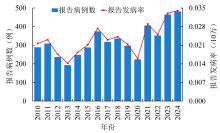
图1
2010—2024年我国人间炭疽发病情况
表1
2010—2024年我国各月份人间炭疽发病的季节指数
| 月 份 | 2010 年 | 2011 年 | 2012 年 | 2013 年 | 2014 年 | 2015 年 | 2016 年 | 2017 年 | 2018 年 | 2019 年 | 2020 年 | 2021 年 | 2022 年 | 2023 年 | 2024 年 | 平均 |
|---|---|---|---|---|---|---|---|---|---|---|---|---|---|---|---|---|
| 1 | 0.374 | 0.194 | 0.405 | 0.622 | 0.532 | 0.208 | 0.449 | 0.604 | 0.357 | 0.242 | 0.482 | 0.473 | 0.341 | 0.490 | 0.175 | 0.386 |
| 2 | 0.291 | 0.272 | 0.304 | 0.311 | 0.532 | 0.333 | 0.353 | 0.377 | 0.357 | 0.444 | 0.321 | 0.296 | 0.307 | 0.310 | 0.424 | 0.349 |
| 3 | 0.457 | 0.272 | 0.405 | 0.933 | 0.484 | 0.208 | 0.385 | 0.264 | 0.393 | 0.485 | 0.375 | 0.266 | 0.511 | 0.516 | 0.748 | 0.446 |
| 4 | 0.913 | 0.583 | 0.658 | 0.808 | 0.629 | 0.458 | 0.545 | 0.415 | 0.857 | 0.566 | 0.964 | 0.562 | 0.750 | 0.490 | 0.499 | 0.625 |
| 5 | 1.080 | 0.854 | 0.861 | 1.244 | 0.871 | 0.958 | 0.417 | 0.679 | 0.429 | 0.646 | 0.804 | 0.414 | 0.648 | 0.645 | 0.524 | 0.695 |
| 6 | 1.080 | 1.087 | 1.519 | 0.933 | 0.726 | 0.708 | 1.251 | 0.906 | 1.036 | 1.455 | 0.857 | 0.739 | 0.989 | 0.800 | 1.023 | 0.999 |
| 7 | 2.035 | 2.136 | 2.228 | 1.679 | 2.226 | 1.542 | 2.374 | 1.887 | 1.393 | 1.737 | 0.857 | 1.951 | 2.182 | 1.316 | 1.397 | 1.786 |
| 8 | 2.657 | 3.301 | 2.127 | 1.057 | 2.081 | 2.625 | 3.209 | 2.943 | 3.536 | 2.869 | 2.732 | 3.399 | 2.489 | 3.174 | 2.270 | 2.778 |
| 9 | 1.121 | 1.243 | 1.114 | 1.430 | 1.452 | 1.750 | 1.155 | 1.094 | 1.357 | 1.131 | 1.714 | 1.714 | 1.432 | 1.574 | 2.245 | 1.470 |
| 10 | 1.080 | 1.204 | 1.063 | 1.554 | 1.016 | 1.167 | 0.738 | 1.132 | 1.357 | 0.970 | 1.018 | 1.123 | 1.193 | 1.213 | 1.497 | 1.161 |
| 11 | 0.415 | 0.466 | 0.759 | 1.057 | 0.871 | 1.000 | 0.674 | 0.981 | 0.429 | 1.172 | 1.125 | 0.532 | 0.784 | 0.929 | 0.599 | 0.762 |
| 12 | 0.498 | 0.388 | 0.557 | 0.373 | 0.581 | 1.042 | 0.449 | 0.717 | 0.500 | 0.283 | 0.750 | 0.532 | 0.375 | 0.542 | 0.599 | 0.543 |
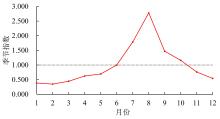
图2
2010—2024年我国人间炭疽发病的平均季节指数
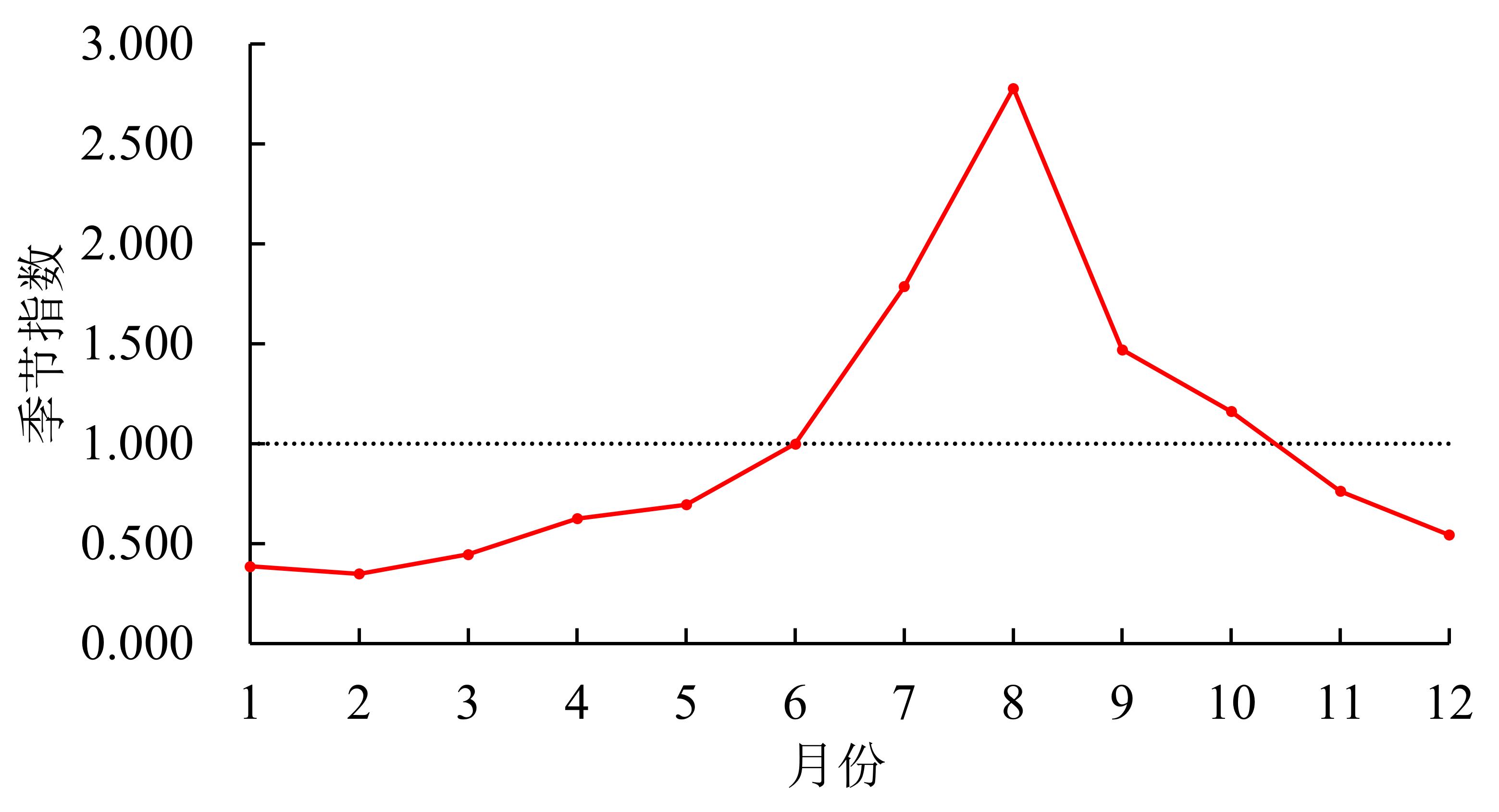
图3
2010—2024年我国人间炭疽发病月份分布雷达图
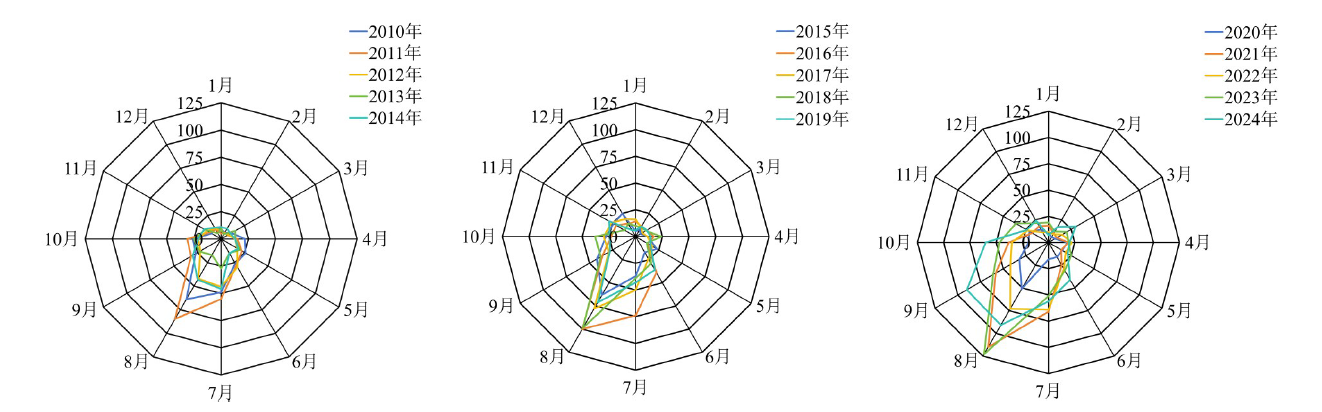
表2
2010—2024年我国人间炭疽集中度分析结果
| 月 份 | 2010 年 | 2011 年 | 2012 年 | 2013 年 | 2014 年 | 2015 年 | 2016 年 | 2017 年 | 2018 年 | 2019 年 | 2020 年 | 2021 年 | 2022 年 | 2023 年 | 2024 年 |
|---|---|---|---|---|---|---|---|---|---|---|---|---|---|---|---|
| 1 | 0.031 | 0.016 | 0.034 | 0.052 | 0.044 | 0.017 | 0.037 | 0.050 | 0.030 | 0.020 | 0.040 | 0.039 | 0.028 | 0.041 | 0.015 |
| 2 | 0.024 | 0.023 | 0.025 | 0.026 | 0.044 | 0.028 | 0.029 | 0.031 | 0.030 | 0.037 | 0.027 | 0.025 | 0.026 | 0.026 | 0.035 |
| 3 | 0.038 | 0.023 | 0.034 | 0.078 | 0.040 | 0.017 | 0.032 | 0.022 | 0.033 | 0.040 | 0.031 | 0.022 | 0.043 | 0.043 | 0.062 |
| 4 | 0.076 | 0.049 | 0.055 | 0.067 | 0.052 | 0.038 | 0.045 | 0.035 | 0.071 | 0.047 | 0.080 | 0.047 | 0.063 | 0.041 | 0.042 |
| 5 | 0.090 | 0.071 | 0.072 | 0.104 | 0.073 | 0.080 | 0.035 | 0.057 | 0.036 | 0.054 | 0.067 | 0.034 | 0.054 | 0.054 | 0.044 |
| 6 | 0.090 | 0.091 | 0.127 | 0.078 | 0.060 | 0.059 | 0.104 | 0.075 | 0.086 | 0.121 | 0.071 | 0.062 | 0.082 | 0.067 | 0.085 |
| 7 | 0.170 | 0.178 | 0.186 | 0.140 | 0.185 | 0.128 | 0.198 | 0.157 | 0.116 | 0.145 | 0.071 | 0.163 | 0.182 | 0.110 | 0.116 |
| 8 | 0.221 | 0.275 | 0.177 | 0.088 | 0.173 | 0.219 | 0.267 | 0.245 | 0.295 | 0.239 | 0.228 | 0.283 | 0.207 | 0.265 | 0.189 |
| 9 | 0.093 | 0.104 | 0.093 | 0.119 | 0.121 | 0.146 | 0.096 | 0.091 | 0.113 | 0.094 | 0.143 | 0.143 | 0.119 | 0.131 | 0.187 |
| 10 | 0.090 | 0.100 | 0.089 | 0.130 | 0.085 | 0.097 | 0.061 | 0.094 | 0.113 | 0.081 | 0.085 | 0.094 | 0.099 | 0.101 | 0.125 |
| 11 | 0.035 | 0.039 | 0.063 | 0.088 | 0.073 | 0.083 | 0.056 | 0.082 | 0.036 | 0.098 | 0.094 | 0.044 | 0.065 | 0.077 | 0.050 |
| 12 | 0.042 | 0.032 | 0.046 | 0.031 | 0.048 | 0.087 | 0.037 | 0.060 | 0.042 | 0.024 | 0.063 | 0.044 | 0.031 | 0.045 | 0.050 |
| Rx值 | -0.088 | -0.191 | -0.113 | -0.092 | -0.161 | -0.283 | -0.176 | -0.241 | -0.221 | -0.170 | -0.220 | -0.281 | -0.179 | -0.266 | -0.256 |
| Ry值 | -0.407 | -0.488 | -0.387 | -0.211 | -0.304 | -0.315 | -0.446 | -0.328 | -0.395 | -0.389 | -0.255 | -0.417 | -0.388 | -0.326 | -0.325 |
| M值 | 0.416 | 0.524 | 0.403 | 0.230 | 0.344 | 0.423 | 0.479 | 0.407 | 0.452 | 0.425 | 0.337 | 0.503 | 0.427 | 0.421 | 0.414 |
表3
2010—2024年我国人间炭疽发病高峰日和高峰期
| 年份 | s(°) | 高峰日 | 高峰期 | γ值 | Z值 | P值 | 持续时间(d) | |
|---|---|---|---|---|---|---|---|---|
| 2010 | 208.75 | 76.35 | 8月1日 | 5月15日—10月17日 | 0.412 | 48.958 | <0.001 | 155 |
| 2011 | 221.49 | 65.57 | 8月14日 | 6月8日—10月19日 | 0.520 | 83.414 | <0.001 | 133 |
| 2012 | 214.02 | 77.73 | 8月5日 | 5月18日—10月23日 | 0.398 | 37.624 | <0.001 | 158 |
| 2013 | 225.08 | 98.99 | 8月17日 | 5月9日—11月26日 | 0.225 | 9.752 | <0.001 | 201 |
| 2014 | 232.30 | 84.27 | 8月25日 | 5月31日—11月18日 | 0.339 | 28.510 | <0.001 | 171 |
| 2015 | 267.02 | 75.57 | 9月29日 | 7月14日—12月14日 | 0.419 | 50.561 | <0.001 | 153 |
| 2016 | 221.59 | 69.88 | 8月13日 | 6月3日—10月23日 | 0.475 | 84.504 | <0.001 | 142 |
| 2017 | 250.41 | 77.32 | 9月12日 | 6月25日—11月29日 | 0.402 | 51.471 | <0.001 | 157 |
| 2018 | 235.26 | 72.56 | 8月28日 | 6月15日—11月9日 | 0.449 | 67.589 | <0.001 | 147 |
| 2019 | 225.08 | 75.42 | 8月17日 | 6月2日—11月2日 | 0.421 | 52.522 | <0.001 | 153 |
| 2020 | 263.79 | 84.98 | 9月24日 | 6月30日—12月20日 | 0.333 | 24.828 | <0.001 | 172 |
| 2021 | 244.82 | 67.53 | 9月6日 | 6月30日—11月14日 | 0.499 | 101.234 | <0.001 | 137 |
| 2022 | 226.84 | 75.20 | 8月19日 | 6月4日—11月3日 | 0.423 | 62.868 | <0.001 | 153 |
| 2023 | 258.54 | 75.78 | 9月20日 | 7月5日—12月6日 | 0.417 | 80.855 | <0.001 | 154 |
| 2024 | 256.08 | 76.55 | 9月17日 | 7月1日—12月3日 | 0.410 | 80.719 | <0.001 | 155 |
| [1] |
Carlson CJ, Kracalik IT, Ross N, et al. The global distribution of Bacillus anthracis and associated anthrax risk to humans, livestock and wildlife[J]. Nat Microbiol, 2019, 4(8):1337-1343.
doi: 10.1038/s41564-019-0435-4 pmid: 31086311 |
| [2] | 钟惠澜. 热带医学[M]. 北京: 人民卫生出版社,1986:507. |
| [3] | 李歌, 孙雨, 李琦, 等. 炭疽病流行病学与防治技术研究进展[J]. 中国兽医卫生, 2025, 2(6):1-8. |
| [4] | 何达, 周凌云. 《炭疽诊疗方案(2023年版)》解读[J]. 中国抗生素杂志, 2024, 49(7):749-754. |
| [5] |
Ashique S, Biswas A, Mohanto S, et al. Anthrax: a narrative review[J]. New Microbes New Infect, 2024, 62:101501.
doi: 10.1016/j.nmni.2024.101501 URL |
| [6] |
Subedi D, Pantha S, Jyoti S, et al. Anthrax in humans, animals, and the environment and the One Health strategies for anthrax control[J]. Pathogens, 2024, 13(9):773.
doi: 10.3390/pathogens13090773 URL |
| [7] |
Zhang HJ, Zhang EM, He JR, et al. Genetic characteristics of Bacillus anthracis isolated from northwestern China from 1990 to 2016[J]. PLoS Negl Trop Dis, 2018, 12(11):e0006908.
doi: 10.1371/journal.pntd.0006908 URL |
| [8] | 李舒雯, 李致远, 闫肃, 等. 炭疽:疾病特征与“同一健康”防控策略[J]. 现代疾病预防控制, 2025, 36(11):801-807,811. |
| [9] | 张慧娟, 张恩民, 贺金荣, 等. 2005—2024年中国炭疽流行特征分析[J]. 中国预防医学杂志, 2025, 26(8):945-952. |
| [10] | 段红菊, 吴向林, 马天波, 等. 2004—2019年宁夏回族自治区人间布鲁氏菌病流行病学分析[J]. 中华地方病学杂志, 2022, 41(7):580-584. |
| [11] | 饶华祥, 石燕, 蔡芝锋, 等. 基于集中度和圆形分布法的青海省手足口病季节特征分析[J]. 中华疾病控制杂志, 2018, 22(4):345-348. |
| [12] | 耿浩翔, 储娜, 李明, 等. 2010—2023年安徽省发热伴血小板减少综合征季节性特征分析[J]. 热带病与寄生虫学, 2024, 22(5):262-266,288. |
| [13] | 高桂玲, 王超, 姚春霞. 基于集中度和圆形分布法的中国登革热季节性流行特征分析[J]. 热带病与寄生虫学, 2024, 22(4):208-211. |
| [14] | 王荣, 范习康, 吴洵, 等. 2006—2022年江苏省哨点医院道路交通伤害病例流行特征及变化趋势[J]. 中华疾病控制杂志, 2024, 28(10):1204-1211. |
| [15] |
Chen WJ, Lai SJ, Yang Y, et al. Mapping the distribution of anthrax in Chinese Mainland, 2005-2013[J]. PLoS Negl Trop Dis, 2016, 10(4):e0004637.
doi: 10.1371/journal.pntd.0004637 URL |
| [16] |
Luong T, Nguyen TD, Lu VT, et al. Spatial epidemiology of human anthrax in Son La province, Vietnam, 2003-2022[J]. Zoonoses Public Health, 2024, 71(4):392-401.
doi: 10.1111/zph.v71.4 URL |
| [17] | 刘东立, 朱妮, 马国柱, 等. 陕西省炭疽流行病学回顾性分析及防治对策探讨[J]. 中华疾病控制杂志, 2017, 21(1):52-55. |
| [18] |
Sangwan N, Gangwal A, Jain P, et al. Anthrax: transmission, pathogenesis, prevention and treatment[J]. Toxins, 2025, 17(2):56.
doi: 10.3390/toxins17020056 URL |
| [19] |
Ezhova E, Orlov D, Suhonen E, et al. Climatic factors influencing the Anthrax outbreak of 2016 in Siberia, Russia[J]. Ecohealth, 2021, 18(2):217-228.
doi: 10.1007/s10393-021-01549-5 pmid: 34453636 |
| [20] |
Savransky V, Ionin B, Reece J. Current status and trends in prophylaxis and management of anthrax disease[J]. Pathogens, 2020, 9(5):370.
doi: 10.3390/pathogens9050370 URL |
| [21] | 张芳蕾, 郑灿军, 吴洪涛, 等. 2004—2023年中国炭疽突发公共卫生事件流行特征分析[J]. 中华流行病学杂志, 2026, 47(5):874-880. |
| [22] | 张巾晖, 张慧娟, 周海健, 等. 2014—2024年中国炭疽流行特征及时空聚集性分析[J]. 中华流行病学杂志, 2025, 46(10):1795-1801. |
| [1] | 耿浩翔, 储娜, 李明, 储修杰, 孙永, 陈晴晴, 龚磊. 2010—2023年安徽省发热伴血小板减少综合征季节性特征分析[J]. 热带病与寄生虫学, 2024, 22(5): 262-266. |
| [2] | 高桂玲, 王超, 姚春霞. 基于集中度和圆形分布法的中国登革热季节性流行特征分析[J]. 热带病与寄生虫学, 2024, 22(4): 208-211. |
| [3] | 戴艳妮, 李青, 储修杰, 袁媛, 孙永, 龚磊. 2019—2023年安徽省肾综合征出血热流行特征与宿主动物监测分析[J]. 热带病与寄生虫学, 2024, 22(3): 152-156. |
| [4] | 余晚凤, 陶际春, 范冬青, 卜祥祥, 孙恩涛, 杨进孙, 王文节. 综合运用集中度与圆形分布法分析124例肾综合征出血热季节性分布特征[J]. 热带病与寄生虫学, 2022, 20(5): 260-263. |
| 阅读次数 | ||||||
|
全文 |
|
|||||
|
摘要 |
|
|||||
