
热带病与寄生虫学 ›› 2026, Vol. 24 ›› Issue (3): 135-141.doi: 10.20199/j.issn.1672-2302.2026.03.002
段仪雯1( ), 陈绅波1(), 陈军虎1,2, 沈海默1
收稿日期:2026-02-06
出版日期:2026-06-20
发布日期:2026-07-31
通信作者:
陈绅波,E-mail: 作者简介:段仪雯,女,硕士在读,研究方向:病原微生物。E-mail: 基金资助:
DUAN Yiwen1(), CHEN Shenbo1(), CHEN Junhu1,2, SHEN Haimo1
Received:2026-02-06
Online:2026-06-20
Published:2026-07-31
Contact:
CHEN Shenbo, E-mail: 摘要:
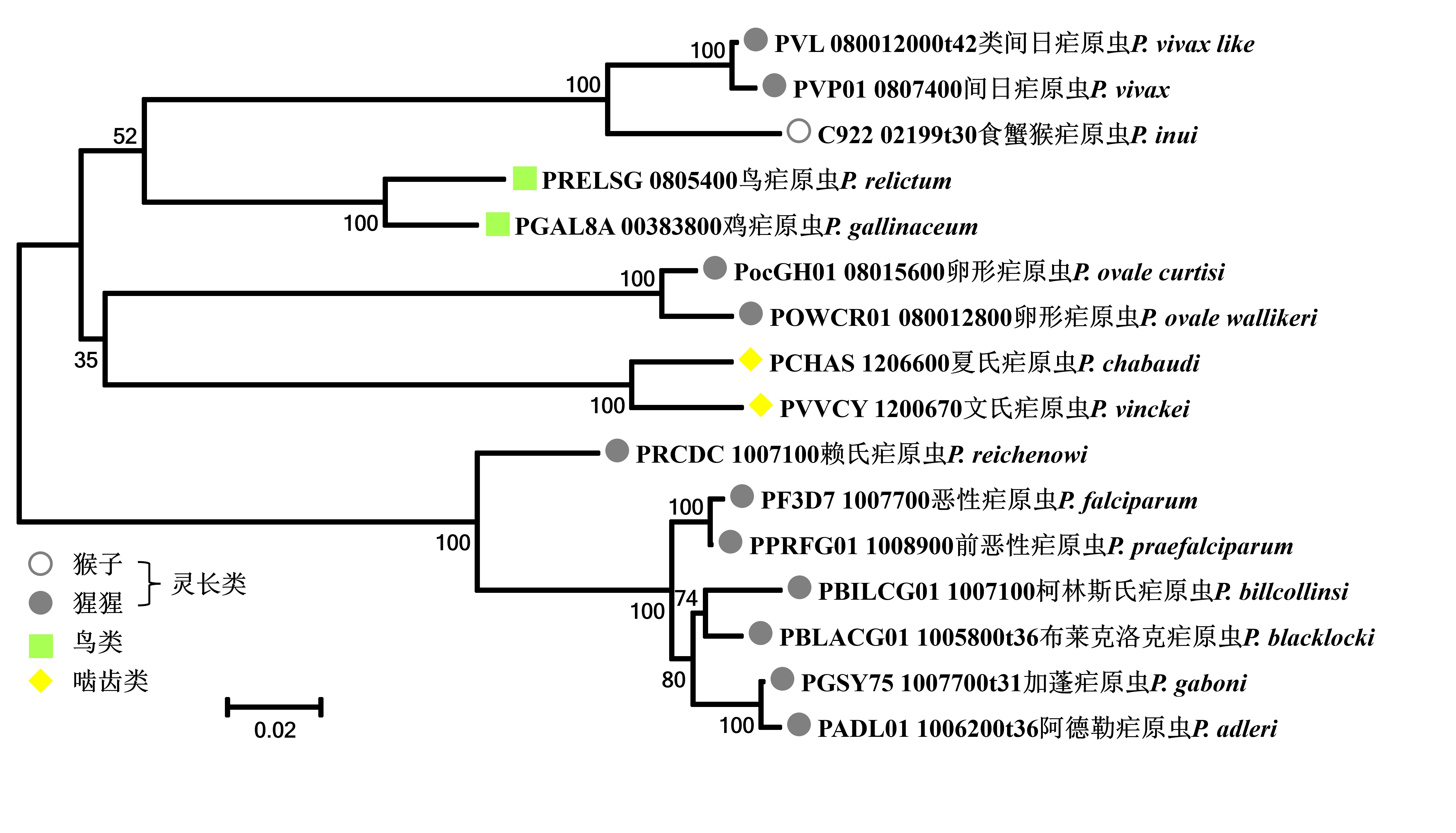
目的 分析恶性疟原虫PfAP2-I基因编码区在不同地理种群中的遗传多样性、群体分化、群体遗传结构及跨物种进化特征,为阐明其关键功能区的保守性和功能约束提供依据。方法 从PlasmoDB和Pf3k项目下载PfAP2-I参考基因及群体基因组数据,构建来自13个国家的PfAP2-I编码区参考基因序列数据集,采用MEGA、DnaSP、KaKs_Calculator、Arlequin、STRUCTURE和NETWORK等软件分析其遗传多样性、选择压力、群体分化、群体结构及单倍型网络,并基于直系同源基因构建跨物种系统发育树。结果 共纳入13个国家390条PfAP2-I基因编码区序列,编码区全长4 794 bp。各国样本单倍型数为5~18,其中孟加拉国样本最多(18个),缅甸最少(5个);单倍型多样性为0.506~0.943。核苷酸多样性整体较低,最大值为0.013,主要分布于非DNA结合结构域,而3个DNA结合结构域中未见明显多样性峰值。各国样本Tajima’s D值均小于0。大多数国家样本Ka/Ks值小于1。FST、单倍型网络和群体结构分析均显示,非洲与东南亚种群之间存在较明显分化。跨物种系统发育树显示,不同疟原虫物种AP2-I基因分支清晰,并呈现一定宿主相关聚类特征。结论 PfAP2-I基因编码区整体较为保守,关键DNA结合相关区域保守性更高,并存在一定地理分化特征,提示该基因可能受到较强功能约束。
中图分类号:
段仪雯, 陈绅波, 陈军虎, 沈海默. 恶性疟原虫PfAP2-I基因编码区遗传多态与种间进化研究[J]. 热带病与寄生虫学, 2026, 24(3): 135-141.
DUAN Yiwen, CHEN Shenbo, CHEN Junhu, SHEN Haimo. Genetic polymorphism and interspecific evolution of the PfAP2-I gene coding sequence in Plasmodium falciparum[J]. Journal of Tropical Diseases and Parasitology, 2026, 24(3): 135-141.

图1
PfAP2-I参考基因结构示意图 注:图中标示了ACDC结构域、3个DNA结合结构域、AThook和NLS在CDS中的相对位置。

表1
恶性疟原虫PfAP2-I基因CDS在13个国家的遗传多样性与自然选择
| 样本 来源 | 样本数(条) | K 值 | H 值 | Hd±SD 值 | S 值 | Sv 值 | Sp 值 | η 值 | π值 | Ka值 | Ks值 | Ka/Ks值 | P值 | Da值 | Db值 | Fc值 |
|---|---|---|---|---|---|---|---|---|---|---|---|---|---|---|---|---|
| 孟加拉国 | 30 | 3.092 | 18 | 0.943±0.027 | 13 | 0 | 13 | 13 | 0.000 64 | 0.000 69 | 0.000 32 | 2.185 | 0.167 86 | -0.191 | 1.497 | 1.137 |
| 柬埔寨 | 30 | 1.014 | 8 | 0.651±0.086 | 7 | 3 | 4 | 7 | 0.000 21 | 0.000 24 | 0.000 24 | 0.995 | 0.962 56 | -1.259 | -0.817 | -1.108 |
| 刚果(金) | 30 | 1.172 | 9 | 0.717±0.075 | 8 | 4 | 4 | 8 | 0.000 24 | 0.000 20 | 0.000 32 | 0.639 | 0.460 29 | -1.274 | -1.211 | -1.436 |
| 冈比亚 | 30 | 0.841 | 6 | 0.579±0.095 | 5 | 1 | 4 | 5 | 0.000 18 | 0.000 14 | 0.000 48 | 0.284 | 0.024 34 | -0.909 | 0.268 | -0.093 |
| 加纳 | 30 | 1.175 | 8 | 0.692±0.071 | 8 | 3 | 5 | 8 | 0.000 25 | 0.000 19 | 0.000 63 | 0.293 | 0.010 83 | -1.271 | -0.577 | -0.920 |
| 几内亚 | 30 | 1.862 | 12 | 0.798±0.068 | 16 | 12 | 4 | 16 | 0.000 39 | 0.000 38 | 0.000 44 | 0.871 | 0.613 09 | -1.830 | -2.927 | -3.030 |
| 老挝 | 30 | 2.011 | 14 | 0.853±0.056 | 14 | 5 | 9 | 14 | 0.000 42 | 0.000 44 | 0.000 24 | 1.847 | 0.458 83 | -1.438 | -0.559 | -0.978 |
| 马拉维 | 30 | 2.607 | 14 | 0.752±0.084 | 17 | 3 | 14 | 17 | 0.000 54 | 0.000 57 | 0.000 63 | 0.905 | 0.838 42 | -1.343 | 0.513 | -0.087 |
| 马里 | 30 | 1.168 | 9 | 0.662±0.089 | 8 | 4 | 4 | 8 | 0.000 24 | 0.000 20 | 0.000 48 | 0.426 | 0.080 62 | -1.281 | -1.211 | -1.439 |
| 缅甸 | 30 | 1.044 | 5 | 0.540±0.099 | 5 | 1 | 4 | 5 | 0.000 22 | 0.000 30 | 0 | 0.007 41 | -0.472 | 0.268 | 0.057 | |
| 塞内加尔 | 30 | 1.584 | 10 | 0.639±0.099 | 14 | 8 | 6 | 14 | 0.000 33 | 0.000 33 | 0.000 28 | 1.186 | 0.988 24 | -1.841 | -1.807 | -2.132 |
| 泰国 | 30 | 1.046 | 7 | 0.685±0.061 | 7 | 3 | 4 | 7 | 0.000 22 | 0.000 22 | 0.000 16 | 1.385 | 0.944 89 | -1.206 | -0.817 | -1.089 |
| 越南 | 30 | 0.768 | 6 | 0.506±0.106 | 7 | 4 | 3 | 7 | 0.000 16 | 0.000 15 | 0.000 24 | 0.639 | 0.354 75 | -1.671 | -1.513 | -1.820 |
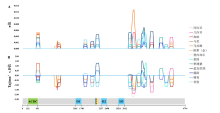
图2
恶性疟原虫PfAP2-I基因CDS在13个国家的核苷酸多样性与中性检验
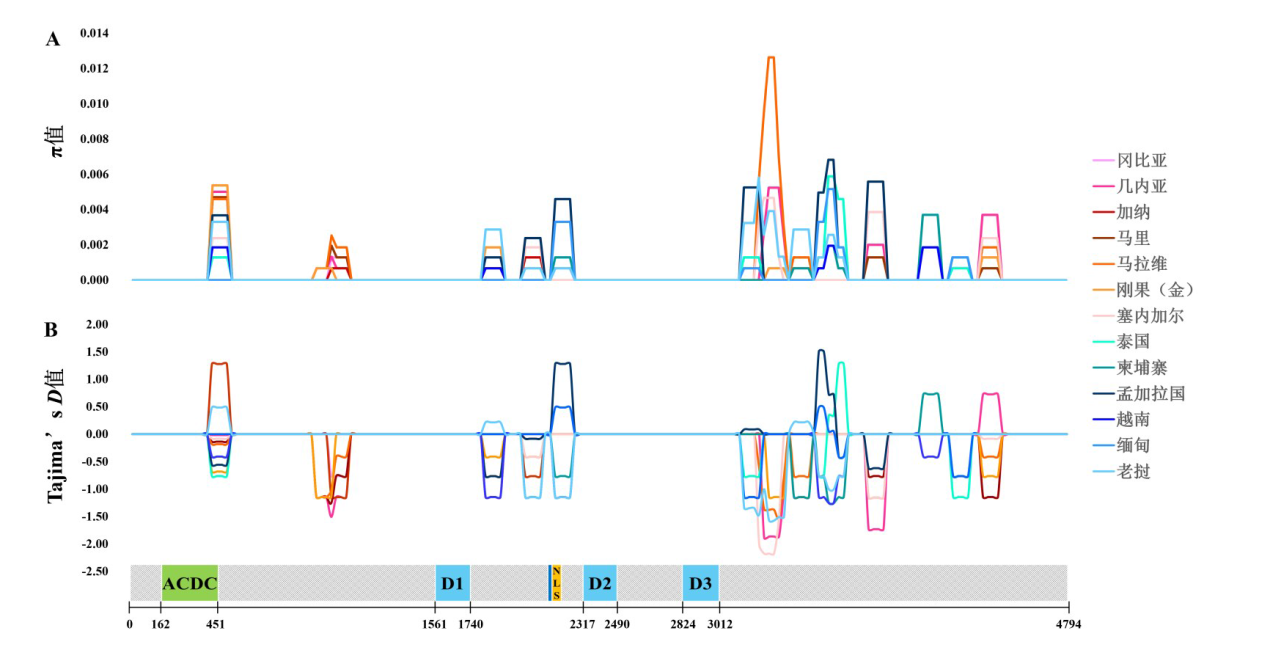
表2
恶性疟原虫PfAP2-I基因CDS在13个国家的群体分化检验
| 样本来源 | 冈比亚 | 几内亚 | 泰国 | 加纳 | 柬埔寨 | 马里 | 孟加拉国 | 马拉维 | 越南 | 缅甸 | 老挝 | 刚果(金) |
|---|---|---|---|---|---|---|---|---|---|---|---|---|
| 几内亚 | 0.0252 | |||||||||||
| 泰国 | 0.670 8 | 0.579 5 | ||||||||||
| 加纳 | 0.007 4 | 0.018 3 | 0.632 3 | |||||||||
| 柬埔寨 | 0.659 0 | 0.564 9 | 0.103 6 | 0.618 0 | ||||||||
| 马里 | -0.015 9 | 0.012 0 | 0.637 7 | -0.011 7 | 0.624 4 | |||||||
| 孟加拉国 | 0.300 4 | 0.268 6 | 0.123 3 | 0.274 9 | 0.117 7 | 0.284 2 | ||||||
| 马拉维 | 0.012 9 | 0.002 5 | 0.519 4 | 0.026 5 | 0.503 9 | 0.007 8 | 0.239 0 | |||||
| 越南 | 0.701 3 | 0.598 0 | 0.064 0 | 0.657 5 | -0.004 7 | 0.663 7 | 0.121 0 | 0.534 2 | ||||
| 缅甸 | 0.584 2 | 0.493 2 | 0.065 3 | 0.546 7 | 0.070 4 | 0.551 7 | 0.050 5 | 0.429 6 | 0.056 5 | |||
| 老挝 | 0.565 1 | 0.493 6 | 0.070 4 | 0.529 6 | 0.052 0 | 0.537 9 | 0.084 3 | 0.444 6 | 0.027 5 | 0.071 1 | ||
| 刚果(金) | -0.009 1 | 0.001 8 | 0.637 3 | 0.001 7 | 0.623 9 | -0.018 5 | 0.285 6 | 0.006 6 | 0.662 4 | 0.550 8 | 0.534 2 | |
| 塞内加尔 | 0.004 2 | 0.004 7 | 0.594 4 | 0.017 9 | 0.581 0 | 0.004 6 | 0.260 2 | 0.004 3 | 0.617 1 | 0.501 1 | 0.507 9 | 0.004 5 |
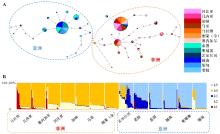
图3
恶性疟原虫PfAP2-I基因CDS的单倍型网络及群体遗传结构分析 注:A图为PfAP2-I基因CDS单倍型网络分析,图中蓝色圈内为亚洲簇,橙色圈内为非洲簇(混有少量的亚洲单倍型);B图为PfAP2-I基因CDS种群结构分析。
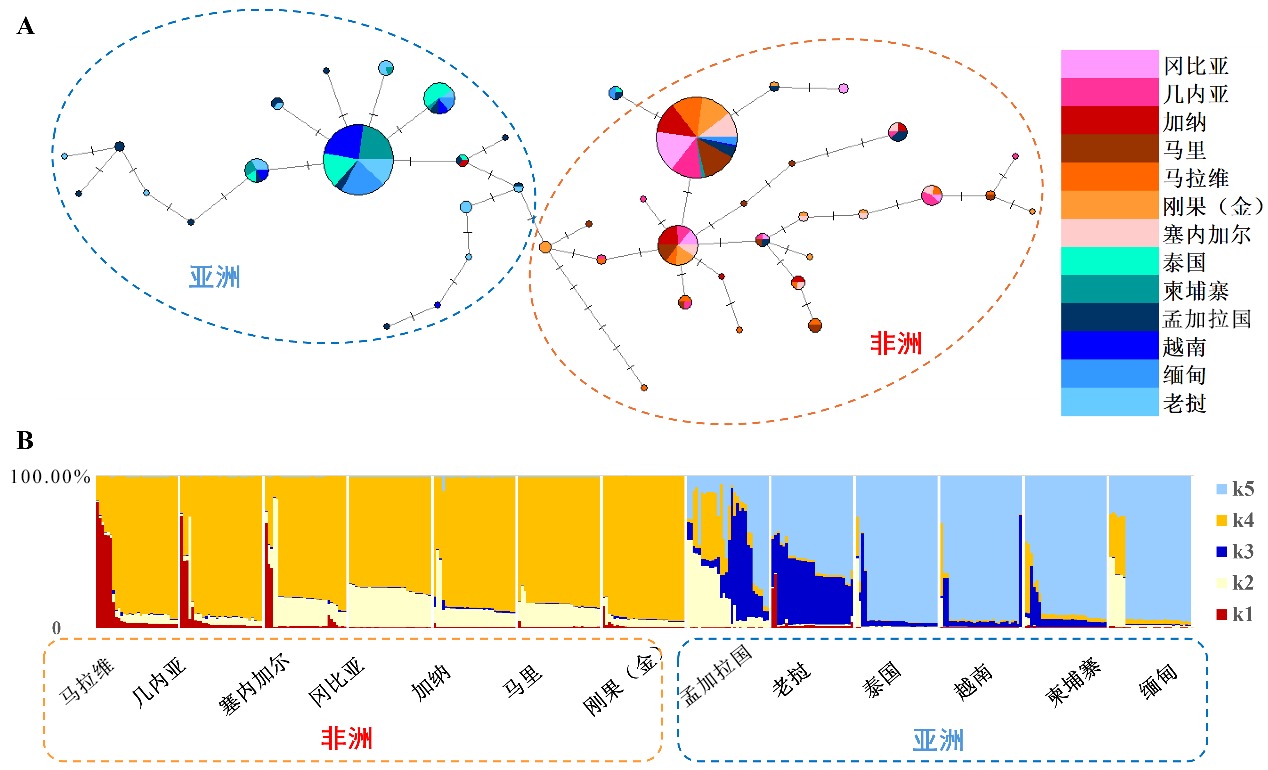
表3
恶性疟原虫PfAP2-I基因CDS跨物种系统发育分析所纳入的直系同源基因信息
| 序号 | 物种名称 | 参考株(系) | 基因编号 | 宿主类型 |
|---|---|---|---|---|
| 1 | P. falciparum | 3D7 | PF3D7_1007700 | 人类 |
| 2 | P. inui | San Antonio 1 | C922_02199t30 | 非人灵长类,猕猴为主 |
| 3 | P. adleri | G01 | PADL01_1006200t36 | 非人灵长类,大猩猩为主 |
| 4 | P. billcollinsi | G01 | PBILCG01_1007100 | 非人灵长类,黑猩猩为主 |
| 5 | P. blacklocki | G01 | PBLACG01_1005800t36 | 非人灵长类,大猩猩为主 |
| 6 | P. chabaudi | chabaudi | PCHAS_1206600 | 啮齿类 |
| 7 | P. gallinaceum | 8A | PGAL8A_00383800 | 鸟类 |
| 8 | P. gaboni | SY75 | PGSY75_1007700t31 | 非人灵长类,黑猩猩为主 |
| 9 | P. ovalecurtisi | GH01 | PocGH01_08015600 | 人类 |
| 10 | P. ovale wallikeri | CR01 | PowCR01_080012800 | 人类 |
| 11 | P. praefalciparum | G01 | PPRFG01_1008900 | 非人灵长类,大猩猩为主 |
| 12 | P. reichenowi | CDC | PRCDC_1007100 | 非人灵长类,黑猩猩为主 |
| 13 | P. relictum | SGS1 | PRELSG_0805400 | 鸟类 |
| 14 | P. vivaxlike | Pvl01 | PVL_080012000t42 | 非人灵长类 |
| 15 | P. vivax | P01 | PVP01_0807400 | 人类 |
| 16 | P. vinckei | CY | PVVCY_1200670 | 啮齿类 |
图4
PfAP2-I基因CDS种间遗传进化分析
| [1] |
Fikadu M, Ashenafi E. Malaria: an overview[J]. Infect Drug Resist, 2023, 16:3339-3347.
doi: 10.2147/IDR.S405668 pmid: 37274361 |
| [2] | Li QL, Liu T, Lv KY, et al. Malaria: past, present, and future[J]. Signal Transduct Target Ther, 2025, 10:188. |
| [3] |
Venkatesan P. WHO world malaria report 2024[J]. Lancet Microbe, 2025, 6(4):101073.
doi: 10.1016/j.lanmic.2025.101073 URL |
| [4] | Balmith M, Basson C, Brand SJ. The malaria burden: a South African perspective[J]. J Trop Med, 2024, 2024:6619010. |
| [5] |
Weiss DJ, Dzianach PA, Saddler A, et al. Mapping the global prevalence, incidence, and mortality of Plasmodium falciparum and Plasmodium vivax malaria, 2000-22: a spatial and temporal modelling study[J]. Lancet, 2025, 405(10483):979-990.
doi: 10.1016/S0140-6736(25)00038-8 URL |
| [6] | Tseha ST. Plasmodium species and drug resistance[M]. London: Intech Open, 2021. |
| [7] |
Cowman AF, Berry D, Baum J. The cellular and molecular basis for malaria parasite invasion of the human red blood cell[J]. J Cell Biol, 2012, 198(6):961-971.
doi: 10.1083/jcb.201206112 pmid: 22986493 |
| [8] |
Weiss GE, Gilson PR, Taechalertpaisarn T, et al. Revealing the sequence and resulting cellular morphology of receptor-ligand interactions during Plasmodium falciparum invasion of erythrocytes[J]. PLoS Pathog, 2015, 11(2):e1004670.
doi: 10.1371/journal.ppat.1004670 URL |
| [9] |
Modrzynska K, Pfander C, Chappell L, et al. A knockout screen of ApiAP2 genes reveals networks of interacting transcriptional regulators controlling the Plasmodium life cycle[J]. Cell Host Microbe, 2017, 21(1):11-22.
doi: S1931-3128(16)30514-5 pmid: 28081440 |
| [10] |
Balaji S, Babu MM, Iyer LM, et al. Discovery of the principal specific transcription factors of Api complexa and their implication for the evolution of the AP2-integrase DNA binding domains[J]. Nucleic Acids Res, 2005, 33(13):3994-4006.
pmid: 16040597 |
| [11] |
Le Berre M, Tubiana T, Reuterswärd Waldner P, et al. Structural characterization of the ACDC domain from ApiAP2 proteins, a potential molecular target against api complexan parasites[J]. Acta Crystallogr D Struct Biol, 2025, 81(Pt 1):38-48.
doi: 10.1107/S2059798324012518 URL |
| [12] |
Painter HJ, Campbell TL, Llinás M. The Api complexan AP2 family: integral factors regulating Plasmodium development[J]. Mol Biochem Parasitol, 2011, 176(1):1-7.
doi: 10.1016/j.molbiopara.2010.11.014 URL |
| [13] |
Tamura K, Stecher G, Peterson D, et al. MEGA6: molecular evolutionary genetics analysis version 6.0[J]. Mol Biol Evol, 2013, 30(12):2725-2729.
doi: 10.1093/molbev/mst197 pmid: 24132122 |
| [14] |
Rozas J, Ferrer-Mata A, Sánchez-DelBarrio JC, et al. DnaSP 6: DNA sequence polymorphism analysis of large data sets[J]. Mol Biol Evol, 2017, 34(12):3299-3302.
doi: 10.1093/molbev/msx248 pmid: 29029172 |
| [15] |
Nei M, Gojobori T. Simple methods for estimating the numbers of synonymous and nonsynonymous nucleotide substitutions[J]. Mol Biol Evol, 1986, 3(5):418-426.
doi: 10.1093/oxfordjournals.molbev.a040410 pmid: 3444411 |
| [16] |
Wang DP, Zhang YB, Zhang Z, et al. KaKs_Calculator 2.0: a toolkit incorporating gamma-series methods and sliding window strategies[J]. Genom Proteom Bioinform, 2010, 8(1):77-80.
doi: 10.1016/S1672-0229(10)60008-3 URL |
| [17] |
Yang Z, Nielsen R. Estimating synonymous and nonsynonymous substitution rates under realistic evolutionary models[J]. Mol Biol Evol, 2000, 17(1):32-43.
doi: 10.1093/oxfordjournals.molbev.a026236 pmid: 10666704 |
| [18] |
Excoffier L, Lischer HEL. Arlequin suite ver 3.5: a new series of programs to perform population genetics analyses under Linux and Windows[J]. Mol Ecol Resour, 2010, 10(3):564-567.
doi: 10.1111/j.1755-0998.2010.02847.x pmid: 21565059 |
| [19] |
Evanno G, Regnaut S, Goudet J. Detecting the number of clusters of individuals using the software STRUCTURE: a simulation study[J]. Mol Ecol, 2005, 14(8):2611-2620.
doi: 10.1111/j.1365-294X.2005.02553.x pmid: 15969739 |
| [20] |
Earl DA, VonHoldt BM. STRUCTURE HARVESTER: a website and program for visualizing STRUCTURE output and implementing the Evanno method[J]. Conserv Genet Resour, 2012, 4(2):359-361.
doi: 10.1007/s12686-011-9548-7 URL |
| [21] |
Bandelt HJ, Forster P, Röhl A. Median-joining networks for inferring intraspecific phylogenies[J]. Mol Biol Evol, 1999, 16(1):37-48.
doi: 10.1093/oxfordjournals.molbev.a026036 pmid: 10331250 |
| [22] |
Carrington E, Cooijmans RHM, Keller D, et al. The ApiAP2 factor PfAP2-HC is an integral component of heterochromatin in the malaria parasite Plasmodium falciparum[J]. iScience, 2021, 24(5):102444.
doi: 10.1016/j.isci.2021.102444 URL |
| [23] |
Campbell TL, De Silva EK, Olszewski KL, et al. Identification and genome-wide prediction of DNA binding specificities for the ApiAP2 family of regulators from the malaria parasite[J]. PLoS Pathog, 2010, 6(10):e1001165.
doi: 10.1371/journal.ppat.1001165 URL |
| [24] |
Russell TJ, De Silva EK, Crowley VM, et al. Inhibitors of ApiAP2 protein DNA binding exhibit multistage activity against Plasmodium parasites[J]. PLoS Pathog, 2022, 18(10):e1010887.
doi: 10.1371/journal.ppat.1010887 URL |
| [25] |
Shang XM, Wang CH, Fan YT, et al. Genome-wide landscape of ApiAP2 transcription factors reveals a heterochromatin-associated regulatory network during Plasmodium falciparum blood-stage development[J]. Nucleic Acids Res, 2022, 50(6):3413-3431.
doi: 10.1093/nar/gkac176 URL |
| [26] |
Subudhi AK, Green JL, Satyam R, et al. DNA-binding protein PfAP2-P regulates parasite pathogenesis during malaria parasite blood stages[J]. Nat Microbiol, 2023, 8(11):2154-2169.
doi: 10.1038/s41564-023-01497-6 pmid: 37884813 |
| [27] |
Jeninga MD, Quinn JE, Petter M. ApiAP2 transcription factors in api complexan parasites[J]. Pathogens, 2019, 8(2):47.
doi: 10.3390/pathogens8020047 URL |
| [28] |
郑雨昕, 张义伟, 姜宁. 恶性疟原虫ApiAP2蛋白质家族研究进展[J]. 畜牧兽医学报, 2022, 53(5):1354-1363.
doi: 10.11843/j.issn.0366-6964.2022.05.004 |
| [29] |
Pacheco MA, Matta NE, Valkiunas G, et al. Mode andrate of evolution of haemosporidian mitochondrial genomes: timing the radiation of avian parasites[J]. Mol Biol Evol, 2018, 35(2):383-403.
doi: 10.1093/molbev/msx285 URL |
| [30] | Alemneh T, Molla W, Abdela S, et al. Avian malaria: an in-depth overview on its biology, epidemiology, pathogenesis, clinical features, economic impacts, diagnostic, treatment and control strategies[J]. J Parasit Dis, 2025:1-40. |
| [31] |
Galinski MR. Systems biology of malaria explored with nonhuman Primates[J]. Malar J, 2022, 21(1):177.
doi: 10.1186/s12936-022-04199-2 |
| [32] |
De Niz M, Heussler VT. Rodent malaria models: insights into human disease and parasite biology[J]. Curr Opin Microbiol, 2018, 46:93-101.
doi: S1369-5274(17)30250-3 pmid: 30317152 |
| [33] |
Singhal R, Prata IO, Bonnell VA, et al. Unraveling the complexities of ApiAP2 regulation in Plasmodium falciparum[J]. Trends Parasitol, 2024, 40(11):987-999.
doi: 10.1016/j.pt.2024.09.007 pmid: 39419713 |
| [34] |
Smith JD, Gamain B, Baruch DI, et al. Decoding the language of var genes and Plasmodium falciparum sequestration[J]. Trends Parasitol, 2001, 17(11):538-545.
pmid: 11872399 |
| [35] |
Kraemer SM, Kyes SA, Aggarwal G, et al. Patterns of gene recombination shape var gene repertoires in Plasmodium falciparum: comparisons of geographically diverse isolates[J]. BMC Genomics, 2007, 8:45.
pmid: 17286864 |
| [36] |
Lau CKY, Turner L, Jespersen JS, et al. Structural conservation despite huge sequence diversity allows EPCR binding by the PfEMP1 family implicated in severe childhood malaria[J]. Cell Host Microbe, 2015, 17(1):118-129.
doi: 10.1016/j.chom.2014.11.007 pmid: 25482433 |
| [37] |
Frech C, Chen NS. Variant surface antigens of malaria parasites: functional and evolutionary insights from comparative gene family classification and analysis[J]. BMC Genomics, 2013, 14:427.
doi: 10.1186/1471-2164-14-427 pmid: 23805789 |
| [38] |
Niang M, Bei AK, Madnani KG, et al. STEVOR is a Plasmodium falciparum erythrocyte binding protein that mediates merozoite invasion and rosetting[J]. Cell Host Microbe, 2014, 16(1):81-93.
doi: 10.1016/j.chom.2014.06.004 URL |
| [1] | 孙芷珊, 尹静娴, 赵翰卿, 朱银山, 周晓农, 陈军虎. 恶性疟原虫感染红细胞表面STEVOR蛋白的结构和功能研究进展[J]. 热带病与寄生虫学, 2025, 23(2): 125-130. |
| [2] | 张曼, 沈海默, 陈绅波, 陈军虎. 中缅边境地区间日疟原虫几丁质酶基因的遗传特性分析[J]. 热带病与寄生虫学, 2024, 22(2): 89-96. |
| 阅读次数 | ||||||
|
全文 |
|
|||||
|
摘要 |
|
|||||
